Saturday, February 21, 2015

Pope Francis: ‘The Che Guevara of the Palestinians’?

Pope Francis: ‘The Che Guevara of the Palestinians’?

pa“The Che Guevara of the Palestinians” is set to visit Palestinian Authority-controlled Judea and Samaria next week, beginning in Bethlehem, and the city of Jesus’s birth is already in high excitement. The bearer of that illustrious title is none other than Pope Francis. According to Israel National News, “Rabbi Sergio Bergman, a member of the Argentinian parliament and close friend of Pope Francis…said that the pope intends to define himself as the ‘Che Guevera of the Palestinians’ and support their ‘struggle and rights’ during his visit.”
If the Pope or anyone around him has expressed a similar intention to speak out about the Muslim persecution of Palestinian Christians, it has not been recorded – in sharp contrast to the abundance of signals that the Pope has sent to Palestinian Authority officials. Fr. Jamal Khader of the Latin patriarchate of Jerusalem explained: “He is taking a helicopter directly from Jordan to Palestine — to Bethlehem. It’s a kind of sign of recognizing Palestine.” In anticipation of his doing just that officially, Palestinian officials have put up posters proclaiming “State of Palestine” and depicting Palestinian Authority President Mahmoud Abbas, Pope Francis, and Ecumenical Patriarch Bartholomew I of Constantinople.
Not only that, but while in Bethlehem, Pope Francis will meet with Abbas; he also plans to celebrate Mass there rather than in Jerusalem, a move that Israel National News says “has been called a show of support for the PA.” He then plans to visit a Palestinian “refugee camp.”
Khader predicted: “Knowing who he is, and his sensitivity for all those who suffer, I am sure that he will say something defending all those who are suffering, including the Palestinians who live under occupation.” Ziyyad Bandak, Abbas’s adviser for Christian affairs, was enthusiastic: “This visit will help us in supporting our struggle to end the longest occupation in history….We welcome this visit and consider it as support for the Palestinian people, and confirmation from the Vatican of the need to end the occupation.”
All this comes after a Church official in Jerusalem criticized Israeli authorities for asking that a sign announcing the Pope’s visit be taken down from a historic site on which such signs are prohibited for preservation reasons. The unnamed official referenced recent Hebrew-language hate graffiti spray-painted on mosques and churches, saying that he and other Church officials “question the fact that the police, instead of taking action against the extremists who paint hate slogans on mosques and churches, choose to remove a sign with a positive message that welcomes the pope in three languages. We hope the police will act with the same determination to prevent the growing incitement and violence against Christians.”
While referring to the graffiti as “incitement and violence against Christians,” however, Church officials have been much more reticent regarding Muslim persecution of Palestinian Christians, even when it has included actual violence. According to Israel National News, “Christian Arab residents of the village of El-Khader in the Bethlehem area were savagely attacked by local Muslims as they celebrated a Christian holiday two weeks ago. A report by CAMERA, an organization which monitors anti-Israel bias in the media, reported that Christians attempting to enter Saint George’s Monastery in the village were intimidated and attacked with rocks and stones.”
Yet about this and other incidents of Muslim persecution of Christians, Pope Francis, as well as Vatican and Church officials, have said little. Last November, Pope Francis decried the plight of “Christians who suffer in a particularly severe way the consequences of tensions and conflicts in many parts of the Middle East.” He added that “Syria, Iraq, Egypt and other areas of the Holy Land sometimes overflow with tears” and declared: “We won’t resign ourselves to a Middle East without Christians who for two thousand years confess the name of Jesus, as full citizens in social, cultural and religious life of the nations to which they belong.”
Neither on that occasion or any other, however, has Pope Francis ever ascribed the suffering of Middle Eastern Christians to anything beyond “the consequences of tensions and conflicts in many parts of the Middle East.” Apparently he believes that if those tensions and conflicts could somehow be resolved, Christians would be able to live freely in the Middle East. After all, he has famously asserted that “authentic Islam and the proper reading of the Koran are opposed to every form of violence,” thereby dismissing the possibility that Christians may be facing persecution from Muslims who are obeying the Qur’anic imperative to fight them “until they pay the jizya with willing submission and feel themselves subdued” (9:29).
What’s more, when Pope Benedict XVI spoke out in January 2011 against the jihad bombing of the Coptic cathedral in Alexandria, Egypt, Al-Azhar University in Cairo, the world’s most prestigious Sunni Muslim institution, reacted angrily, breaking off dialogue with the Vatican and accusing the Pope of interference in internal Egyptian affairs. In a statement, Al-Azhar denounced the pontiff’s “repeated negative references to Islam and his claims that Muslims persecute those living among them in the Middle East.” When Pope Francis succeeded Benedict, Al-Azhar and other Muslim authorities expressed hopes that he would repair relations between Muslims and Christians by not repeating the mistakes of his predecessor — including speaking out about the Muslim persecution of Christians.
Francis complied, affirming his “respect” for Islam and apparently accepting al-Azhar’s stipulation that “casting Islam in a negative light is ‘a red line’ that must not be crossed.” He has not, in any case, crossed it, even to decry the actions of Muslims to harass, victimize and persecute Christians because of Qur’anic declarations that they are accursed of Allah for saying Jesus is the Son of God (9:30); are unbelievers for affirming the divinity of Christ (5:17; 5:72); and must be warred against and subjugated (9:29).
And so during his trip that the Palestinians are awaiting with such excitement, it is likely that he will have little, if anything, to say about how core beliefs held by the Palestinians he is celebrating are used to justify the oppression of their Christian brethren. It is even less likely that he will note that Christians in Israel enjoy greater rights and freedoms than their brethren in any Muslim country. We may only hope that whatever the “Che Guevara of the Palestinians” says in Bethlehem or elsewhere in the Palestinian Authority, that it will not be capable of being exploited, by those persecutors of Christians he seems determined to ignore, to justify their actions and perpetuate that persecution.
Freedom Center pamphlets now available on Kindle: Click here.

Wednesday, February 18, 2015

Wednesday, February 18, 2015

Another oil train explodes in West Virginia. Here's why this keeps happening.

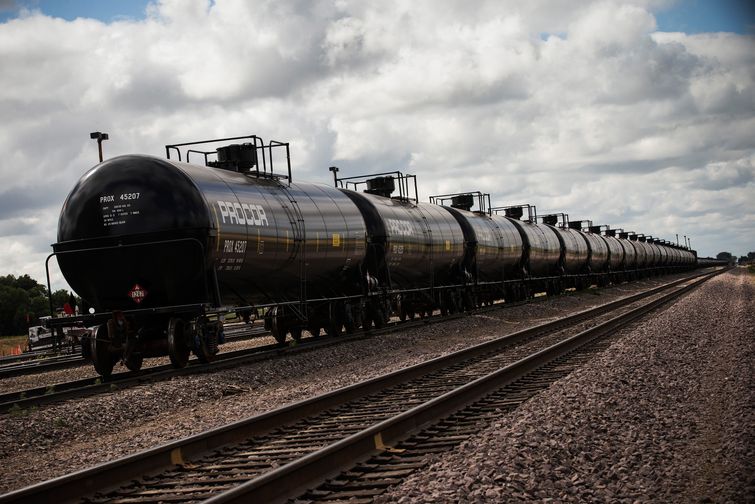
Oil containers sit at a train depot on July 26, 2013 outside Williston, North Dakota. (Andrew Burton/Getty Images)
It's one of the darker, violent aspects of the North American oil boom. We've been shipping a lot more crude oil by rail in recent years. And, on occasion, those trains can derail and explode — with horrific results.
West Virginia is now the latest casualty. On Monday, a CSX-owned freight train traveling through Fayette County went off the rails and burst into flame. Two nearby towns had to evacuate, and a water-treatment plant shut down after concern that oil seeped into the Kanawha River. Gov. Earl Ray Tomblin has declared a state of emergency for the county.
It's still unclear what caused the derailment. Early reports suggest 9 or 10 tank cars caught fire, and one person was being treated for smoke inhalation.(CSX said the tank cars were a newer model, not a widely used older version known to be especially prone to puncture.) The AP got video of the fireball:
This is the second derailment of an oil train along this CSX line in less than a year. In April 2014, a train crashed in Lynchburg, Virginia, and caught fire, with thousands of gallons of crude spilling into the James River. Meanwhile, an oil train in northern Ontario derailed and caught fire just last Thursday.
These aren't isolated incidents. Since 2006, there have been at least 17 major accidents involving trains carrying crude or ethanol in the US and Canada — including the notorious explosion in Lac-Mégantic, Quebec in 2013 that killed 47 people. Here's a rundown of what's behind this trend:

More trains are carrying crude, leading to more accidents

lac-megantic oil
Photo dated July 6, 2013 shows firefighters dousing blazes after a freight train loaded with oil derailed in Lac-Megantic in Quebec. The accident left 47 dead. (Francois Laplante-Delagrave/AFP/Getty Images)
The simplest reason for the uptick in oil accidents is that trains are carrying more crude. In recent years, thanks to advances in drilling technology, both North Dakota and western Canada have seen massive growth in oil production. But there aren't enough pipelines to ship all that crude to market.
So, instead, more and more trains are transporting crude and petroleum: over 15,000 carloads per week and 1.5 million barrels per day. Nearly 10 percent of US crude now moves by rail:
(Energy Information Administration)
The vast, vast majority of trains don't derail or spill. But a small percentage do, with the biggest risks in extreme weather. And when there's a big increase in rail traffic, there's likely to be an uptick in accidents and leaks, as well.
An investigation by Curtis Tate of McClatchy found that trains spilled more oil in 2013 — about 1.1 million gallons — than in the previous four decades combined. That included major derailments in Aliceville, Alabama and Casselton, North Dakota, but it also included many smaller incidents, too:
(McClatchy)
(McClatchy)
Canada has also seen several big accidents. Most gruesomely, in July 2013, an unattended oil train carrying particularly volatile from North Dakota crashed into downtown Lac-Mégantic, Quebec, causing a series of gigantic explosions, destroying buildings, and killing 47 people.

Two problems: Volatile oil and older, flawed tank cars

A DOT-111 tank car, specification 111A100W1, constructed by fusion welding carbon steel. (Harvey Henkelmann/Wikimedia Commons)
Different rail accidents often have different causes. Operator failure was a huge reason behind the Lac-Mégantic disaster, for instance. But experts have pointed to a few common problems in many recent crashes:
1) The newer oil is more volatile: Crude oil from the Bakken formation in North Dakota — where much of the new oil-by-rail is coming from — often contains extra chemicals like benzene that make the crude more flammable. The trains in the Lac-Mégantic and West Virginia accidents were both carrying crude from this region.
Federal regulators have begun stepping up inspections of shipments from the Bakken, and North Dakota is considering rules that may require certain crudes to be treated to reduce volatility before shipping. These regulations could, however, potentially raise costs for the oil industry.
2) Outdated cars: Another big issue is that the majority of trains carrying crude still use DOT-111 tank cars — older models dating back to the 1960s with serious design flaws. In an accident, the shells of these trains can rupture more easily.
DOT-111 tank cars were in use in the major accidents in Lac-Mégantic, Quebec; Casselton, North Dakota; and Aliceville, Alabama. Deborah Hersman, the former chair of the National Transportation Safety Board, has said these trains are simply "not safe" to carry hazardous liquids like crude oil.
Regulators are pushing for thicker steel on cars and lower speeds through cities
There are more than 220,000 of these older DOT-111s in service, with 92,000 or so still transporting oil and other flammable liquids. The industry has voluntarily upgraded about 14,000 cars to add thicker walls and other protections, but retrofitting all of them could cost $1 billion or more.
Last October, the US Department of Transportation proposed new rules to require thicker steel, newer braking systems, and lower speeds on both new and existing tank cars. US regulators are mulling a timetable that may phase out the use of DOT-111s for carrying volatile crude within four years or so. Canada's regulators are pushing for a more aggressive phase-out, by 2017.
That said, even newer cars aren't immune from spills. CSX said that the train that erupted and burst into flames in West Virginia on Monday was actually newer model CPC 1232 with safety upgrades that the industry had adopted four years ago. Likewise, the car that caught fire in Lynchburg, Virginia in 2014 was a newer model with thicker steel.
3) Trains going too fast. Some analysts have also argued that railroads are pushing their shipments too fast, increasing the risk of accidents. Last year, the industry agreed to slow the speed of large trains carrying Bakken crude to 40 miles per hour in cities (down from 50 miles per hour). But it's not clear how much this will help. As Politico reported last year, most recent major accidents have involved trains going slower than 40 mph.

Cities don't always know if volatile crude is passing through

(Oil Change International)
Most of the oil-by-rail routes around the United States are easy to map — Oil Change International made an interactive map here.
But there's a catch: As Russell Gold of the Wall Street Journal recently reported, it's extremely difficult for most people to find out whether trains carrying the most volatile types of crude are passing through their town.
Railroads have been pushing to keep this information secret
Ever since the Lac-Mégantic explosion, US regulators have ordered rail companies to tell states about trains carrying volatile crude from the Bakken through specific counties. Yet states don't make this information easy to find, and railroads have been pushing them to keep it secret. Their argument? Publicizing this info could make trains more vulnerable to terrorist attacks.
The secrecy is striking. If an oil company were proposing to run a crude-oil pipeline through a city, there would be public hearings and environmental reviews. After all, there's a real risk of a spill. But if highly flammable oil gets shipped through by train, there are no hearings and little public oversight — even though the trains can, on occasion, explode spectacularly.
Through painstaking reporting, the Journal was able to piece together maps about key oil routes running from the Bakken through counties around the United States. Their piece worth reading in full.

Rail accidents are one key aspect of the Keystone XL debate

(Joe Posner/Vox)
As oil production grows in Canada and North Dakota, energy companies have been pushing for new pipelines to transport their crude to market.
One of these proposed pipelines is the controversial Keystone XL expansion, which would carry 830,000 barrels per day from the oil sands of Alberta down to refineries on the Gulf Coast. President Obama is currently deciding whether to approve or deny the pipeline.
If Keystone XL is blocked, more crude is likely to travel by rail
Environmentalists have opposed this pipeline because they want to constrain production in the oil sands — crude from there is worse for global warming than regular crude. Back in 2013, though, the State Department argued that this wouldn't make much difference, since even if the pipeline was blocked, much of Alberta's oil would get carried by rail anyway.
But if accidents continue, there's a real chance that regulations could get much stricter — and rail may become a less viable option. Indeed, the State Department's review found that some of the rail routes that would carry crude from Alberta's oil sands were three to eight times more likely to spill than Keystone XL was.
That could be seen as a stronger argument in favor of Keystone — it's much safer than trains. But it could also be seen as a potential weak spot for the continued growth of North America's oil boom.

Further reading

-- Kathryn Wolfe and Bob King of Politico wrote a long and terrific analysis of the exploding train situation back in 2014.
-- 9 questions about the Keystone XL pipeline you were too embarrassed to ask.

3 suns rise over Western Russia, and blue snow

3 suns rise over Western Russia, and blue snow

Discussion in 'General Discussion' started by Binman4OSU, Yesterday at 11:04 AM.
Binman4OSU

Binman4OSU Federal Marshal

Joined:
Aug 31, 2007
Messages:
14,976
Location:
The Party of Government Cheese
Russian's in Chelyabinsk are waking up to an amazing optical illusion in the sky....due to the weather and the temps ice crystals are forming in the air and making it appear there are 3 suns rising each morning.

They also got a huge suprise when they awoke to a town covered in blue snow...turns out a local factory making Easter Egg coloring had a spill and the blue colored powder mixed in with the air and tinted the snow.
[​IMG]


Some may remeber this is the same town where the giant meteor exploded over in 2013 with the force of 10 early nukes sending about 500 to the hospital

http://www.bbc.com/news/blogs-news-from-elsewhere-31505470?ocid=socialflow_twitter
 

A Russian City Had A “Triple Sunrise” This Morning

A Russian City Had A “Triple Sunrise” This Morning

Russia or Tatooine?

People in the Russian city of Chelyabinsk awoke Tuesday morning to not one, not two, but three sunrises.

People in the Russian city of Chelyabinsk awoke Tuesday morning to not one, not two, but three sunrises.
Анюза Айбашева / Via youtube.com

Don’t freak out. The “three suns” appearing in the dawn sky were just a result of a cool optical illusion.

Don't freak out. The "three suns" appearing in the dawn sky were just a result of a cool optical illusion.
Анюза Айбашева / Via youtube.com

The “halo” effect was created by sunlight reflecting through ice crystals in the freezing morning air, according to Russian state news agency Tass.

“In the air, there were small hexagonal ice crystals, which can not be seen with the naked eye,” Tass forecaster Galina Sheporenko said. “The sun’s rays were refracted through them. The result is an optical halo effect.”

Many Chelyabinsk residents shared images of the triple sunrise on social media.

Trippy.

h/t BBC

Watch this giant fireball illuminate the sky over Pittsburgh

Watch this giant fireball illuminate the sky over Pittsburgh

13
A 500-pound space rock about two feet in diameter entered the Earth's atmosphere outside of Pittsburgh last night, according to NASA. The object, detected by three NASA meteor cameras, was moving at a speed of 45,000 miles per hour. Visibility was lost at an altitude of 13 miles, but the space agency speculates that fragments, or meteorites, might be found on the ground east of Kittanning, PA. NASA posted this animation from the meteor's perspective showing its trajectory as it raced towards western Pennsylvania.

NASA maintains a network of more than a dozen specialized black-and-white cameras in its All Sky Fireball Network. The growing network of cameras was set up by the NASA Meteoroid Environment Office (MEO) with the aim of observing fireballs, or meteors brighter than the planet Venus. Fifteen cameras are currently spread across the US offering overlapping fields of view, each located at schools, observatories, and other public spaces designed for the worship of science.

Please Join Daystar in Praying for John Paul Jackson!

Please Join Daystar in Praying for John Paul Jackson!

041
Pray for John Paul Jackson**UPDATE: John Paul is currently undergoing radiation therapy in the hopes of shrinking the High Grade, cancerous tumor on his leg, which would in turn provide the surgeons with a better opportunity to remove the tumor without doing damage to the sciatic nerve. Thankfully, the cancer has not spread to the bone, nor has it spread to any other part of the body! This is amazing news as it makes treatment and recovery much less difficult. However, John Paul is still in need of your prayers, so please continue to pray for him, and consider donating towards his medical expenses. See below for details on how to give.**

John Paul Jackson, frequent Joni Table Talk guest and Host of the show, Dreams and Mysteries, has recently been diagnosed with an aggressive cancerous growth in his leg that requires immediate treatment.
Jackson is calling this cancer his “great personal test” and writes, “I have said on many occasions that I do not understand God’s ways, especially in the heat of a test, but I do always trust Him, in good times and in difficult times.”
We believe, as does Jackson, that our God is a healer and that the power of prayer in this type of situation is vital. “I have not ruled out any and all forms of treatment paths, but at the top of that list is prayer. I know that God can heal me in one instant or through the hands of doctors over time,” Jackson writes. “We are focusing our faith for a miracle, while following doctor’s advice until my healing is complete.”
Please join us in praying for John Paul Jackson! He is loved by so many in the body of Christ, and his show, Dreams and Mysteries, which airs on Thursdays at 10:00 p.m. Eastern only on Daystar, has helped so many people.
Also, please consider joining Daystar in giving towards John Paul Jackson’s medical expenses. Daystar has already given $10,000, and is asking that if you appreciate John Paul Jackson’s ministry, that you give towards his expenses as well. 100% of what you donate to the “John Paul Jackson Medical Fund” on Daystar’s website will be given directly to John Paul Jackson. See below for details on how to give.

How to Donate to the John Paul Jackson Medical Fund

Explosion and oil spill after train derails in West Virginia

Explosion and oil spill after train derails in West Virginia

ac360 train derailment oil spill west virginia_00000805

Massive explosion after train carrying oil derails 02:34
(CNN)A train carrying crude oil derailed Monday in West Virginia and exploded, filling the sky with thick clouds of fire and smoke.
One home was destroyed, and one person was injured, according to Lawrence Messina, spokesman for the West Virginia Department of Military Affairs and Public Safety.
Nearly 30 of the train's more than 100 cars came off the tracks, he said. It's unclear what caused the derailment, which happened around 1:30 p.m. in Fayette County, West Virginia.
Oil from the train spilled into the Kanawha River, a source of drinking water in Kanawha and Fayette counties. Gov. Earl Ray Tomblin issued a state of emergency for both those counties Monday night. Area residents are being urged to conserve water.
Police are also asking residents within a half a mile of the scene to evacuate until further notice.
Messina said authorities are still gathering their facts.
"We've had some severe winter weather conditions here with significant snowfall. We don't yet know whether that's a factor in this," he said.