Copyright Disclaimer Under Section 107 of the Copyright Act 1976?Fair use is a use permitted by copyright statute that might otherwise be infringing. Non-profit, educational or personal use tips the balance in favor of fair use. Unless you are in this field of investigative journalism, especially covering extremely sensitive subjects and potentially dangerous subjects as well, you simply cannot understand the complexities and difficulties involved with this work that I face every day.
US and Russian astronauts successfully dock at International Space Station
A Russian Soyuz spacecraft carrying a US astronaut and two Russian
cosmonauts has successfully docked with the International Space Station
(ISS). The scientists' stay on board the ISS will be the longest ever.
According to Russian space agency officials, the trio successfully
docked the Soyuz-TMA16M spacecraft at 01:33 a.m. (UTC) on Saturday after
setting off from the Baikonur cosmodrome in Kazakhstan at 7:42 p.m.
(UTC) on Friday.
US astronaut Scott Kelly, 51, and 54-year-old Russian cosmonaut Mikhail
Kornienko will spend 342 days on board the 400-kilometer high (250-mile)
orbiting outpost. Longest stay
Kelly and Kornienko, both of whom have flown multiple missions to orbit
and have each previously spent about six months on the ISS, will be the
first people to spend almost an entire year there.
Second Russian cosmonaut, Gennady Padalka, will return to Earth after six months, however.
The trip will mark the longest amount of time that two people will live
continuously on the ISS. During the 1990s, however, four Russian
cosmonauts spent between 12 and 14 months aboard the Russian space
station Mir. Mission to Mars
The aim of the time spent onboard the ISS is to enable scientists to
gain a wider understanding of the effects on the human body of living in
microgravity for longer time periods.
Kelly's twin brother Mark is also taking part in the experiment. The
retired US astronaut, who previously flew to the ISS four times, will
undergo regular health checks on Earth so doctors can compare the
brothers' vital signs. Space tourism
Speaking ahead of Friday's launch, Kelly said the experiment could prove
vital in planning future international missions, including to Mars.
"If we ever go beyond Low Earth orbit again, perhaps to Mars, because of
the cost and the complexity it will most likely be an international
mission, so I see this as a stepping stone to that."
The US astronaut also said he thought the international partnership was
"one of the great success stories of the International Space Station."
In September, the newly-arrived crew will also have a visit from the
first space tourist since 2009, British soprano Sarah Brightman. The
Phantom of the Opera star who has be training at Star City near Moscow
since January is set to sing a new song in space, written by her former
husband and composer Andrew Lloyd Webber.
ksb/bk (dpa, AFP)
Emails
disclosed by a hacker show a close family friend was funneling
intelligence about the crisis in Libya directly to the Secretary of
State’s private account starting before the Benghazi attack.
by Jeff Gerth, ProPublica, and Sam Biddle, Gawker, March 27, 2015, 3:45 p.m.
Then
Secretary of State Hillary Clinton testifies before the Senate Foreign
Relations Committee in January 2013. Lawmakers questioned Clinton about
the security failures during the attack on the U.S. diplomatic compound
in Benghazi, Libya, that left four dead and 10 people injured. (Alex
Wong/Getty Images)This story was co-published with Gawker. Update, March 27, 6:48 p.m.: This story has been updated to include responses from the FBI and the State Department.
Starting
weeks before Islamic militants attacked the U.S. diplomatic outpost in
Benghazi, Libya, longtime Clinton family confidante Sidney Blumenthal
supplied intelligence to then Secretary of State Hillary Clinton
gathered by a secret network that included a former CIA clandestine
service officer, according to hacked emails from Blumenthal’s account.
The emails, which were posted on the internet in 2013,
also show that Blumenthal and another close Clinton associate discussed
contracting with a retired Army special operations commander to put
operatives on the ground near the Libya-Tunisia border while Libya’s
civil war raged in 2011.
Blumenthal’s emails to Clinton, which
were directed to her private email account, include at least a dozen
detailed reports on events on the deteriorating political and security
climate in Libya as well as events in other nations. They came to light
after a hacker broke into Blumenthal’s account and have taken on new
significance in light of the disclosure that she conducted State
Department and personal business exclusively over an email server that
she controlled and kept secret from State Department officials and which
only recently was discovered by congressional investigators.
The
contents of that account are now being sought by a congressional inquiry
into the Benghazi attacks. Clinton has handed over more than 30,000
pages of her emails to the State Department, after unilaterally deciding
which ones involved government business; the State Department has so
far handed almost 900 pages of those over to the committee. A Clinton
spokesman told Gawker and ProPublica (which are collaborating on this
story) that she has turned over all the emails Blumenthal sent to
Clinton.
The dispatches from Blumenthal to Clinton’s private email
address were posted online after Blumenthal’s account was hacked in
2013 by Romanian hacker Marcel-Lehel Lazar, who went by the name
Guccifer. Lazar also broke into accounts belonging to George W. Bush’s
sister, Colin Powell, and others. He’s now serving a seven-year sentence
in his home country and was charged in a U.S. indictment last year.
The contents of the memos, which have recently become the subject of speculation
in the right-wing media, raise new questions about how Clinton used her
private email account and whether she tapped into an undisclosed back
channel for information on Libya’s crisis and other foreign policy
matters.
Blumenthal, a New Yorker staff writer in the 1990s,
became a top aide to President Bill Clinton and worked closely with
Hillary Clinton during the fallout from the Whitewater investigation
into the Clinton family. She tried to hire him when she joined
President Obama’s cabinet in 2009, but White House Chief of Staff Rahm
Emanuel reportedly nixed the idea
on the grounds Blumenthal was a divisive figure whose attacks on Obama
during the Democratic primary had poisoned his relationship with the new
administration.
It’s unclear who tasked Blumenthal, known for his
fierce loyalty to the Clintons, with preparing detailed intelligence
briefs. It’s also not known who was paying him, or where the operation
got its money. The memos were marked “confidential” and relied in many
cases on “sensitive” sources in the Libyan opposition and Western
intelligence and security services. Other reports focused on Egypt,
Germany, and Turkey.
Indeed, though they were sent under
Blumenthal’s name, the reports appear to have been gathered and prepared
by Tyler Drumheller, a former chief of the CIA’s clandestine service in
Europe who left the agency in 2005. Since then, he has established a
consulting firm called Tyler Drumheller, LLC. He has also been
affiliated with a firm called DMC Worldwide, which he co-founded with
Washington, D.C., attorney Danny Murray and former general counsel to
the U.S. Capitol Police John Caulfield. DMC Worldwide’s now-defunct website describes it at as offering “innovative security and intelligence solutions to global risks in a changing world.”
In
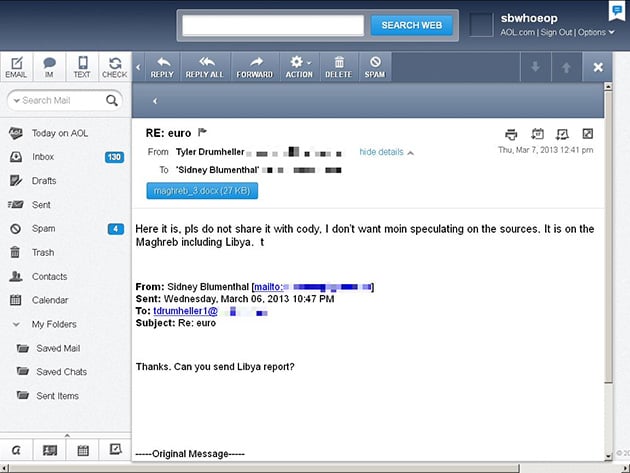
one exchange in March 2013, Blumenthal emailed Drumheller, “Thanks. Can
you send Libya report.” Drumheller replied, “Here it is, pls do not
share it with Cody. I don’t want moin speculating on sources. It is on
the Maghreb and Libya.” Cody is Cody Shearer, a longtime Clinton family
operative—his brother was an ambassador under Bill Clinton and his
now-deceased sister was married to Clinton State Department official
Strobe Talbott—who was in close contact with Blumenthal. While it’s not
entirely clear from the documents, “Moin” may refer to the nickname of
Mohamed Mansour El Kikhia, a member of the Kikhia family, a prominent
Libyan clan with ties to the Libyan National Transition Council. (An
email address in Blumenthal’s address book, which was also leaked, was associated with his Facebook page.)
There’s
no indication in Blumenthal’s emails whether Clinton read or replied to
them before she left State on February 1, 2013, but he was clearly part
of a select group with knowledge of the private clintonemail.com
address, which was unknown to the public until Gawker published it this year.
They do suggest that she interacted with Blumenthal using the account
after she stepped down. “H: got your message a few days ago,” reads the
subject line of one email from Blumenthal to Clinton on February 8,
2013; “H: fyi, will continue to send relevant intel,” reads another.
The
memos cover a wide array of subjects in extreme detail, from German
Prime Minister Angela Merkel’s conversations with her finance minister
about French president Francois Hollande–marked “THIS INFORMATION COMES
FROM AN EXTREMELY SENSITIVE SOURCE”—to the composition of the newly
elected South Korean president’s transition team. At least 10 of the
memos deal in whole or in part with internal Libyan politics and the
government’s fight against militants, including the status of the Libyan
oil industry and the prospects for Western companies to participate.
One
memo was sent on August 23, 2012, less than three weeks before Islamic
militants stormed the diplomatic outpost in Benghazi. It cites “an
extremely sensitive source” who highlighted a string of bombings and
kidnappings of foreign diplomats and aid workers in Tripoli, Benghazi
and Misrata, suggesting they were the work of people loyal to late
Libyan Prime Minister Muammar Gaddafi.
While the memo doesn’t rise
to the level of a warning about the safety of U.S. diplomats, it
portrays a deteriorating security climate. Clinton noted a few days
after the Benghazi attack, which left four dead and 10 people injured,
that U.S. intelligence officials didn’t have advance knowledge of the
threat.
On September 12, 2012, the day after the Benghazi attack,
Blumenthal sent a memo that cited a “sensitive source” saying that the
interim Libyan president, Mohammed Yussef el Magariaf, was told by a
senior security officer that the assault was inspired by an anti-Muslim
video made in the U.S., as well as by allegations from Magariaf’s
political opponents that he had CIA ties.
Blumenthal followed up
the next day with an email titled “Re: More Magariaf private reax.” It
said Libyan security officials believed an Islamist radical group called
the Ansa al Sharia brigade had prepared the attack a month in advance
and “took advantage of the cover” provided by the demonstrations against
the video.
An October 25, 2012 memo says that Magariaf and the
Libyan army chief of staff agree that the “situation in the country is
becoming increasingly dangerous and unmanageable” and “far worse” than
Western leaders realize.
Blumenthal’s email warnings, of course,
followed a year of Libyan hawkishness on the part of Clinton. In
February of 2011, she told the UN Human Rights Council in Geneva that
"it is time for Gaddafi to go.” The next month, after having described
Russian reluctance over military intervention as “despicable,” Clinton
met with rebel leaders in Paris and drummed up support for a no-fly zone
while in Cairo. On March 17, 2011, the UN Security Council voted to
back Libyan rebels against Gaddafi.
It’s this buildup, which
Clinton still proudly recalled in her 2014 memoir, that Blumenthal
appears to join in on 2011. In addition to the intel memos, his emails
also disclose that he and his associates worked to help the Libyan
opposition, and even plotted to insert operatives on the ground using a
private contractor.
A May 14, 2011 email exchange between
Blumenthal and Shearer shows that they were negotiating with Drumheller
to contract with someone referred to as “Grange” and “the general” to
place send four operatives on a week-long mission to Tunis, Tunisia, and
“to the border and back.” Tunisia borders Libya and Algeria.
“Sid,
you are doing great work on this,” Drumheller wrote to Blumenthal. “It
is going to be around $60,000, coverting r/t business class airfare to
Tunis, travel in country to the border and back, and other expenses for
7–10 days for 4 guys.”
After Blumenthal forwarded that note to
Shearer, he wrote back questioning the cost of the operation. “Sid, do
you think the general has to send four guys. He told us three guys
yesterday, a translator and two other guys. I understand the difficulty
of the mission and realize that K will be repaid but I am going to need
an itemized budget for these guys.”
“The
general” and “Grange” appear to refer to David L. Grange, a major
general in the Army who ran a secret Pentagon special operations unit
before retiring in 1999. Grange subsequently founded Osprey Global Solutions,
a consulting firm and government contractor that offers logistics,
intelligence, security training, armament sales, and other services. The
Osprey Foundation, which is a nonprofit arm of Osprey Global Solutions,
is listed as one of the State Department’s “global partners” in a 2014 report from the Office of Global Partnerships.’
Among
the documents in the cache released by Lazar is an August 24, 2011,
memorandum of understanding between Osprey Global Solutions and the
Libyan National Transition Council—the entity that took control in the
wake of Qadaffi’s execution—agreeing that Osprey will contract with the
NTC to “assist in the resumption of access to its assets and operations
in country” and train Libyan forces in intelligence, weaponry, and
“rule-of-land warfare.” The document refers to meetings held in Amman,
Jordan between representatives of Osprey and a Mohammad Kikhia, who
represented the National Transition Council.
Five months later,
according to a document in the leak, Grange wrote on Osprey Global
letterhead to Assistant Secretary of State Andrew Shapiro, introducing
Osprey as a contractor eager to provide humanitarian and other
assistance in Libya. “We are keen to support the people of Libya under
the sponsorship of the Ministry of Finance and the Libyan Stock
Exchange,” Grange wrote. Shapiro is a longtime Clinton loyalist; he
served on her Senate staff as foreign policy advisor.
Another
document in the cache, titled “Letter_for_Moin,” is an appeal from
Drumheller to then-Libyan Prime Minister Ali Zeidan offering the
services of Tyler Drumheller LLC, “to develop a program that will
provide discreet confidential information allowing the appropriate
entities in Libya to address any regional and international challenges.”
The “K” who was, according to Shearer’s email, to be “repaid” for his role in the Tunisia operation appears to be someone named Khalifa al Sherif,
who sent Blumenthal several emails containing up-to-the-minute
information on the civil war in Libya, and appears to have been cited as
a source in several of the reports.
Contacted by ProPublica and
Gawker, Drumheller’s attorney and business partner Danny Murray
confirmed that Drumheller “worked” with Blumenthal and was aware of the
hacked emails, but declined to comment further.
Shearer said only
that "the FBI is involved and told me not to talk. There is a massive
investigation of the hack and all the resulting information.” The FBI
declined to comment.
Blumenthal, Grange, and Kikhia all did not
respond to repeated attempts to reach them. Nick Merrill, a spokesman
for Clinton had no comment on Blumenthal’s activities with Drumheller.
Whatever
Blumenthal, Shearer, Drumheller, and Grange were up to in 2011, 2012,
and 2013 on Clinton’s behalf, it appears that she could have used the
help: According to State Department personnel directories, in 2011 and
2012—the height of the Libya crisis—State didn’t have a Libyan desk
officer, and the entire Near Eastern Magreb Bureau, which which covers
Algeria, Tunisia, Morocco and Libya, had just two staffers. Today, State
has three Libyan desk officers and 11 people in the Near Eastern Magreb
Bureau. A State Department official wouldn't say how many officers were
on the desk in 2011, but said there was always "at least one" officer
and "sometimes many more, working on Libya."
Reached for comment, a
State Department public affairs official who would only speak on
background declined to address questions about Blumenthal’s relationship
to Clinton, whether she was aware of the intelligence network, and who
if anyone was paying Blumenthal. Asked about the Tunisia-Libya mission,
the official replied, “There was a trip with the secretary in October of
2011, but there was also a congressional delegation in April, 2011.
There were media reports about both of these at the time." Neither trip
involved travelling via Tunis. Related stories: For more coverage of Hillary Clinton’s email practices, read about her Top Five Clashes Over Secrecy and Echoes of her Past.
image: http://joemiller.us/wp-content/uploads/Eyeglass-150x150.jpg Starting
weeks before Islamic militants attacked the U.S. diplomatic outpost in
Benghazi, Libya, longtime Clinton family confidante Sidney Blumenthal
supplied intelligence to then Secretary of State Hillary Clinton
gathered by a secret network that included a former CIA clandestine
service officer, according to hacked emails from Blumenthal’s account.
The emails, which were posted on the internet in 2013, also show that
Blumenthal and another close Clinton associate discussed contracting
with a retired Army special operations commander to put operatives on
the ground near the Libya-Tunisia border while Libya’s civil war raged
in 2011.
Blumenthal’s emails to Clinton, which were directed to her private
email account, include at least a dozen detailed reports on events on
the deteriorating political and security climate in Libya as well as
events in other nations. They came to light after a hacker broke into
Blumenthal’s account and have taken on new significance in light of the
disclosure that she conducted State Department and personal business
exclusively over an email server that she controlled and kept secret
from State Department officials and which only recently was discovered
by congressional investigators.
The contents of that account are now being sought by a congressional
inquiry into the Benghazi attacks. Clinton has handed over more than
30,000 pages of her emails to the State Department, after unilaterally
deciding which ones involved government business; the State Department
has so far handed almost 900 pages of those over to the committee. A
Clinton spokesman told Gawker and ProPublica (which are collaborating on
this story) that she has turned over all the emails Blumenthal sent to
Clinton.
The dispatches from Blumenthal to Clinton’s private email address
were posted online after Blumenthal’s account was hacked in 2013 by
Romanian hacker Marcel-Lehel Lazar, who went by the name Guccifer. Lazar
also broke into accounts belonging to George W. Bush’s sister, Colin
Powell, and others. He’s now serving a seven-year sentence in his home
country and was charged in a U.S. indictment last year. (Read more from
“Private Emails Reveal Clinton Aide’s Secret Spy Network” HERE)
Read
more at
http://joemiller.us/2015/03/hacked-emails-reveal-clinton-aides-secret-spy-network-involving-ex-cia-operative/#uBpV5VEuXX57Vh9b.99
The
Microsoft Malicious Software Removal Tool is an anti-malware utility
that checks computers running Windows 10 Technical Preview, Windows 8
and Windows 8.1, Windows 7, Windows Vista, Windows XP*, Windows Server
2012 R2 and Windows Server 2012, Windows Server 2008, and Windows Server
2003 for infections by specific, prevalent malicious software—including
Blaster, Sasser, and Mydoom—and helps remove malware and any other
infections found.
When the detection and malware removal process
is complete, the tool displays a report describing the outcome,
including which, if any, malware was detected and removed.
*The
Malicious Software Removal Tool will continue to be provided for
Windows XP through July 14, 2015; it will also continue to be delivered
automatically via Windows Update and for download via the Download
Center.
New anti-malware additions
We have added detection and cleaning capabilities for:
The March 2015 MSRT release is available for Windows Server 2003 x64-bit operating systems only through the Download Center.
See the list of malicious software cleaned by this tool. Note:
The version of the tool delivered by Microsoft Update and Windows
Update runs in the background and then reports if a malware infection is
found. To run this tool more than once a month, use the version on
this web page or install the version that is available at the Microsoft Download Center.
Because
computers can appear to function normally when infected, it's a good
idea to run this tool regularly even if your computer seems to be fine.
You should also use up-to-date antivirus software, such as Microsoft Security Essentials, to help protect your computer from other malware. Windows 8.1
includes antivirus and antispyware software called Windows Defender.
Windows Defender for Windows 8 and Windows 8.1 replaces Microsoft
Security Essentials.
Get a free safety scan
To scan your computer for malicious and unwanted software, see the Microsoft Safety Scanner.
The
Microsoft Safety Scanner is a free downloadable security tool that
provides on-demand scanning and helps remove viruses, spyware, and other
malware. It works with your existing antivirus software, but is not a
replacement for antivirus software.
Technical assistance
Contact
your anti-malware vendor for assistance with identifying or removing
virus or worm infections. If you need more help with malware removal and
other virus-related issues, contact Microsoft Support.
If you would prefer to bring your computer to a local repair person or to have someone come to you, use Microsoft Pinpoint to enter your zip code and find a Microsoft partner in your area that can help you remove malware.
We know that the Windows operating system contains some files and yet other system files
and folders which are hidden by default. These are hidden so that the
end-user does not by chance end up deleting or modifying their contents
as they are required by the system to function properly. But there may
be times, when you may need to show these hidden files and folders.
Show Hidden files and folders
To do this, type Folder Options in start search and hit Enter to open Folder Options window. Under the View tab, check the Hidden files, folders and drives check box. If you need to also show the system protected hidden files and folders too, uncheck the Hide protected operating system files option.
Click Apply and exit. The hidden files and folders will now be visible.
Hidden files and folders option missing
If you find that in your Windows, when you open your Windows Explorer > Organize > Folder & Search Option > Folder Options > View > Advanced Settings, the Show Hidden Files, Folders and Drives option is missing, then here is a Registry hack you can try, to enable it.
Create a system restore point first. Then type regedit in Windows start search box and hit Enter. Navigate to the following key:
In the right pane, right click on Type and select Modify. Here Change Value Data to “group” without the inverted commas.
Click OK > Exit.
Hope this helps. If this doesn’t help, then Windows 8.1 users may download and apply this registry fix. Alternatively Windows 7, Windows Vista users could use our freeware FixWin to fix this issue. You will find the fix under its Explorer section.
Anand Khanse aka HappyAndyK is an end-user Windows enthusiast, a
Microsoft MVP in Windows, since 2006, and the Admin of
TheWindowsClub.com. Please create a System Restore Point before trying out any software & be careful about any third-party offers while installing freeware. Add me on Google+.




 Print


