Eclipses During 2014
Fred Espenak
Published in Observer's Handbook 2014, Royal Astronomical Society of Canada
In 2014, there are two solar eclipses and two total lunar eclipses as follows.
| 2014 Apr 15: Total Lunar Eclipse |
| 2014 Apr 29: Annular Solar Eclipse |
| 2014 Oct 08: Total Lunar Eclipse |
| 2014 Oct 23: Partial Solar Eclipse |
Predictions for the eclipses are summarized in Figures
1,
2,
3, and
4.
World maps show the regions of visibility for each eclipse.
The lunar eclipse diagrams also include the path of the Moon through
Earth's shadows.
Contact times for each principal phase are tabulated along with the
magnitudes and geocentric coordinates of the Sun and Moon at greatest
eclipse.
All times and dates used in this publication are in Universal
Time or UT. This astronomically derived time system is
colloquially referred to as Greenwich Mean Time or GMT. To
learn more about UT and how to convert UT to your own local time,
see Time Zones and Universal
Time.
Total Lunar Eclipse of April 15
The first eclipse of the year is well placed for observers throughout
the Western Hemisphere.
The eclipse occurs at the lunar orbit's ascending node in Virgo.
The apparent diameter of the Moon is close to its average since the
eclipse occurs nearly midway between apogee (April 08 at 14:53 UT) and
perigee (April 23 at 00:28 UT).
This is the first of four consecutive total lunar eclipses in 2014 and
2015 (see Lunar Eclipse Tetrads).
The Moon's orbital trajectory takes it through the southern half of Earth's umbral shadow.
Although the eclipse is not central, the total phase still lasts 78 minutes.
The Moon's path through Earth's shadows as well as a map illustrating worldwide visibility of the event are shown in Figure 1.
The times of the major eclipse phases are listed below.
          Penumbral Eclipse Begins:  04:53:37 UT
          Partial Eclipse Begins:    05:58:19 UT
          Total Eclipse Begins:      07:06:47 UT
          Greatest Eclipse:          07:45:40 UT
          Total Eclipse Ends:        08:24:35 UT
          Partial Eclipse Ends:      09:33:04 UT
          Penumbral Eclipse Ends:    10:37:37 UT
At the instant of greatest eclipse[1] (07:45:40 UT) the Moon lies at the zenith for a point in the South Pacific about 3000 km southwest of the Galapagos Islands.
The umbral eclipse magnitude[2]
peaks at 1.2907 as the Moon's northern limb passes 1.7 arc-minutes
south of the shadow's central axis.
In contrast, the Moon's southern limb lies 9.0 arc-minutes from the
southern edge of the umbra and 40.0 arc-minutes from the shadow centre.
Thus, the northern half of the Moon will appear much darker than the
southern half because it lies deeper in the umbra.
Since the Moon samples a large range of umbral depths during totality,
its appearance will change significantly with time.
It is not possible to predict the exact brightness distribution in the
umbra, so observers are encouraged to estimate the Danjon value at
different times during totality (see Danjon Scale of Lunar Eclipse Brightness).
Note that it may also be necessary to assign different Danjon values to
different portions of the Moon (i.e., north verses south).
During totality, the spring constellations are well placed for viewing
so a number of bright stars can be used for magnitude comparisons.
Spica (m = +1.05) is the most conspicuous star lying just 2° west of the
eclipsed Moon.
This juxtaposition reminds the author of the total lunar eclipse of 1968
Apr 13 when Spica appeared only 1.3° southwest of the Moon at
mid-totality.
The brilliant blue color of Spica made for a striking contrast with the
crimson Moon.
Just a week past opposition, Mars (m = -1.4) appears two magnitudes
brighter than Spica and lies 9.5° northwest of the Moon.
Arcturus (m = +0.15) is 32° to the north, Saturn (m = +0.2) is 26° to
the east, and Antares (m = +1.07) is 44° to the southeast.
The entire event is visible from both North and South America.
Observers in the western Pacific miss the first half of the eclipse because it occurs before moonrise.
Likewise most of Europe and Africa experience moonset just as the eclipse begins.
None of the eclipse is visible from north/east Europe, eastern Africa, the Middle East or Central Asia.
Table 1 lists predicted umbral immersion and emersion times for 25 well-defined lunar craters.
The timing of craters is useful in determining the atmospheric enlargement of Earth's shadow (see Crater Timings During Lunar Eclipses).
The April 15 eclipse is the 56th eclipse of Saros[3]
122.
This series began on 1022 August 14 and is composed of 74 lunar eclipses
in the following sequence: 22 penumbral, 8 partial, 28 total, 7
partial, and 9 penumbral eclipses (Espenak and Meeus, 2009).
The last eclipse of the series is on 2338 October 29.
Complete details for Saros 122 can be found at:
For additional diagrams, maps, tables and information on the April 15 total lunar eclipse can be found at:


Annular Solar Eclipse of April 29
The first solar eclipse of 2014 occurs at the Moon's descending node in
southern Aries.
This particular eclipse is rather unusual because the central axis of
the Moon's antumbral shadow misses Earth entirely while the shadow edge
grazes the planet.
Classified as a non-central annular eclipse, such events are rare.
Out of the 3,956 annular eclipses occurring during the 5,000-year period
-2000 to +3000, only 68 of them or 1.7% are non-central (Espenak and
Meeus, 2006).
The northern edge of the antumbral shadow first touches down in Antarctica at 05:57:35 UT.
The instant of greatest eclipse[4]
occurs just six minutes later at 06:03:25 UT.
For an observer at the geographic coordinates nearest the shadow axis
(131° 15.6' E, 79° 38.7' S), the Sun would appear on the horizon during
the 49-second annular phase.
Six minutes later (06:09:36 UT), the antumbral shadow lifts off the
surface of Earth as the annular eclipse ends.
The entire zone of annularity appears as a small D-shaped region in
eastern Antarctica (Figure 2).
A partial eclipse is seen within the much broader path of the Moon's
penumbral shadow, that includes the southern Indian Ocean, the southern
edge of Indonesia and all of Australia (Figure 2).
Local circumstances for a number of cities in Australia are found in Table 2.
All times are given in Universal Time.
The Sun's altitude and azimuth, the eclipse magnitude[5] and obscuration[6] are all given at the instant of maximum eclipse.
This is the 21st eclipse of Saros 148 (Espenak and Meeus, 2006).
The family began with a series of 20 partial eclipses starting on 1653
Sep 21.
The 2014 Apr 29 eclipse is actually the first annular eclipse of the
series.
It will be followed by another annular on 2032 May 09.
The series switches to hybrid on 2050 May 20 followed by the first 40
total eclipses on 2068 May 31.
After a final 12 partial eclipses, Saros 148 terminates on 2987 Dec 12.
Complete details for the 75 eclipses in the series (in the sequence of
20 partial, 2 annular, 1 hybrid, 40 total, and 12 partial) may be found
at:

Total Lunar Eclipse of October 08
The second lunar eclipse of 2014 is also total and is best seen from the Pacific Ocean and bordering regions.
The eclipse occurs at the Moon's descending node in southern Pisces, two days after perigee (October 06 at 09:41 UT).
This means that the Moon will appear 5.3% larger than it did during the April 15 eclipse (32.7 vs. 31.3 arc-minutes).
This time the orbital path of the Moon takes it through the northern half of Earth's umbral shadow.
The total phase lasts 59 minutes primarily because the diameter of the umbral shadow is larger (1.49° verses 1.39°).
The lunar path through Earth's shadows as well as a map illustrating worldwide visibility of the event are shown in Figure 3.
The times of the major eclipse phases are listed below.
               Penumbral Eclipse Begins:   08:15:33 UT
               Partial Eclipse Begins:     09:14:48 UT
               Total Eclipse Begins:       10:25:10 UT
               Greatest Eclipse:           10:54:36 UT
               Total Eclipse Ends:         11:24:00 UT
               Partial Eclipse Ends:       12:34:21 UT
               Penumbral Eclipse Ends:     13:33:43 UT
At the instant of greatest eclipse (10:54:36 UT) the Moon lies near the
zenith from a location in the Pacific Ocean about 2000 km southwest of
Hawaii.
At this time, the umbral magnitude peaks at 1.1659 as the Moon's
southern limb passes 6.6 arc-minutes north of the shadow's central axis.
In contrast, the Moon's northern limb lies 5.4 arc-minutes from the
northern edge of the umbra and 39.3 arc-minutes from the shadow centre.
As a result, the southern half of the Moon will appear much darker than
the northern half because it lies deeper in the umbra.
The Moon samples a large range of umbral depths during totality so its
appearance will change considerably with time.
The exact brightness distribution in the umbra is difficult to predict,
so observers are encouraged to estimate the Danjon value at different
times during totality (see Danjon Scale of Lunar Eclipse Brightness).
It may also be necessary to assign different Danjon values to different portions of the Moon (e.g., north vs. south).
During totality, the autumn constellations are well placed for viewing
and the brighter stars can be used for magnitude comparisons.
The center of the Great Square of Pegasus lies 15° to the northwest, its
brightest star being Alpheratz (m = +2.02).
Deneb Kaitos (m = +2.04) in Cetus is 30° south of the eclipsed Moon,
while Hamal (m = +2.01) is 25° to the northeast, Aldebaran (m = +0.87)
is 56° to the east, and Almach (m = +2.17) is 40° to the north.
Although relatively faint, the planet Uranus (m = +5.7) lies just 2/3°
southeast of the Moon during totality.
Is a transit of the Earth and Moon across the Sun's disk visible from
Uranus during the eclipse? An interesting idea but calculations show a
miss.
From Uranus, the Sun's disk is only 1.7 arc-minutes in diameter and this
is a very small target to hit.
Nevertheless, transits of Earth from Uranus are possible - the next one
takes place on 2024 November 17 (Meeus, 1989).
The entire October 08 eclipse is visible from the Pacific Ocean and
regions immediately bordering it.
The northwestern 1/3 of North America also witnesses all stages.
Farther east, various phases occur after moonset.
For instance, the Moon sets during totality from eastern Canada and the
USA.
Observers in South America also experience moonset during the early
stages of the eclipse.
All phases are visible from New Zealand and eastern 1/4 of Australia -
the Moon rises during the early partial phases from Australia's west
coast.
Most of Japan and easternmost Asia catch the entire eclipse as well.
Farther west in Asia, various stages of the eclipse occur before
moonrise.
None of the eclipse is visible from Europe, Africa, and the Middle East.
Table 3 lists predicted umbral immersion and emersion times for 25 well-defined lunar craters.
The timing of craters is useful in determining the atmospheric enlargement of Earth's shadow (see Crater Timings During Lunar Eclipses).
The October 08 eclipse is the 42nd eclipse of Saros 127.
This series is composed of 72 lunar eclipses in the following sequence:
11 penumbral, 18 partial, 16 total, 20 partial, and 7 penumbral eclipses
(Espenak and Meeus, 2009).
The family began with the penumbral eclipse of 1275 July 09, and ends
with another penumbral eclipse on 2555 September 02.
Complete details for Saros 127 can be found at:

Partial Solar Eclipse of October 23
The final event of 2014 occurs at the Moon's ascending node in southern
Virgo.
Although it is only a partial solar eclipse, it is of particular
interest because the event is widely visible from Canada and the USA (Figure 4).
The penumbral shadow first touches Earth's surface near the Kamchatka
Peninsula in eastern Siberia at 19:37:33 UT.
As the shadow travels east, much of North America will be treated to a
partial eclipse.
The eclipse magnitude from cities like Vancouver (0.658), San Francisco
(0.504), Denver (0.556), and Toronto (0.443) will surely attract the
media's attention.
Greatest eclipse occurs at 21:44:31 UT in Canada's Nunavut Territory
near Prince of Wales Island where the eclipse in the horizon will have a
magnitude of 0.811.
At that time, the axis of the Moon's shadow will pass about 675 km above
Earth's surface.
A sunset eclipse will be visible from the eastern half of the USA and
Canada (except for the far northeast).
The partial eclipse ends when the penumbra leaves Earth at 23:51:40 UT.
Local circumstances and eclipse times for a number of cities in Canada and Mexico are listed in Table 4, and for the USA in Table 5.
All times are in Local Daylight Time.
The Sun's altitude and azimuth, the eclipse magnitude and eclipse obscuration are all given at the instant of maximum eclipse.
When the eclipse is in progress at sunset, this information is indicated by '- s'.
The NASA JavaScript Solar Eclipse Explorer is an interactive web page
that can quickly calculate the local circumstances of the eclipse from
any geographic location not included in Tables 4 and 5:
Javascript Solar Eclipse Explorer:
eclipse.gsfc.nasa.gov/JSEX/JSEX-index.html
This is the 9th eclipse of Saros 153 (Espenak and Meeus, 2006).
The series began on 1870 Jul 28 with a string of 13 partial eclipses.
The first of 49 annular eclipses begins on 2104 Dec 17.
The series ends with a set of 8 partial eclipses the last of which occurs on 3114 Aug 22.
In all, Saros 153 produces 70 solar eclipses in the sequence of 13 partial, 49 annular, and 8 partial eclipses.
Complete details for the series can be found at:
Lunar Eclipse Tetrads
The lunar eclipses of 2014 are the first of four consecutive total lunar
eclipses - a series known as a tetrad.
During the 5000-year period from -1999 to +3000, there are 4378
penumbral eclipses (36.3%), 4207 partial lunar eclipses (34.9%) and 3479
total lunar eclipses (28.8%).
Approximately 16.3% (568) of all total eclipses belong to one of the 142
tetrads occurring over this period (Espenak and Meeus, 2009).
The mechanism causing tetrads involves the eccentricity of Earth's orbit
in conjunction with the timing of eclipse seasons (Meeus, 2004).
During the present millennium, the first eclipse of every tetrad occurs
sometime from February to July.
In later millennia, the first eclipse date gradually falls later in the
year because of precession.
Italian astronomer Giovanni Schiaparelli first pointed out that the
frequency of tetrads is variable over time.
He noticed that tetrads were relatively plentiful during one 300-year
interval, while none occurred during the next 300 years.
For example, there are no tetrads from 1582 to 1908, but 17 tetrads
occur during the following 2 and 1/2 centuries from 1909 to 2156.
The ~565-year period of the tetrad "seasons" is tied to the slowly
decreasing eccentricity of Earth's orbit.
Consequently, the tetrad period is gradually decreasing (Meeus, 2004).
In the distant future when Earth's eccentricity is 0, tetrads will no
longer be possible.
The umbral magnitudes of the total eclipses making up a tetrad are all relatively small.
For the 300-year period 1901 to 2200, the largest umbral magnitude of a tetrad eclipse is 1.4251 on 1949 Apr 13.
For comparison, some other total eclipses during this period are much deeper.
Two examples are the total eclipses of 2000 Jul 16 and 2029 Jun 26 with umbral magnitudes of 1.7684 and 1.8436, respectively.
Table 6 gives the dates of each eclipse in the 8 tetrads occurring during the 21st century.
The tetrad prior to 2014-15 was in 2003-04 while the next group is nearly 20 years later in 2032-33.
Explanatory Information
Solar Eclipse Figures
Lunar Eclipse Figures
Shadow Diameters and Lunar Eclipses
Danjon Scale of Lunar Eclipse Brightness
Crater Timings During Lunar Eclipses
Eclipse Altitudes and Azimuths
The altitude a and azimuth A of the Sun or Moon during an eclipse depend on the time and the observer's geographic coordinates.
They are calculated as follows:
h = 15 (GST + UT - α ) + λ
a = arcsin [sin δ sin φ + cos δ cos h cos φ]
A = arctan [-(cos δ sin h)/(sin δ cos φ - cos δ cos h sin φ)]

where

h = hour angle of Sun or Moon
a = altitude
A = azimuth
GST = Greenwich Sidereal Time at 0:00 UT
UT = Universal Time
α = right ascension of Sun or Moon
δ = declination of Sun or Moon
λ = observer's longitude (east +, west -)
φ = observer's latitude (north +, south -)
During the eclipses of 2014, the values for GST and the geocentric Right Ascension and Declination
of the Sun or the Moon (at greatest eclipse) are as follows:
Eclipse              Date           GST         α          δ

Total Lunar       2014 Apr 15     13.560     13.556     -10.050
Annular Solar     2014 Apr 29     14.475      2.431      14.448
Total Lunar       2014 Oct 08      1.133      0.919       6.307
Partial Solar     2014 Oct 23      2.148     13.887     -11.613
Two web based tools that can also be used to calculate the local
circumstances for all solar and lunar eclipses visible from any
location.
They are the Javascript Solar Eclipse Explorer and the Javascript Lunar Eclipse Explorer.
The URLs for these tools are:
Javascript Solar Eclipse Explorer:
eclipse.gsfc.nasa.gov/JSEX/JSEX-index.html
Javascript Lunar Eclipse Explorer:
eclipse.gsfc.nasa.gov/JLEX/JLEX-index.html
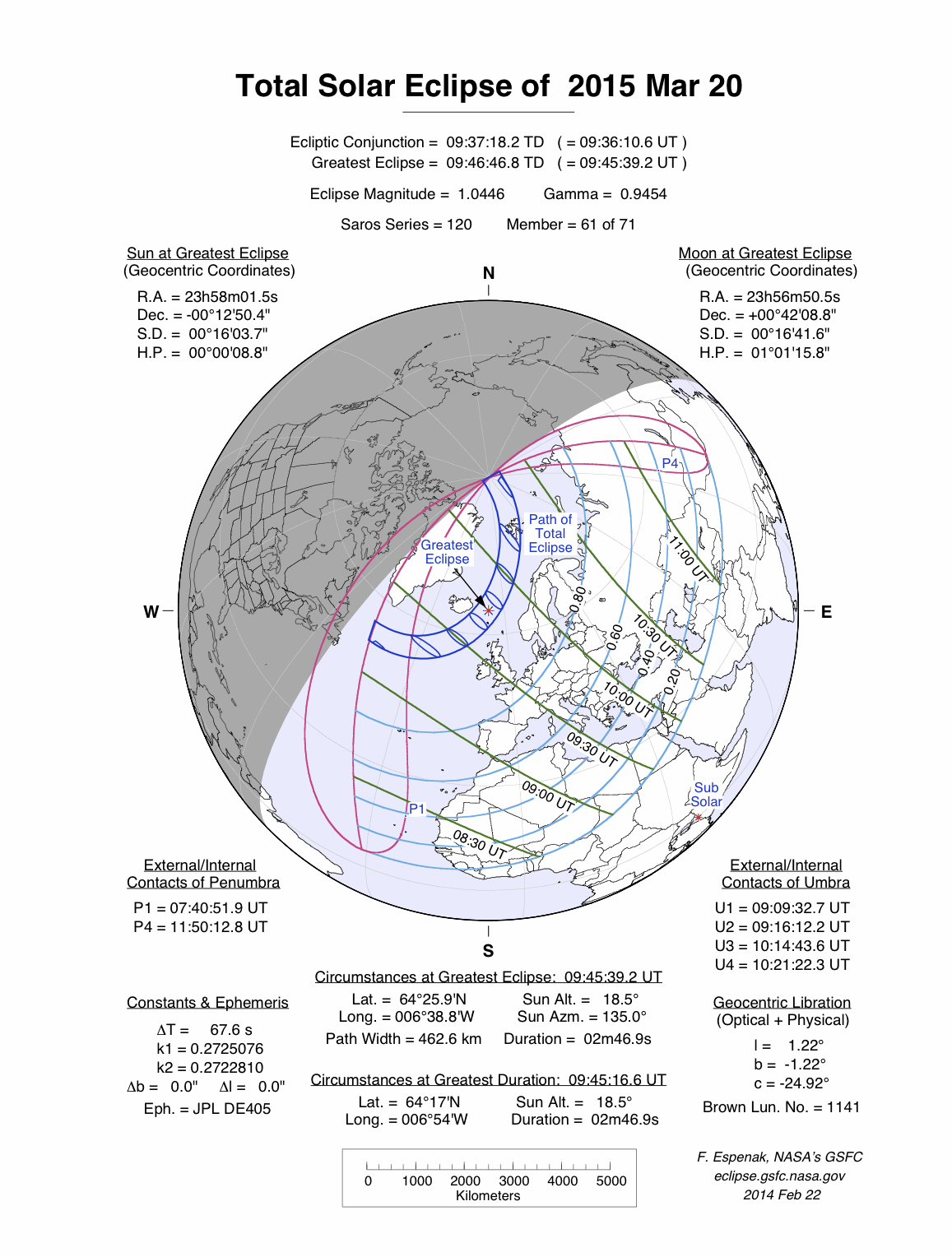
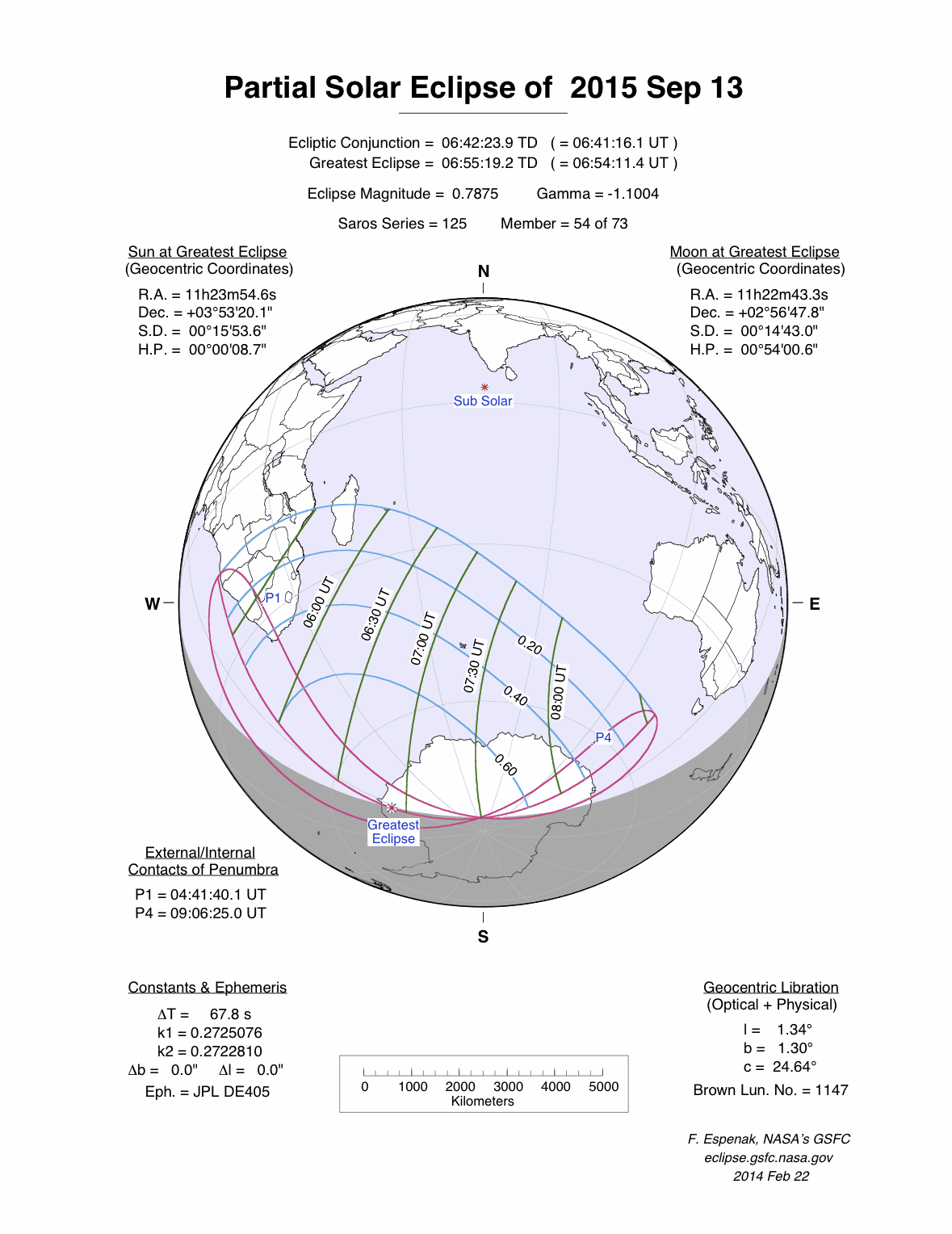
Eclipses During 2015
In 2015, there are two solar eclipses and two total lunar eclipses:
- 2015 Mar 20: Total Solar Eclipse
- 2015 Apr 04: Total Lunar Eclipse
- 2015 Sep 13: Partial Solar Eclipse
- 2015 Sep 28: Total Lunar Eclipse
A full report on eclipses during 2015 will be published in Observer's Handbook: 2015.
Eclipse Web Sites
The NASA Eclipse Web Site features predictions and maps for all solar
and lunar eclipses throughout the 21st century, with special emphasis on
upcoming eclipses.
The World Atlas of Solar Eclipses provides maps of all central eclipse paths from 2000 BCE to 3000 CE.
The entire Five Millennium Canon of Solar Eclipses (Espenak and Meeus, 2006) and Five Millennium Canon of Lunar Eclipses (Espenak and Meeus, 2009a) can be downloaded in PDF format and all figures are also available online as individual GIFs.
On-line versions of the entire Five Millennium Catalog of Solar Eclipses (Espenak and Meeus, 2009c)
and Five Millennium Catalog of Lunar Eclipses (Espenak and Meeus, 2009b) list details for every solar and lunar eclipse over the same 5000-year period.
The NASA Eclipse Web Site is located at:
Detailed information on solar and lunar eclipse photography, and tips on eclipse observing and eye safety may be found at:
Acknowledgments
All eclipse predictions were generated on an Apple Power Mac G4 computer
using algorithms developed from the Explanatory Supplement [1974] with
additional algorithms from Meeus, Grosjean, and Vanderleen [1966].
The solar coordinates used in the eclipse predictions are based on
VSOP87 [P. Bretagnon and G. Francou, 1988].
The lunar coordinates are based on ELP-2000/82 [M. Chapront-Touzé and J.
Chapront, 1983].
For lunar eclipses, the diameter of the umbral and penumbral shadows
were calculated using Danjon's rule of enlarging Earth's radius by 1/85
to compensate for the opacity of the terrestrial atmosphere; corrections
for the effects of oblateness have also been included.
Text and table composition was done on a Macintosh using Microsoft Word.
Additional figure annotation was performed with Claris MacDraw Pro.
All calculations, diagrams, tables, and opinions presented in this paper
are those of the author, and he assumes full responsibility for their
accuracy.
Footnotes
[1]
The instant of greatest eclipse for lunar eclipses occurs when the
distance between the Moon's shadow axis and Earth's geocentre reaches a
minimum.
[2] Umbral eclipse magnitude is defined as the fraction of the Moon's diameter occulted by the umbral shadow.
[3]
The Saros is a period of 6,585.3 days (18 years 11 days 8 hours) in
which eclipses (both solar and lunar) repeat. The geometry isn't exact
but close enough for a Saros series to last 12 or more centuries.
[4]
The instant of greatest eclipse for solar eclipses occurs when the
distance between the Moon's shadow axis and Earth's geocentre reaches a
minimum.
[5]
Eclipse magnitude for solar eclipses is defined as the fraction of the Sun's diameter occulted by the Moon.
[6]
Eclipse obscuration is defined as the fraction of the Sun's area occulted by the Moon.
References
Bretagnon P., Francou G., "Planetary Theories in rectangular and
spherical variables: VSOP87 solution", Astron. and Astrophys.,
vol. 202, no. 309 (1988).
Chapront-Touzé, M and Chapront, J., "The Lunar Ephemeris ELP 2000," Astron. and Astrophys., vol. 124, no. 1, pp 50-62 (1983).
Chauvenet, W., Manual of Spherical and Practical Astronomy, Vol.1, 1891 (Dover edition 1961).
Danjon, A., "Les éclipses de Lune par la pénombre
en 1951," L'Astronomie, 65, 51-53 (Feb. 1951).
Espenak, F., Fifty Year Canon of Solar Eclipses: 1986–2035, Sky Publishing Corp., Cambridge, MA, 1988.
Espenak, F., Fifty Year Canon of Lunar Eclipses: 1986–2035, Sky Publishing Corp., Cambridge, MA, 1989.
Espenak, F., and Meeus, J., Five Millennium Canon of Solar Eclipses: –1999 to +3000 (2000 BCE to 3000 CE), NASA TP–2006-214141, Goddard Space Flight Center, Greenbelt, MD, 2006.
Espenak, F., and Meeus, J., Five Millennium Canon of Lunar Eclipses: –1999 to +3000 (2000 BCE to 3000 CE), NASA TP–2009-214172, Goddard Space Flight Center, Greenbelt, MD, 2009a.
Espenak, F., and Meeus, J., Five Millennium Catalog of Lunar Eclipses: –1999 to +3000 (2000 BCE to 3000 CE), NASA TP–2009-214173, Goddard Space Flight Center, Greenbelt, MD, 2009b.
Espenak, F., and Meeus, J., Five Millennium Catalog of Solar Eclipses: –1999 to +3000 (2000 BCE to 3000 CE), NASA TP–2009-214174, Goddard Space Flight Center, Greenbelt, MD, 2009c.
Explanatory Supplement to the Astronomical Ephemeris and the American Ephemeris and Nautical Almanac, Her Majesty's Nautical Almanac Office, London, 1974.
Littmann, M., Espenak, F., & Willcox, K., Totality—Eclipses of the Sun, 3rd Ed., Oxford University Press, New York, 2008.
Meeus, J., Mathematical Astronomy Morsels III, Ch. 21, Willmann-Bell, Richmond, 2004.
Meeus, J., Grosjean, C.C., & Vanderleen, W., Canon of Solar Eclipses, Pergamon Press, New York, 1966.
Meeus, J. & Mucke, H., Canon of Lunar Eclipses: -2002 to +2526, Astronomisches Buro, Wien, 1979.