Thursday, April 25, 2013

THANK YOU LORD JESUS 'Department of Homeland Security Must Surrender Their War Weapons to Department of Defense'... Says Retired Army Officer

'Department of Homeland Security Must Surrender Their War Weapons to Department of Defense'... Says Retired Army Officer

Submitted by SadInAmerica on Tue, 04/23/2013 - 9:52pm.
military-retired-Capt.-Terry-Hestilow-cropped
On Saturday March 23, Terry M. Hestilow, a retired Army officer with nearly 30 years of service under his belt, posted this letter he sent to Sen. John Cornyn (R-TX) this week. Hestilow wants DHS to hand over their war weapons to the Department of Defense.

A letter by retired Capt. Terry Hestilow to his US Senator John Cornyn.

The Honorable Senator John Cornyn, State of Texas
United States Senate
517 Hart Senate Office Building
Washington, D.C. 20510
Re: Department of Homeland Security (DHS) and that agencies preparation for war against citizens of the United States of America
Dear Senator Cornyn,
It is with gravest concern that I write to you today concerning the recent appropriation of weapons by the Department of Homeland Security (DHS) that can only be understood as a bold threat of war by that agency, and the Obama administration, against the citizens of the United States of America.
To date, DHS has been unwilling to provide to you, the elected representatives of the People, justification for recent purchases of almost 3,000 mine-resistant ambush-protected (MRAP) armored personnel carriers, 1.6 billion rounds of ammunition (with associated weapons), and other weapons systems, when, in fact, the DHS has no war mission or war making authority within the limits of the United States of America.
Significant is the fact that at the same time the Obama administration is arming his DHS for war within the limits of the United States against the People of the United States in accordance with his 2008 campaign speech claiming,
“We cannot continue to rely only on our military in order to achieve the national security objectives that we’ve set. We’ve gotta (sic) have a civilian national security force that’s just as powerful, just as strong, just as well funded [as the United States military]”–Candidate Barack Obama, 2008.
The Obama administration is deliberately defunding, overextending, and hollowing the Department of Defense; the only legitimate agency of the U.S. government with a war mission.
This act of the Obama administration stands as a glaring threat of war against our nation’s citizens! This act of the Obama administration can only be understood as a tyrannical threat against the Constitution of the United States of America!
If left unresolved, the peace loving citizens who have sworn to defend the United States Constitution “against all enemies, both foreign and domestic” are left no option except to prepare to defend themselves, and the U.S. Constitution, against this Administration’s “coup” against the People and the foundations of liberty fought for and defended for the past 238 years. We have no choice if we honor our oaths.
The only proper response to this threat against the American people is for the representatives of the People, the members of the U.S. House and Senate, to demand in clear terms that the Administration cannot ignore, that the Department of Homeland Security immediately surrender their newly appropriated weapons of war to the Department of Defense (DoD).
Further, since the DHS has assumed a position in the Administration to enforce the tyrannical acts of this president against the People of the United States against the limits of the United States Constitution, it remains for the United States Congress to exercise its limiting power in the balancing of powers established by our founding fathers, to disestablish and dissolve the DHS as soon as possible.
One needs only to look to the rise of Adolf Hitler, and his associated DHS organizations, the SA and the SS, of 1932-1934, to see the outcome of allowing an agency of government this kind of control over the free citizens of a nation.
The people of Germany could not have imagined, until it was too late, the danger of allowing a tyrant this kind of power. We must not be so naïve as to think it will not happen to us as well if we remain passive toward this power grab by the Marxist Obama administration!
Finally, for more than two centuries the nation has lived in peace at home because of the protections of our legitimate military and the many appropriate state and federal law enforcement agencies, supported by Constitutional courts.
We stand today at a cross-road. Will we allow this present Administration to overthrow our United States Constitution and its legal processes to amend injustices, or, will we honor our obligations to defend the Constitution against a “domestic” enemy?
Our Constitution lays out the proper methods of resolving our differences; and it does not include its overthrow by a rogue agency of a Marxist leadership at home.
You, sir, are our constitutionally elected agent to defend our Constitution at home. We are counting upon you. We remain aware, however, of this present threat and will not expose ourselves as an easy prey to the authors of the destruction of our nation.
I know that this letter demands much of you. We elected you because we, the citizens of the State of Texas, believe that you are up to the task at hand and will, against all threats, honor your oath and office.
We are also writing to your fellow members of the House and Senate to stand in integrity with the Constitution and against this present threat by the Obama administration and his DHS.
We refuse to surrender our Constitution or our nation!
Resolved,
Captain Terry M. Hestilow
United States Army, Retired
Fort Worth, Texas
March 23, 2013

military-retired-Capt.-Terry-Hestilow

April 23, 2013 - posted at 12160

This article was posted at Gateway Pundit, by Jim Hoft

Justice Department “Reclassifies Documents,” Fights to Withhold Ground-breaking Immigration Court Decision on El Salvadorian Vides Casanova

April 15, 2013
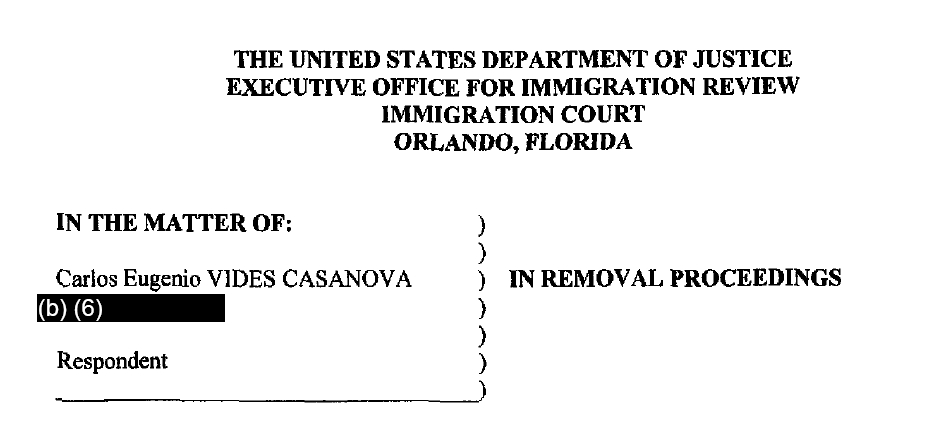
written decision imageThe Department of Justice (DOJ) continues to earn its second annual Rosemary Award for Worst Open Government Performance with its abysmal performance regarding a ground breaking decision in an immigration case of Carlos Eugenio Vides Casanova, former defense minister of El Salvador who is implicated in dozens of cases of torture and extrajudicial execution.  To withhold this information from the public the DOJ made up FOIA procedures and erroneously withheld previously declassified information in its misguided attempt to preserve secrecy surrounding the case.
The New York Times filed a FOIA request, numerous appeals, and eventually filed suit against the DOJ, for copies of Judge Grim’s final decision regarding the U.S. Immigration Court case against Vides Casanova. Last week, the New York Times partially won the FOIA case by getting a copy of Judge Grim’s February 2012 decision  released, but with redactions. Among the redactions were all of the witnesses’ names, even though it was a public hearing and their names are available thanks to extensive news coverage.  Additionally, the expert witness report, which includes hundreds of pages of declassified U.S. documents obtained by the National Security Archive and used as evidence in the court is being held from the public as “confidential.” These documents remain confidential despite the fact that they were released through the FOIA and through President Clinton’s executive orders for declassification in response to the El Salvador Truth Commission request.
sample doc picture
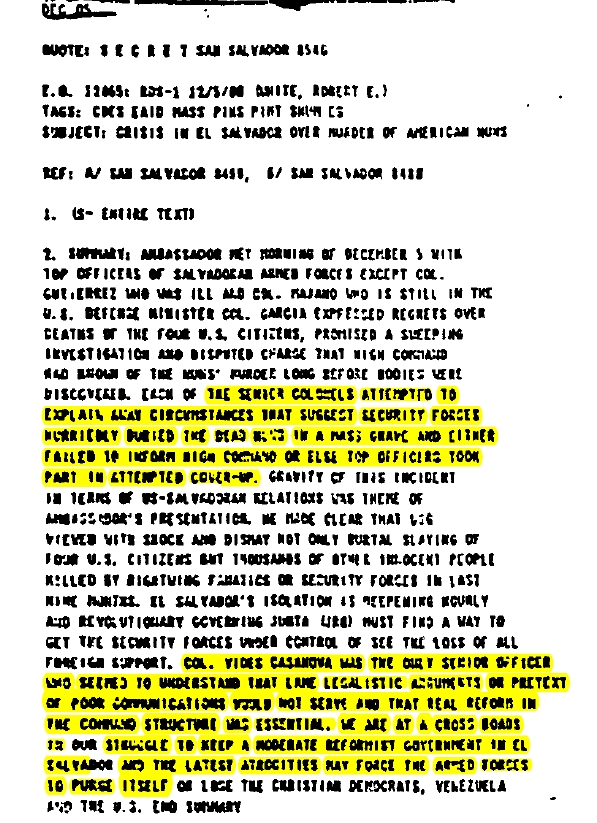
Example of “reclassified” document – Reports meeting of Ambassador White and leaders of El Salvador Armed Forces during which officers attempt to deny military involvement in and subsequent cover-up of American churchwomen killings. See full document here.
Here is the chronology of the New York Times battle to get the written decision of a public trial released:
  • September 2012 – NYT submits a FOIA for the full release of both decisions written by Judge Grim in February and August of 2012.
  • October 2012 – DOJ denies request claiming that the decisions were “preliminary,” and the agency had not issued a final agency decision. The DOJ also cited personal privacy concerns. [This is absurd. The hearing was public, and the general outline of the decision was made public in February of 2012, while the details were withheld.]
  • November 2012 – NYT files an administrative appeal, arguing that it knew “nothing about the FOIA exemption determination that would turn on the absence or existence of a final decision,” arguing that the denial was improper.
  • January 2013 – DOJ denies the appeal, simply citing the B6 exemption, making no reference to whether the decisions were preliminary or not.
  • February 2013 – NYT submitted a letter to the DOJ stating that the denial of access is contrary to the First Amendment and common law rights of access.
  • April 2, 2013 – NYT files suit against the DOJ in the District Court of New York after receiving no response to February letter.
  • April 4, 2013 – DOJ responds to February letter without mention of lawsuit, treating the February letter as “request for reconsideration” (which does not exist as a procedure of the FOIA) and releases a redacted version of Judge Grim’s February 2012 decision.
The DOJ is the agency in charge of enforcing the FOIA. How can the DOJ appropriately enforce the FOIA if it does not follow the FOIA itself?  This is also especially worrisome considering the rosy report on the state of FOIA presented by Melanie Pustay, director of the Office of Information Policy at DOJ.
Why this all the more important…
Carolyn Patty Blum, a human rights attorney of the Center for Justice and Accountability explains that “this [Vides Casanova] may be the highest military commander of any country” who has been subject to a new law stating that a commander can be ordered removed from the United States, if he has “ordered, assisted or participated in torture or extrajudicial killing. Key to the ruling is that it is sufficient to know or have reason to know about the acts of subordinates and then fail to prevent or punish those acts.” The New York Times reports that this is the first time that a high-ranking foreign military commander will be deported under the new human rights violations law which was passed in 2004.
This is also the first time to have a ruling about very specific cases of torture, extrajudicial killings and/or disappearance. Judge Grim’s finding that General Vides Casanova “assisted or otherwise participated” in the killing of four churchwomen is probably the best known case in the US.
The implications that this case has on the human rights world are huge, and important precedents have been set – all the more important that the DOJ moves to release the report in its entirely, along with expert witness reports and accompanying documentation, rather than going out of its way to act contrary to DOJ’s very own Attorney General Eric Holder’s memo calling agencies to act with a “presumption of openness.”

Story of B-53 'bunker buster' is a lesson in managing nuclear weapons


By Walter Pincus
Washington Post Staff Writer
Monday, October 18, 2010; 10:33 PM
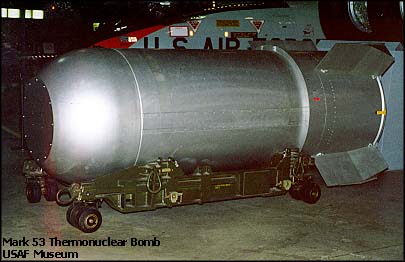
Outside of the nuclear weapons communities, little notice was paid last week to the announcement that authorization had finally come through to begin dismantling the last of the minivan-size B-53s, the most powerful thermonuclear bombs ever deployed in the active U.S. stockpile.
A terror weapon if there ever was one, the 10,000-pound B-53 was designed to deliver an explosion of nine megatons. That is the equivalent of 9 million pounds of TNT, or 600 times the power of the bomb that destroyed Hiroshima.
Believe it or not, the last 50 B-53s were not retired from the active stockpile until 1997, and even then some were held as a "hedge" in case a new threat emerged.
The two nuclear bombs that destroyed Hiroshima and Nagasaki, termed military targets at the time, immediately killed more than 200,000 people and resulted in the deaths within five years of an additional 100,000. They won the war against Japan and none has been used since.
ad_icon
Why did the United States in the late 1950s and early 1960s need to build more than 300 B-53s? And why were as many as 50 kept through the late 1990s, while the U.S government built and deployed thousands of other nuclear weapons with less powerful warheads?
What did war planners have in mind? It's a tale that should have lessons for today as the Obama administration considers spending more than $180 billion over the next decade modernizing the nation's nuclear stockpile and replacing the intercontinental ballistic missiles, strategic submarines and aircraft that would deliver them.
There are steps being taken to win Republican votes for a treaty with Russia designed to reduce nuclear weapons. The lesson: Don't build more weapons than you need or could use.
From the start, the first B-53s built in 1962 were thought of as bunker busters, needed to attack deep underground shelters near Moscow that U.S. intelligence said were built to protect the Soviet leadership. The bomb had a rear compartment that contained five parachutes; they were designed to lay the bomb down softly on the surface so that its explosive power would send a shock wave through the earth to collapse the underground shelters, crushing the people within them. When production was halted in mid-1965, more than 300 B-53s had been built.
The test of the first U.S. thermonuclear fusion device took place in 1952 as a surface shot on Enewetak Atoll in the South Pacific. Called Ivy Mike, the bomb, like the B-53, had a yield of nine to 10 megatons.
Its radioactive fallout on Marshall Islanders living on Rongelap Atoll 140 miles away caused any number of health issues. They included miscarriages and thyroid losses among teenagers who played in the coral flakes that fell like snow on the beaches. The test shot even delivered low-level radiation to an atoll more than 300 miles away.


Story of B-53 'bunker buster' is a lesson in managing nuclear weapons


Imagine for a moment the impact radioactivity would have had on the world if several B-53s had been dropped on the Soviet Union. The Strategic Air Command (SAC) had models of what the fallout could have been though they never have been made public. Inside SAC, during the Cold War years the B-53 was known as "a crowd pleaser," a former senior officer told me recently.
Some early versions of the B-53 were retired as early as 1967. In the 1970s, the United States was dismantling 1,000 to 3,000 nuclear weapons a year, using their fissionable material to build thousands more modern and safer ones.
Through the 1970s, 50 B-53 bombs and 54 Titan liquid-fueled ICBMs, with identical nine-megaton warheads, had the high-priority responsibility to destroy the Soviet underground bunkers. But in September 1980, after a Titan exploded accidentally in Arkansas, the decision was made to retire the remaining deployed Titans. That left the B-53s alone with the task, causing Pentagon planners to begin developing a new nuclear bunker buster.
ad_icon
By 1987, there were 25 of the B-53 bombs in the active stockpile. They were considered so dangerous that only dummies were used when crews practiced loading and unloading them on B-52s.
In the spring of 1987, with development of a replacement bomb delayed, the Reagan Pentagon decided to activate 25 more B-53s, so that 50 would be available if needed. It was not until 1997, when the bunker-busting B-61-11s were deployed, that retirement of B-53s began- but not disassembly.
Disassembly of nuclear weapons is a costly and dangerous process. Safety studies and special tools are needed just to handle the chemical explosive elements of the bomb, according to a 1994 Department of Energy report. "This study does not include study of disassembly of the B-53 primary [its nuclear package] since tooling and procedures are still being developed for this process," the study said.
More recently, the National Nuclear Security Administration (NNSA), which runs the nation's nuclear weapons complex, completed safety studies that will permit its Pantex Plant near Amarillo, Tex., to begin dismantling the B-53s.
The process includes separating the high explosives from the nuclear material. The second stage calls for the nuclear materials and other components to be shipped to NNSA's Y-12 plant at Oak Ridge, Tenn., where a building has been upgraded to handle the job. There the enriched uranium components will be removed and stored. Then other nonnuclear components will be sent to other NNSA plants for final disposition.
The current dismantlement program for retired U.S. nuclear weapons has a completion date of 2022 because thousands of them await dismantlement. One cause of the bottleneck is that the Pantex plant is the only NNSA facility that can assemble and dismantle nuclear weapons. More than half of Pantax's tasks involve putting together warheads in the life-extension program so that they can be among the more than 1,000 the United States can keep deployed over the next 20 years.

Declassified Documents and the B-53 Bunker Buster

October 21, 2010
B-53 Bunker Buster. US AF photo.
Walter Pincus’s Washington Post article, “Story of B-53 ‘bunker buster’ is a lesson in managing nuclear weapons,” provides a fascinating look at the arcane and highly secret history of U.S. nuclear weapons planning.  Pincus shows that the highly dangerous, massively destructive B-53 stayed in the nuclear arsenal for decades because of its mission: the destruction of underground bunkers.   Weapons designers concocted the B-53 after U.S. intelligence had identified the underground installations that would house Soviet leaders in time of superpower crisis and war.  Yet the B-53 was so dangerous that practice loading of them on B-52 bombers was forbidden.  If a substantial quantity of B-53 had been used in war, their radioactive fallout would have caused worldwide environmental damage.  Production of some 300 B-53s began in 1962, but by the end of the Cold War the Pentagon kept only 50 in the active stockpile.  They were not retired until the late 1990s when a replacement, the B-61-11, came on line.   Until recently the B-53s could not even be disassembled like other retired weapons; Washington had no plan for safely disaggregating the dangerous chemicals and highly-enriched uranium in the weapon’s core.  Such problems informed Pincus’s lesson: “Don’t build more weapons than you need or could use.”
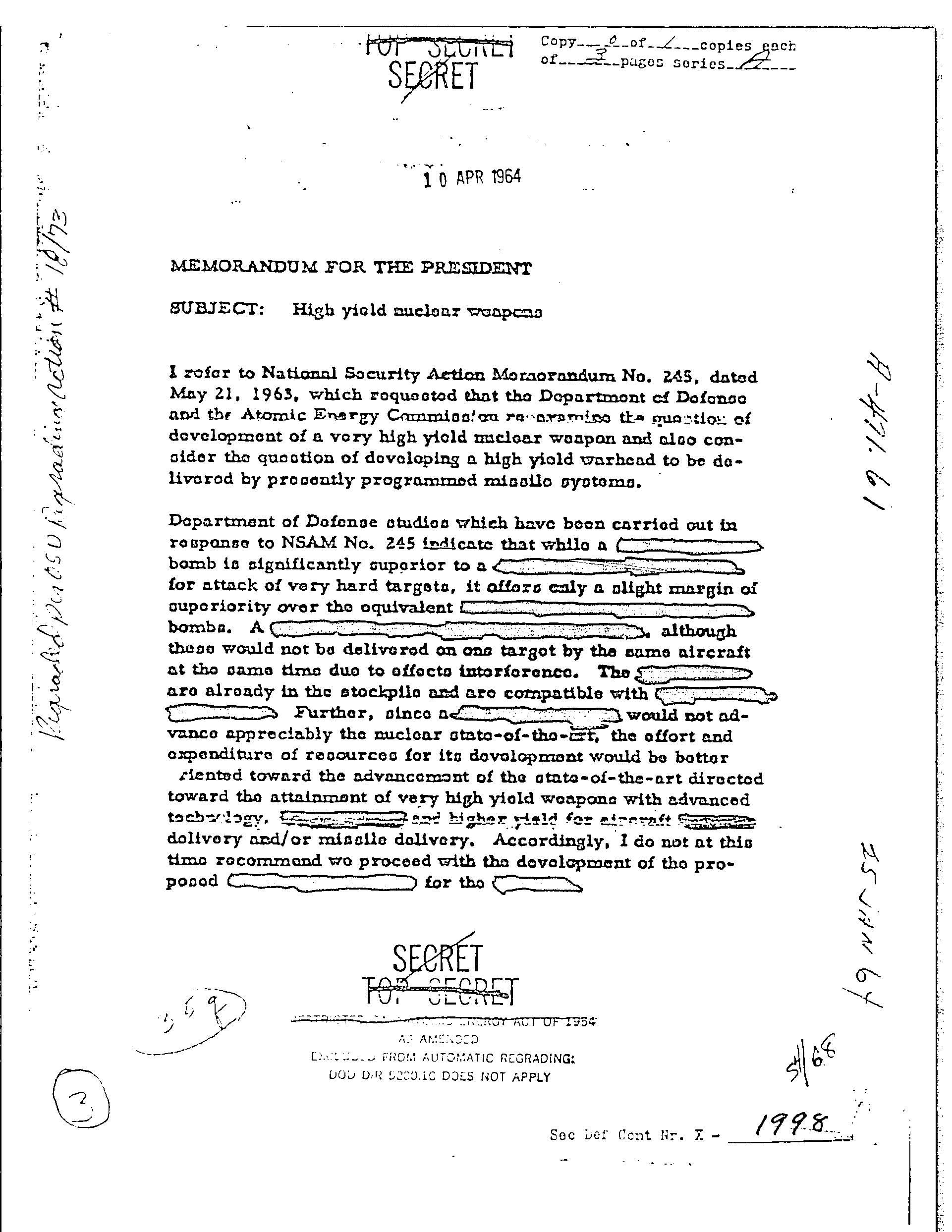
"For attack of very hard targets."
Mr. Pincus noted that a retired senior military officer was one of his sources.   Interview sources are essential, because the story of high yield weapons in the U.S. nuclear arsenals is not an easy one to tell using declassified documents.  A heavily excised Defense Department memorandum makes the point.  It is from Deputy Secretary of Defense Cyrus Vance to President Lyndon B. Johnson, dated 10 April 1964 on “High yield nuclear weapons.”  The previous year, President Kennedy had asked federal agencies to investigate the possibility of developing a “very high yield nuclear weapon.”  The proposed explosive yield of the projected “very high yield” weapon is excised, but it was probably substantially higher than the 9 megaton B-53, perhaps in the order of 15 or 20 megatons (or more).  Vance may have been referring to the B-53 when he discussed which weapons–or how many–could be used for attacking “very hard targets,” and that an unspecified high yield weapon would “offer only a slight margin of superiority” over the equivalent unspecified weapon type.  The numerous excisions make it difficult to grasp the argument. Vance recommended against the development of very high yield weapons, but in the event that the Limited Test Ban (1963) broke down, he endorsed preparations for atmospheric testing of high yield weapons as a way for scientists to draw conclusions about the effects of weapons with even higher yields.
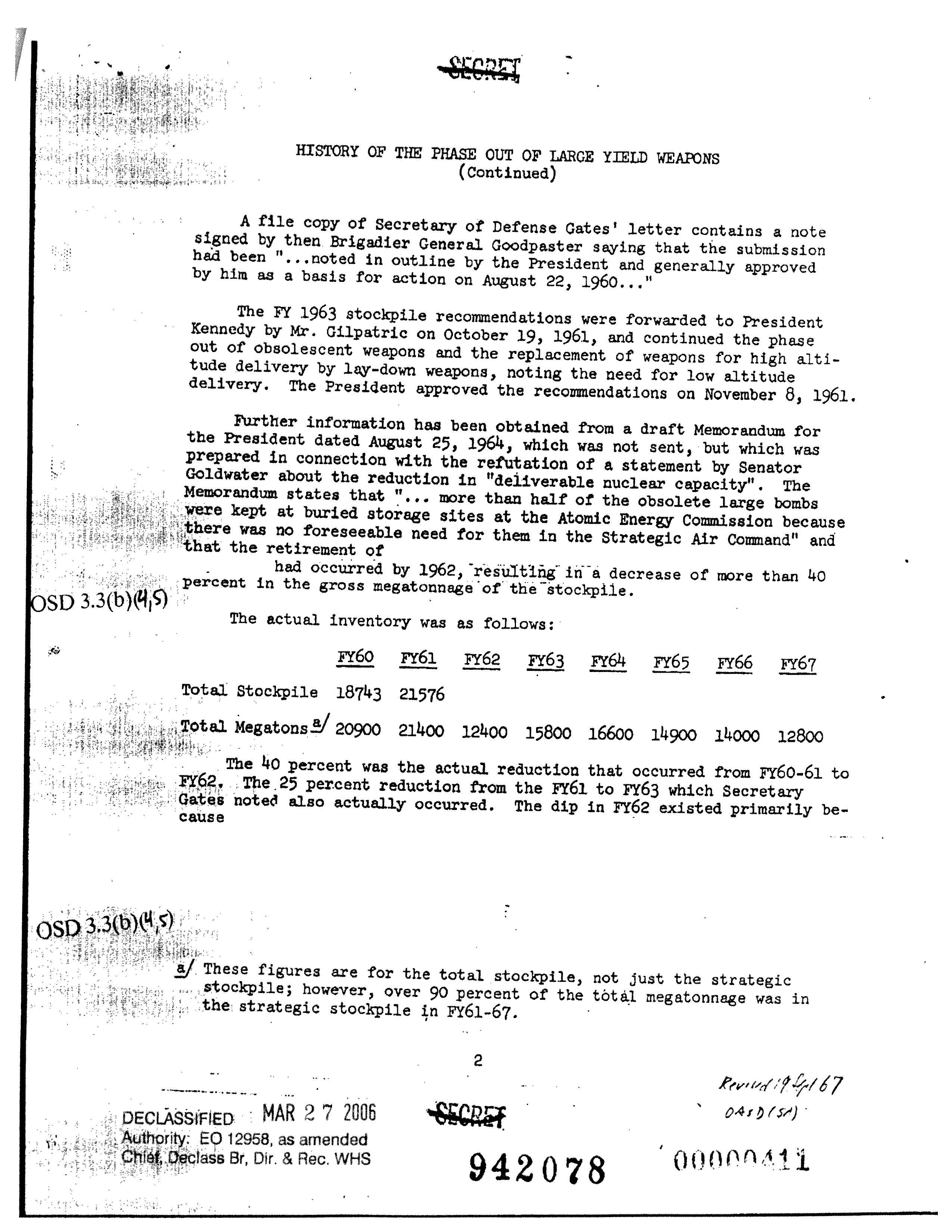
History of the Phase Out of Large Yeild Weapons.
Another excised document, a Defense Department briefing paper from September 1967, “History of the Phase Out of Large Yield Weapons,” provides some prehistory for the B-53.  The Mk-36 was an earlier massive nuclear weapon, weighing over 8 tons and with the same 9 megaton yield as the B-53 (which weighed about 5 tons). [i] The Mk-36 accounted for a huge share, some 40 percent, of the total explosive yield of the nuclear weapons stockpile during the late 1950s.  Unlike the B-53, however, the Mk-36 may have been a general purpose weapon, not slated for a specific mission.   By the end of the 1950s, U.S. defense planners believed that the nuclear arsenal needed larger numbers of a relatively smaller weapon, with a yield in the one megaton range (possibly the B-43).  Such weapons would be more appropriate for target planning because they could be used for “multiple loading, highly selective and low altitude bombing.”  Consequently, President Eisenhower and Secretary of Defense Thomas Gates approved plans to phase out the B-36, which finally occurred during Fiscal Year 1962.  As the table on page 2 shows, from FY61 to FY62 total megatonnage for all U.S. nuclear weapons dropped from a high of 21,400 to 12,400, a huge decrease. The introduction of the high yield B-53 may partly explain the uptick in the following fiscal years, but not the drop to significantly lower megatonnage numbers during FY 1965-1967.
Excessive secrecy accounts for the significant excisions from these documents.   The source for the Vance memorandum is obscure and it is unclear which exemptions the Pentagon invoked to withhold data from it. It was classified under the Atomic Energy Act so it is possible that the Pentagon used the rules for “Formerly Restricted Data” to withhold some of the information.  Important classes of nuclear secrets (e.g., weapons design or technology for producing fissile material) are worth protecting, but it is unlikely that the information withheld from Vance’s memorandum would help a would-be profliferant.  From the document on the “Phase Out of Large Yield Weapons,” the size of the Mk-36 force is sanitized as is the explanation for the “dip in FY62.” The Defense Department justified the excisions on the grounds that the information related to war plans “still in effect” and that the information would “impair the application of state of the art technology within a U.S. weapon system.”  Of course, neither of those exemptions seems plausible. The document is under appeal at the Information Security Classification Appeals Panel.
Perhaps if secrecy had not protected the B-53’s checkered history for so many years, public pressure might have led to a far earlier retirement for such a dubious weapon system.

[i] The predecessors of the B-36 had an even great yield.  The Mk-17 (B-17)’s, was between 10 and 15 megatons as was the B-24’s. Both were in the arsenal during the 1950s for only a few years. See Stephen I. Schwarz, ed., Atomic Audit: The Cost and Consequences of U.S. Nuclear Weapons Since 1940 (Washington, D.C.: Brookings Institution, 1998), 86-87.

SABOTAGED

Printer Friendly VersionPrinter Friendly VersionSend to a FriendSend to a FriendIs a Decorated Combat Vet’s Career Being Sacrificed on the Altar of Political Correctness?
From the May 2013 issue of SOF
By Harold Hutchison
A CAREER IS HALTED
Lieutenant Colonel Matthew Dooley was a rising star, according to his officer evaluation reports (OERs) going back to 2008. Yet instead, his career now lies in limbo. How that happened raises very disturbing questions about the state of professional military education. The threat to LTC Dooley’s brilliant career began with a 19 October, 2011, letter to John Brennan, signed by dozens of Islamic groups, demanding action on six fronts. The letter was copied to other high-ranking officials, including Attorney General Eric Holder, Defense Secretary Leon Panetta, FBI Director Robert Muller, and National Security Advisor Tom Donilon.
“The use of bigoted trainers and materials like those above is not only highly offensive, disparaging the faith of millions of Americans, but leads to biased policing that targets individuals and communities based on religion, not evidence of wrongdoing. Inaccurate and bigoted training materials also foster fear and suspicion of American Muslims amongst law enforcement and the general public, increasing discrimination, bullying, harassment and anti-Muslim violence,” their letter claimed. Three of the groups signing that letter had been named as unindicted coconspirators in the Holy Land Foundation case, which resulted in convictions on 24 November, 2008.
Less than a year after that letter was sent, LTC Dooley’s career would be in limbo after he was relieved from his post as an instructor at the Joint Forces Staff College, having been denounced by none other than General Martin Dempsey, Chairman of the Joint Chiefs of Staff. It was shocking, considering how quickly his star had been rising.
PRAISED BY SENIORS
Dooley had attended the Joint Forces Staff College as a student in 2010. Upon the completion of his studies, he became an instructor there. “Upon graduation from the course, I requested him by name to be a member of my teaching team. This is the only time I have made a by-name request for a faculty member, and it goes to Matt’s credit that he swiftly became a known positive force in the classroom,” Lt. Col. Colin Moening wrote in a memorandum to the Command Review Board.
However, that would soon change, as the result of an elective that LTC Dooley was teaching. The elective was called “Perspectives on Islam and Islamic Radicalism,” and it would run afoul of the new standards of political correctness created by the letter from the Islamic groups. Dooley taught the course. It quickly became a course that was widely discussed.
“Having heard student and faculty discussion regarding the Perspectives on Islam elective, I sat in on five of eight lessons and found the elective to be well done and thought provoking. The guest speakers were dynamic and challenging, leading to impressive student participation. The operational design presented by LTC Dooley was well thought out and obviously intended to foster discussion,” LTC Moening wrote.
A SUPERB INSTRUCTOR’S FALL FROM GRACE
These guest speakers had previously been vetted long before LTC Dooley even attended the Joint Forces Staff College, never mind when he began teaching. One guest speaker targeted in the letter from the Islamist groups was Stephen Coughlin.
Richard Thompson, the President and Chief Counsel with the Thomas More Law Center, which is representing LTC Dooley, said, “Best information I have is that Coughlin was vetted at least by 2009.” Coughlin gave at least one presentation to students of LTC Dooley’s elective course. The 133-slide presentation, dated 14 March, 2011, was titled “Imposing Islamic Law – or – These Are Not the
Droids You Are Looking For,” and included reproductions of web sites, including one article discussing a cleric’s call for the death of then-Libyan dictator Muammar Qaddafi.
Dooley received top evaluations from his superiors at the JFSC. “Exceptionally superb performance from a professional, innovative and enthusiastic officer. LTC Matt Dooley has rapidly integrated into the faculty at the Joint Forces Staff College and achieved significant contributions during his first teaching effort at the Joint and Combined Warfighting School. From the moment Matt joined the faculty, he worked to positively impact the course,” Captain Vincent Bowhers, USN, wrote on Dooley’s OER dated 15 May, 2011. “Matt then went on to independently research, vet, and create a flexible Libyan intervention Crisis Action Plan exercise as an addition to the existing JFSC Tunisian conflict scenario. A by-name-request for his second class, LTC Dooley has established a reputation as a faculty enabler; an experienced professional in his skill sets, solid in his doctrinal understanding, and an asset to any Seminar teach team.”
Student evaluations were also very favorable; LTC Dooley’s averages were no lower than 4.42 among student evaluations in the year prior to his relief. Comments described him as “ultra-professional” and “very strong in all respects.”
WIRED.COM BUSTS THE SANCTUM OF NDU
LTC Dooley’s superb evaluations from his superiors, though, were worthless when Wired.com’s Danger Room blog managed to breach the sanctum of the National Defense University. The elective was discussed in a 24 April, 2012, blog by Spencer Ackerman. Dempsey ordered a review of the course. Then, a 10 May, 2012, article by Ackerman and Noah Shachtman discussed a presentation by Dooley, dated July, 2011. The reporting set off alarm bells, but the reaction of high officials was in the direction of enforcing political correctness, not in determining how the sanctum on NDU was violated.
The National Defense University has a policy of “non-attribution” concerning the courses, according to its handbook. Paragraph 5 of its policy titled “Academic Freedom/Non-Attribution” states, “So that guests and university community members may speak candidly, the university offers its assurance that presentations will be held in strict confidence. Our policy on non-attribution provides that, without the expressed permission of the speaker, nothing will be attributed directly or indirectly in the presence of anyone who was not authorized to attend the lecture.”
In other words, what was discussed at NDU was meant to stay at NDU. This policy was clearly breached by whoever provided Dooley’s July 2011 presentation to Shachtman and Ackerman, who appear to have taken Dooley’s presentation out of context, particularly by failing to mention a disclaimer on slide 7 of the presentation that stated that “the concepts presented herein are not the Official Policy of the United States Government or the DoD.”
The 10 May article by Shachtman and Ackerman prompted an immediate denunciation of the course by General Martin Dempsey, the Chairman of the Joint Chiefs of Staff. “To your question about the issue at the Joint Forces Staff College, as you know, I’ve made an inquiry into a particular course that was brought to my attention by one of the students because he was concerned that it was objectionable and it was counter to our values, you know, our appreciation for religious freedom and cultural awareness. And the young man who brought it to my attention was absolutely right. It’s totally objectionable. And so we are looking at how that course was approved, what motivated the individual to adopt that – it was an elective, but what motivated that elective for being part of the curriculum. And we are looking across the institutions that provide our professional military education now to make sure there’s nothing like that out there. It was just totally objectionable, against our values, and it wasn’t academically sound. This wasn’t about, you know, we’re, you know, pushing back on liberal thought. This was just objectionable,
academically irresponsible.”
DESTROYING A CAREER
During that briefing, Dempsey also said ominously, “The individual instructor is no longer in a teaching status. He is not in a teaching status. And are you asking me am I surprised? Yeah. I’m surprised. And
I was actually quite thankful that the young man who did find the course material offensive spoke up.”
LTC Dooley soon found himself the recipient of a memo from Lieutenant General George J. Flynn, stating that he was being relieved. “I have made this decision because of my lack of confidence in your judgment as an instructor and based upon my review of the course material you created and provided to students in your elective seminar titled, ‘Perspectives on Islam and Islamic Radicalism.’” This was despite the fact that the materials had been prepared and used long before the letter of complaint had been sent.
One student comment written after his relief stated, “Very disappointed however in the way the Islam course controversy was handled at the JCS level – public judgments made prior to collection of the facts and completed investigation. Dooley is an outstanding officer and deserved better from leadership.” A second comment echoed the view: “He is probably too smart. We all feel awful that he was removed from the class. We understand the political sensitivity of the subject, however feel that removing Matt from the classroom went too far. He is an outstanding instructor, very, interested and enthusiastic.”
FIGHTING BACK
LTC Dooley was represented by the Thomas More Law Center. The public-interest legal group began a public-relations offensive to preserve his career. As such, while this author was able to talk with President and Chief Counsel Richard Thompson, LTC Dooley was unavailable to comment on the situation.
For Thompson, Dempsey’s actions appear to be creating a serious threat to America’s security. “In December 2005, Marine General Peter Pace, then Chairman of the Joint Chiefs of Staff, gave a lecture at the National Defense University. He warned his audience—if we are to defeat Muslim extremists, it is important to ‘understand the nature of the enemy,’” he wrote in a statement provided. General Pace went on to reiterate a common observation about World War II. It could have been prevented, and millions of lives saved, if only Western leaders had taken more seriously what Hitler wrote in Mein Kampf, and said in his speeches. General Pace admonished, ‘Read what our enemies have said.’”
“General Dempsey’s public punishment of LTC Dooley for teaching a course offensive to Islam and his order to scrub all military training material offensive to Islam, effectively sabotaged our ability to know the enemy and therefore was detrimental to our national security,” Thompson added. The Thomas More
Law Center filed a complaint to the Middle States Commission on Higher Education on 29 January, 2013, asking that it revoke the accreditation of NDU over the treatment of LTC Dooley.
WHAT DOES THIS MEAN?
The relief of LTC Dooley remains very controversial, notably due to the involvement of General Dempsey and other high-level leaders at the Pentagon. There has been no indication of any investigation into the violation of NDU’s “non-attribution” policy. Furthermore, it also seems apparent from the presentation
that the concepts presented were described as not being DOD policy. Emails were sent to Wired.com and to the DOD, requesting comments from Shachtman, Ackerman and GEN Dempsey. As of this writing, a spokesman for General Dempsey sent a lengthy statement that re-iterated the DOD’s party-line version of the controversy.
“I find it disturbing that Matt’s character and flawless reputation have been called into question, and that our academic freedom and non-attribution policies seem to have been disregarded in this case. If the best among us can so readily be cast aside, with disregard for the protections of the Chairman of the Joint Chiefs own Academic Freedom policies at NDU, I am left with great concern for the rest of the military and civilian faculty to perform their duties without fear,” LTC Moening wrote.
Entities like NDU and JFSC are necessary to ensure that higher leadership can address future threats; this controversial firing has placed its ability to train the next generation of leaders in jeopardy. NDU has had to walk a delicate balance of academic freedom and the discipline needed in the military. That is perhaps the real loss to the military, above and beyond that of the future good that LTC Matthew Dooley would do as he rose to higher levels of command in his military career. This incident clearly requires some significant Congressional oversight to repair the damage, if it is possible to do so.

Privacy Documents for the National Protection and Programs Directorate (NPPD)

Privacy Documents for the National Protection and Programs Directorate (NPPD)

Privacy Impact Assessments (PIAs) for NPPD are listed here under five categories:

  • Cybersecurity

  • EINSTEIN program

  • NPPD's Office of Biometric Identity Management (OBIM)

  • All other active PIAs

  • Retired PIAs


CYBERSECURITY

DHS/NPPD/PIA-026 – National Cybersecurity Protection System (NCPS)

National Cybersecurity Protection System (NCPS), July 30, 2012 (PDF, 37 Pages – 7.91MB) The National Cybersecurity Protection System (NCPS) is an integrated system for intrusion detection, analysis, intrusion prevention, and information sharing capabilities that are used to defend the federal civilian government’s information technology infrastructure from cyber threats. The NCPS includes the hardware, software, supporting processes, training, and services that are developed and acquired to support its mission. The Department of Homeland Security (DHS), National Protection and Programs Directorate (NPPD), National Cyber Security Division (NCSD) is conducting this Privacy Impact Assessment (PIA) because personally identifiable information (PII) may be collected by the NCPS, or through submissions of known or suspected cyber threats received by the United States–Computer Emergency Readiness Team (US-CERT) for analysis. This PIA will serve as a replacement for previously published PIAs submitted by NSCD for the 24/7 Incident Handling Center (March 29, 2007), and the Malware Lab Network (May 4, 2010), and is a program-focused PIA to better characterize the efforts of NCPS and US-CERT.
Associated SORN(s):

DHS/NPPD/PIA-028 Enhanced Cybersecurity Services (ECS)

Enhanced Cybersecurity Services (ECS), January 16, 2013, (PDF 22 pages, 4.3 MB).  ECS is a voluntary program based on the sharing of indicators of malicious cyber activity between DHS and participating Commercial Service Providers.  The purpose of the program is to assist the owners and operators of critical infrastructure to enhance the protection of their systems from unauthorized access, exploitation, or data exfiltration through a voluntary information sharing program.  ECS consists of the operational processes and security oversight required to share unclassified and classified cyber threat indicators with companies that provide internet, network, and communication services to enable those companies to enhance their services to protect U.S. Critical Infrastructure entities. ECS is intended to support U.S. Critical Infrastructure, however, pending deployment of EINSTEIN intrusion prevention capabilities, ECS may also be used to provide equivalent protection to participating Federal civilian Executive Branch agencies.  NPPD conducted this PIA because PII may be collected.  This PIA consolidates and serves as a replacement to the DHS/NPPD/PIA-021 National Cyber Security Division Joint Cybersecurity Services Pilot PIA, published on January 13, 2012, and the DHS/NPPD/PIA-021(a) National Cyber Security Division Joint Cybersecurity Services Program (JCSP), Defense Industrial Base (DIB) – Enhanced Cybersecurity Services (DECS) PIA Update, published on July 18, 2012.

EINSTEIN PROGRAM

DHS/NPPD/PIA-001/008/013/014/027 - EINSTEIN Program

DHS/NPPD/PIA-001 The EINSTEIN Program, September 2004 (PDF, 12 pages - 153 KB) EINSTEIN provides US-CERT a situational awareness snapshot of the health of the federal governments' cyber space. Based upon agreements with participating federal agencies, US-CERT installs systems at their Internet access points to collect network flow data. The agencies are provided tools to analyze their collected data. In addition, the data is shared with US-CERT Security Operations Center, which aggregates it from all EINSTEIN participants to identify network anomalies spanning the federal government.
DHS/NPPD/PIA-008 EINSTEIN 2, May 19, 2008 (PDF, 23 pages - 423 KB). The original PIA for EINSTEIN 1, dated September 2004, explained that EINSTEIN 1 analyzes network flow information from participating federal executive government agencies and provides a high-level perspective from which to observe potential malicious activity in computer network traffic of participating agencies' computer networks. The updated version, EINSTEIN 2, will incorporate network intrusion detection technology capable of alerting the United States Computer Emergency Readiness Team (US-CERT) to the presence of malicious or potentially harmful computer network activity in federal executive agencies' network traffic. EINSTEIN 2 principally relies on commercially available intrusion detection capabilities to increase the situational awareness of the US-CERT.
DHS/NPPD/PIA-013 EINSTEIN 1: Michigan Proof of Concept February 19, 2010 (PDF, 12 pages - 194 KB) The Department of Homeland Security ("DHS") and the State of Michigan ("Michigan") plan to engage in a 12-month proof of concept to determine the benefits and issues presented by deploying the EINSTEIN 1 capability to Michigan government networks managed by the Michigan Department of Information Technology (MDIT). US-CERT and the MDIT's analysis of Michigan network flow records will enable the identification of anomalies in the network traffic that may be indicative of malicious activities.
DHS/NPPD/PIA-014 US-CERT: Initiative Three Exercise March 18, 2010 (PDF 19 pages - 443 KB) Pursuant to Initiative Three of the Comprehensive National Cybersecurity Initiative, DHS is engaging in an exercise to demonstrate a suite of technologies that could be included in the next generation of the Department's EINSTEIN network security program. The Exercise will deploy technology that will include intrusion detection and add intrusion prevention. The goal of the Exercise is to pilot EINSTEIN 3 capabilities based on technology developed by the NSA and to solidify processes for managing and protecting information gleaned from observed cyber intrusions against civilian Executive Branch systems.
Associated PCR(s):
DHS/NPPD/PIA-027 EINSTEIN 3 Accelerated (E3A), April 19, 2013 (PDF, 260 KB, 27 pages).  DHS’ Office of Cybersecurity and Communications (CS&C) continues to improve its ability to defend federal civilian Executive Branch agency networks from cyber threats.  Similar to EINSTEIN 1 and EINSTEIN 2, DHS will deploy EINSTEIN 3 Accelerated (E3A) to enhance cybersecurity analysis, situational awareness, and security response.  With E3A, DHS will not only be able to detect malicious traffic targeting Federal Government networks, but also prevent malicious traffic from harming those networks. This will be accomplished through delivering intrusion prevention capabilities as a Managed Security Service provided by Internet Service Providers (ISP). Under the direction of DHS, ISPs will administer intrusion prevention and threat-based decision-making on network traffic entering and leaving participating federal civilian Executive Branch agency networks.  This was conducted because E3A includes analysis of federal network traffic, which may contain PII.
Associated SORN(s):

NPPD's Office of Biometric Identity Management (OBIM) 

DHS/NPPD/OBIM/PIA-001(j) – Comprehensive Exit Program: Air Exit Pilot

Comprehensive Exit Program: Air Exit Pilot, May 20, 2009 (PDF, 15 pages – 203 KB) OBIM implemented a new pilot phase of a comprehensive exit program for integrating non-U.S. citizen departure with existing arrival information. The Exit Program requires the collection of minimal biometric and biographic data from covered aliens, enablingOBIM Entry/Exit matching, identity verification, and cross-checking against a list of subjects of interest. This Privacy Impact Assessment (PIA) is conducted because OBIM collects PII on non-U.S. citizens.
Associated SORN(s):

DHS/NPPD/OBIM/PIA-002 Automated Biometric Identification System (IDENT)

Automated Biometric Identification System (IDENT), December 7, 2012.  IDENT is the central DHS-wide system for storage and processing of biometric and associated biographic information for national security; law enforcement; immigration and border management; intelligence; background investigations for national security positions and certain positions of public trust; and associated testing, training, management reporting, planning and analysis, or other administrative uses. This PIA and the attached appendices provide transparency into how the system uses PII and details the system’s sharing partners and functions.
Associated SORN(s):

DHS/NPPD/OBIM/PIA-003 Authentication of e-Passports

Authentication of e-Passports, August 18, 2006 (PDF, 21 pages - 256 KB) This is an update to previous OBIM PIAs to address the changes to the port of entry (POE) processing that will result from the deployment of the capability to biometrically compare and authenticate RFID chip-enabled, International Civil Aviation Organization (ICAO)-compliant passports (e-Passports).

DHS/NPPD/OBIM/PIA-004 Technical Reconciliation Analysis Classification System (TRACS)

Technical Reconciliation Analysis Classification System (TRACS), June 6, 2008, (PDF, 20 Pages – 370KB) TRACS will serve as an information management tool used for management and analysis of OBIM records to enhance the integrity of the United States immigration system by detecting, deterring, and pursuing immigration fraud, and by identifying persons who pose a threat to national security and/or public safety. OBIM conducted this PIA because TRACS will use PII.
Associated SORN(s):

DHS/NPPD/OBIM/PIA-005(a) Arrival and Departure System (ADIS)

Arrival and Departure Information System (ADIS), August 1, 2007 (PDF, 19 pages – 295 KB). The ADIS PIA describes changes to ADIS corresponding to the publication of a new ADIS system of records notice (SORN). As now proposed, ADIS will be a DHS-wide system to serve certain programs, including those of the intelligence community that require information in support of the DHS mission on individuals who seek to enter or who have arrived in or departed from the United States. OBIM conducted this PIA update based on these proposed changes.
Associated SORN(s):

DHS/NPPD/OBIM/PIA-007(b) Biometric Interoperability Between DHS and DOJ

Biometric Interoperability Between the U.S. Department of Homeland Security and the U.S. Department of Justice October 13, 2011.  In  2006,  OBIM and the Criminal Justice Information Services (CJIS) Division of the Federal Bureau of Investigation (FBI), Department of Justice (DOJ), developed an interoperability project to support the sharing of information among DHS, DOJ, and their respective stakeholders.   This Privacy Impact Assessment (PIA) update was conducted to reflect the expansion of DHS–DOJ interoperability to include users and  uses  not  previously  covered  under  the  interim  Data  Sharing  Model  (iDSM)  for  the IDENT/IAFIS  Interoperability  Project  (iDSM)  and  First  Phase  of  the  Initial  Operating Capability (IOC) of Interoperability between the DHS and the DOJ PIA (IOC) PIAs. In addition, DHS-DOJ Interoperability is expanding to allow approved users access to a more comprehensive IDENT response, containing up to all data fields captured in IDENT.

ALL OTHER ACTIVE PIAs

DHS/NPPD/PIA-006(a) - Protected Critical Infrastructure Information Management System (PCIIMS)

Protected Critical Infrastructure Information Management System (PCIIMS) Final Operating Capability (FOC), July 13, 2011 (PDF, 28 pages – 333 KB). The Protected Critical Infrastructure Information (PCII) Program, part of the Department of Homeland Security (DHS), National Protection and Programs Directorate (NPPD), Office of Infrastructure Protection (IP), Infrastructure Information Collection Division (IICD), facilitates the sharing of PCII between the government and the private sector. The Protected Critical Infrastructure Information Management System (PCIIMS) Final Operating Capability (FOC) is an Information Technology (IT) system and the means by which PCII submissions from the private sector are received and cataloged, and PCII Authorized Users are registered and managed. The PCII Program conducted this privacy impact assessment (PIA) to analyze and evaluate the privacy impact resulting from the consolidation of the PCIIMS Initial Operating Capability (IOC) functionalities into PCIIMS FOC, as well as the collection of limited personally identifiable information (PII) from the submitting individuals and PCII Authorized Users for contact purposes.

DHS/NPPD/PIA-007 - National Infrastructure Coordinating Center INSight Application (NICC INSight)

National Infrastructure Coordinating Center INSight Application, November 23, 2007 (PDF, 20 Pages - 253 KB) This system is designed to support the identification of potentially significant changes in the operational status of the nation's Critical Infrastructures and Key Resources (CI/KR) so that trained analysts can provide timely coordination with the NOC, respective Information Sharing and Analysis Centers (ISAC), and other involved agencies in the public sector and federal sectors.
Associated SORN(s):

DHS/NPPD/PIA-009 - Chemical Facility Anti-Terrorism Standards (CFATS)

Chemical Facility Anti-Terrorism Standards (CFATS), July 26, 2012 (PDF, 23 pages - 4.5MB). The Department of Homeland Security (DHS), National Protection and Programs Directorate (NPPD) is consolidating and updating the Privacy Impact Assessment (PIA) for the Chemical Facility Anti-Terrorism Standards (CFATS) regulations, 6 CFR Part 27.  This PIA replaces the former PIAs for the Chemical Security Assessment Tool (CSAT) and CFATS, in order to provide a unified analysis of the collection and use of personally identifiable information (PII) as part of CFATS.  CFATS is the DHS regulation that governs security at high-risk chemical facilities and represents a national-level effort to minimize terrorism risk to such facilities.
Associated SORN(s):

DHS/NPPD/PIA-010(a) - FPS Dispatch Incident Records Management System Update

Federal Protective Service Dispatch Incident Records Management Systems March 13, 2012 (PDF, 7 pages - 182 KB) This Privacy Impact Assessment (PIA) updates the National Protection and Programs DirectorateÕs Federal Protective Service Dispatch and Incident Record Management Systems to add the Field Interview Report (FIR) system to its suite of record management systems and to include administrative changes to the existing PIA. FPS will use the FIR system to collect and analyze information from field interviews, contacts, and stops at protected federal facilities around the country that have been identified as a significant vulnerability. NPPD is conducting this PIA because this new management reporting system will collect Personally Identifying Information (PII) about members of the public.
DHS/NPPD/PIA-010 Federal Protective Service Dispatch Incident Records Management Systems, September 16, 2009 (PDF 159 KB, 16 pages)
Associated SORN(s):

DHS/NPPD/PIA-011 - Federal Protective Service Information Support Tracking System (FISTS)

[Note: The 2009 PIA was reviewed in 2012 and no changes were deemed necessary.]
Federal Protective Service Information Support Tracking System (FISTS) Contract Suitability Module September 16, 2009 (PDF, 17 pages - 229 KB) The Department of Homeland Security (DHS) U.S. Immigration and Customs Enforcement (ICE) Federal Protective Service (FPS) Information Support Tracking System (FISTS) Contract Suitability Module is a web-based application used to automate the process for assessing the suitability of FPS and General Services Administration (GSA) contract personnel to work in secure Federal buildings, and to track periodic background re-investigations of those contract employees. The system collects and maintains information on applicants and contractor personnel who work in secure Federal buildings such as security officers, childcare workers, cleaners, and other contracted service positions. ICE is conducting this Privacy Impact Assessment (PIA) because FISTS collects and uses personally identifiable information (PII) on members of the public who seek or are currently employed in these positions within Federal facilities.
Associated SORN(s):

DHS/NPPD/PIA-017(a) - National Infrastructure Coordinating Center Suspicious Activity Reporting Initiative Update

National Infrastructure Coordinating Center Suspicious Activity Reporting Initiative Update, August 12, 2011 (PDF, 15 pages – 196 KB). The Department of Homeland Security (DHS) National Protection and Programs Directorate (NPPD) Office of Infrastructure Protection (IP) National Infrastructure Coordinating Center (NICC) is publishing this PIA to reflect activities under its Suspicious Activity Reporting (SAR) Initiative. The NICC SAR Initiative serves as a mechanism by which a report involving suspicious behavior related to an observed encounter or reported activity is received and evaluated to determine its potential nexus to terrorism. NICC is conducting this PIA because SAR occasionally contain personally identifiable information (PII) and NICC will be collecting and contributing SAR data for reporting and evaluation proceedings. DHS is updating this PIA to clarify that Redacted NICC Patriot Reports are reports that have been scrubbed of any identifiable information to include business and PII.
DHS/NPPD/PIA-017 NICC SARS: National Infrastructure Coordinating Center Suspicious Activity Reporting Initiative December 29, 2010 (PDF, 14 pages – 228 KB).
Associated SORN(s):

DHS/NPPD/PIA-018 - Chemical Facilities Anti-Terrorism Standards Personnel Surety

Chemical Facilities Anti-Terrorism Standards Personnel Surety, May 4, 2011, 2011 (PDF, 27 pages – 253 KB) The Department of Homeland Security (DHS) / National Protection & Programs Directorate (NPPD) / Office of Infrastructure Protection (IP) / Infrastructure Security Compliance Division (ISCD) is conducting this Privacy Impact Assessment (PIA) to detail the privacy impact associated with the Chemical Facility Anti-Terrorism Standards (CFATS) Personnel Surety Program and the required security assessments performed by high-risk chemical facilities in fulfillment of Risk-Based Performance Standard # 12 (6 CFR 27.230(a)(12)). This PIA describes the procedures for submitting personally identifiable information (PII) on individuals impacted by this program to NPPD, and also describes NPPD’s uses of that PII.
Associated SORN(s):

DHS/NPPD/PIA-019 - Ammonium Nitrate Security Program

Ammonium Nitrate Security Program July 25, 2011 (PDF, 31 pages -287.25KB) The Department of Homeland Security (DHS or the Department), National Protection and Programs Directorate (NPPD), is publishing this Privacy Impact Assessment (PIA) to provide a comprehensive analysis of the proposed Ammonium Nitrate Security Program. The proposed Ammonium Nitrate Security Program seeks to prevent the misappropriation or use of ammonium nitrate in an act of terrorism by regulating the sale and transfer of ammonium nitrate by ammonium nitrate facilities (AN Facilities). This PIA provides transparency into how the proposed Ammonium Nitrate Security Program will support the homeland security and infrastructure protection missions of DHS/NPPD through the collection of personally identifiable information (PII), and describes reasonable mitigation solutions proposed to be implemented to address privacy and security risks. This PIA will be updated with any changes to the program concurrently with the rulemaking process.
  • This PIA is made available concurrently with the Department’s publication in the Federal Register of a Notice of Proposed Rulemaking for the Ammonium Nitrate Security Program, see 76 FR 46908 (August 3, 2011)

DHS/NPPD/PIA-020 - Critical Infrastructure Private Sector Clearance Program

Critical Infrastructure Private Sector Clearance Program November 2, 2011 (PDF, 19 pages - 244 KB) The U.S. Department of Homeland Security (DHS), National Protection and Programs Directorate (NPPD), Office of Infrastructure Protection sponsors security clearances for certain private sector officials through the Critical Infrastructure Private Sector Clearance Program. These officials are identified through the National Infrastructure Protection Plan (NIPP) partnership framework and are Critical Infrastructure owners/operators, sector leadership (i.e., Sector Coordinating Council members), or subject matter experts identified by DHS to assist in analyzing Critical Infrastructure-related national security information to further enhance the Department’s infrastructure protection mission. NPPD conducted this PIA because sponsoring individuals for security clearances involves the collection of PII, such as the applicant’s Social Security Number, date and place of birth, and employment contact information.
Associated SORN(s):

DHS/NPPD/PIA-022 – Linking Encrypted Network System (LENS)

Linking Encrypted Network System (LENS), February 9, 2012 (PDF, 25 Pages – 238.51 KB) The Department of Homeland Security (DHS), National Protection and Programs Directorate (NPPD), Critical Infrastructure Technology and Architecture (CITA) Project maintains the Linking Encrypted Network System (LENS), a data repository and application set that acts as a network of online portals or modules, allowing authorized users to obtain, post and exchange information and access common resources. NPPD conducted this PIA to examine the privacy impact associated with the collection of personally identifiable information (PII) related to individuals who are LENS users or seeking access to LENS, as well as PII related to points of contact (POCs) that may be maintained within the LENS data repository. NPPD will conduct separate PIAs, as necessary, for those modules or applications residing on the LENS platform where the scope of the collection is beyond that of this PIA.
Associated SORN(s):

RETIRED PIAs

DHS use of deep packet inspection technology in new net security system raises serious privacy questions

Department of Homeland Security is preparing to deploy a much more powerful version of its EINSTEIN intrusion-detection system that can capture e-mail content and personally identifiable data

By Ellen Messmer, Network World
April 24, 2013 03:26 PM ET
Network World - To protect the federal civilian agencies against cyberthreats, the Department of Homeland Security (DHS) is preparing to deploy a  more powerful version of its EINSTEIN intrusion-detection system that’s supposed to detect attacks and malware, especially associated with e-mail. But since this version of EINSTEIN is acknowledged by DHS to be able to read electronic content, it’s raising privacy concerns.
Homeland security
The DHS recognizes there are privacy implications and just issued a “privacy impact assessment” report about what it calls EINSTEIN 3 Accelerated, the intrusion detection and prevention system expected to be made available as a managed security service from ISPs to monitor the “.gov” traffic to and from civilian agencies and Executive Branch departments, such as Treasury. DHS says EINSTEIN 3 may collect “personally identifiable information” (PII)  in some instances where this network security system will not just monitor but also prevent threats by blocking traffic in order to detect a cyberthreat or potential cyberthreat.  
[SECURITY: Top SSL VPN tools]
[MORE: No humor zone: 33 things you should never say to a TSA agent]
[RELATED: DHS chief Napolitano: Algorithms a big key in solving security, Big Data puzzle]
In its “privacy impact assessment” for EINSTEIN 3 published April 19, DHS states appropriate privacy-protection controls related to PII have been established. DHS says it has procedures in place where analysts will know how to “minimize (i.e., overwrite, redact, or replace) PII data that is not necessary to understand the cyber threat.”
But EINSTEIN 3 is anticipated to include packet-inspection tools that “allow an analyst to look at the content of the threat data, which enables a more comprehensive analysis. Packet capture may contain information that could be considered PII-like malicious data from or associated with email messages or attachments,” the DHS privacy-impact assessment notes.
“DHS is only using this information to better identify a known or suspected cyber threat against computer networks,” states the DHS privacy impact assessment which cites the main contacts as Brendan Goode, director, network security deployment, Office of Cybersecurity & Communications, National Protection and Programs Directorate at DHS and the DHS acting chief privacy officer, Jonathan Cantor.
In their privacy-impact statement, the DHS acknowledges EINSTEIN 3’s threat-prevention capabilities “may include deep-packet inspection by ISPs. DHS will approve indicators to be transferred to ISPs for deployment in E3A to ensure that indicators are specific to a particular type of traffic and are not overly broad in their data collection requirements.”
These “indicators” are expected to be configured by ISPs into “signatures” related to pattern-matching to detect “known or suspected malicious traffic to and from the participating agencies.” ISPs that participate in EINSTEIN 3 are being asked to submit their own “cyber threat indicators” to DHS for consideration as well.
  • 1

    DHS use of deep packet inspection technology in new net security system raises serious privacy questions

    Department of Homeland Security is preparing to deploy a much more powerful version of its EINSTEIN intrusion-detection system that can capture e-mail content and personally identifiable data

    By Ellen Messmer, Network World
    April 24, 2013 03:26 PM ET
    Page 2 of 4
    According to the DHS privacy impact assessment report, the idea is that alerts and other information provided to the DHS cybersecurity office by the ISP providing the managed service “will generally contain the following information: unique ID for the alert, participating agency, indicator/action pair that produced the alert, data and timestamp of the alert, netflow record, and if applicable, identification of quarantined or captured/stored data associated with the alert.”  
    Participating departments and agencies are expected to enter into a “memorandum of understanding” with DHS to authorize the application of these intrusion-prevention capabilities by DHS and lists of identified IP addresses will be verified by DHS.
    However, some privacy-advocacy groups, including the Electronic Privacy Information Center (EPIC) based in Washington, D.C., say they have questions about EINSTEIN 3.
    “We’re not sure entirely where this information is flowing when the government puts it into a database,” says Amie Stepanovich, director, EPIC domestic surveillance project, who has read the EINSTEIN 3 privacy impact assessment report. The ability of the government to intercept and sort through any collected data could include not just official business but intercepted communications that involve personal contacts as well, she points out.
    Stepanovich says the secretive EINSTEIN program appears to operate under what’s known as National Security Presidential Directive 54 (NSPD-54), an as-yet undisclosed cybersecurity directive signed by George W. Bush in 2008 whose contents have not yet been made public. She noted EPIC has an ongoing lawsuit to compel the government to make NSPD-54  available to the public.
    Originally called the National Cybersecurity Protection System, the EINSTEIN project started in 2004 as a way to automatically collect computer network security information from voluntarily participating federal executive agencies by means of EINSTEIN 1. EINSTEIN 2, launched in 2008, evolved further into “a network intrusion detection system that monitors for malicious activity in network traffic to and from participating federal executive agencies” to assist the U.S. Computer Emergency Readiness Team (US-CERT). That’s according to the “Privacy Compliance Review of the EINSTEIN Program” published Jan. 3, 2012 by DHS.
    Both EINSTEIN 1 and 2 continue to operate for their distinct purposes, according to the DHS report. EINSTEIN 1 collects network flow records, which identify the source Internet Protocol (IP) address of the computer that connects to the federal system, recording port source, communications time, federal destination IP address and other protocol information. EINSTEIN 2 makes use of custom signatures based upon known malicious traffic to detect attacks. The DHS report from January 2012 said EINSTEIN 2 can collect some PII, including email header and the body of the email message, when  custom signature indicates a cyberthreat. The Jan. 2012 privacy compliance review by DHS indicated any information collected related to a cyberthreat will be maintained for up to three years.
    There has been some external sharing of information collected by EINSTEIN 2, including with India and Israel, and DHS Privacy Office recommended that US-CERT stipulate what PII is to be shared in the reports and retention rates in memorandums of understanding with all foreign partners.
  • 2
  • 3
  • 4