Monday, February 25, 2013

The Obama Administration's PR Campaign for Morsi and the MB IPT News

Obama to Inform Netanyahu of Plans for Summer Iran War

Obama to Inform Netanyahu of Plans for Summer Iran War

Will Urge Israel to 'Sit Tight' And Let US Start War

by Jason Ditz, February 25, 2013
According to unnamed officials quoted by Israel’s Channel 10, President Obama is planning to inform Israeli Prime Minister Benjamin Netanyahu of his intention to attack Iran this summer, with June beginning the “window of opportunity” for his next war.
Secretary of State John Kerry said in a press conference earlier today that time is “running out” for diplomacy, and it seems that the next P5+1 talks are being set up as the “last chance” for Iran to give in to assorted US demands before being attacked.
President Obama will reportedly inform Israel of this decision during his upcoming visit next month, and will ask Netanyahu to “sit tight” and stop talking up the war for a few months until the US can get it off the ground unilaterally.
The US has been setting the stage for a June war since last year, when Obama had likewise reassured Israel in the lead-up to elections that a US war would be launched by June 2013, an effort to keep Israel from starting the war ahead of the US vote.
Netanyahu has been making much of the “red line” of Iran’s civilian enrichment program growing more efficient, despite the UN confirming that Iran keeps diverting the civilian uranium to civilian uses and the stockpile is not getting considerably larger than its been. He has presented summer as a likely time to start a war.
Most of Iran’s uranium is enriched to 3.5 percent, for the Bushehr electricity plant, while a small fraction is further enriched to 20 percent, the level needed for the US-built Tehran Research Reactor, which makes medical isotopes.
Indeed, US intelligence agencies have repeatedly conceded in “threat assessments” that Iran’s program is purely civilian and that there is “no decision” by Iran to even attempt to make a nuclear weapon. Despite this, polls show that an overwhelming majority of Americans have been convinced by politicians that Iran’s program is a “threat” to American interests.

The War of Ideologies in the Arab World

Now a similar mistake is being made by U.S. policies through apparent support for the Muslim brotherhood. Clerics on satellite channels who directly incite terrorist acts must be should be held responsible as criminals. Terrorism cannot be defeated only by killing extremist leaders and holding premature elections. Radical Islamist ideology must be analyzed and challenged.
If one were to ask an Arab what has happened to the Arab countries, and why the terrorism and extremism we see today did not exist in the 1950s and 1960s, the answer would probably point to the frustrations and struggles of dual identities: Arab nationalism and Islamism. After the collapse of Arab nationalism, Islamist movements and ideologies emerged to fill the void. The two developments that exposed the dangerous turn to extremism the Islamist movements had taken were the attacks of September 11, 2001 and the recent Arab uprisings, called the "Arab Spring."
From the events of 2001 until the latest Arab upheavals, the West has pursued support for a moderate Islam in the region, to eliminate terrorism. Concepts such as that of a "new Middle East" and support for democracies rather than tyrants became prominent rhetorically. But do leaders in the West realize how rivalries and distrust persist among Muslims, between Muslims, and against other, non-Muslim minorities? Do the values of a moderate and pluralist Islam exist today or have they disappeared completely? If they exist, how can the West support such examples of moderate Islam?
Suspicion among Muslims and toward non-Muslim minorities has a long history, but has become aggravated especially now. Sunnis do not trust Shias and Islamists are suspicious of liberals, and tension is mutual, as each group reacts to the other. Many who do not belong to Islamist parties and who represent minority groups in Egypt and Tunisia are terrified of the Muslim Brotherhood and their more extreme counterparts, the so-called "Salafis" (imitators of the Saudi Wahhabis). An Islamist state could not be expected to guarantee liberty for everyone. Shias, for their part, are anxious about the power of political Sunnism and its impact on them.
Extremist and terrorist ideological networks are present throughout the Middle East and North Africa. The recent terrorist attack on Algeria, in which foreign hostages from Japan, Philippines, Romania, Britain and the United States were killed, is connected to the terrorist invasion of nearby northern Mali. Absence of security, arms smuggling from a collapsed Libya, and rising instability are aggravated, not resolved, by Islamists in power around the region. The horrible situation in Syria, with continued fighting between the regime and armed groups, is a breeding ground for terrorism. Lack of security and stability have spread in Iraq, Yemen, and Lebanon no less than Tunisia and Egypt.
This shift to extremism in the Arab world did not happen overnight. After the disintegration of the Ottoman Empire beginning in the nineteenth century, Pan-Arabism came forward with a vision of resistance to outside rule through a "new" social order, conceived along Islamic lines. Some Egyptian and the Syrian representatives of Pan-Arab nationalism believed in an authoritarian state that would unify the heterogeneous Arabs into a single nation and creed. Pan-Arab nationalism was secular, and was crystallised as a political movement in the 20th century by a Syrian Christian, Michel Aflaq, who founded the Ba'ath ("Renaissance") Party in Damascus in 1940. Aflaq, a Christian, said that Islam could not be dissociated from an Arab nationalist identity, but that the state must be separate from religious institutions. As cited by Kanan Makiya in his 1998 book Republic of Fear, Aflaq wrote, "We wish that a full awakening of Arab Christians takes place, so that they can see in Islam a nationalist education for themselves."
When Gamal Abd Al-Nasser took power in Egypt in 1952, the country became the spiritual home of Arab nationalism. But enthusiasm for this identity did not liberate the Arab nation from foreign hegemony; nor did it generate the freedom, development and democracy that the people and especially the youth desired. Arab leaders in Egypt, Syria and Iraq, as extreme ultranationalists, disregarded the principles of freedom and democracy. One of the main causes of the decline of nationalist ideology seems to have been the 1967 Arab defeat in the Egyptian-led war against Israel.
The failure of, and disappointment in, nationalism allowed Islamists to gain new ground. At the end of the 19th and the beginning of the 20th centuries, Muslim thought was occupied by the critical, philosophical views of reformers such as the Iranian Jamal ad-Din al-Afghani (1839-97), the Egyptians Muhammad Abduh (1849-1905) and Ali Abderraziq (1888-1966) as well as others who favoured adoption of Western cultural achievements while preserving Islamic belief.
The advocates of that version of reform called themselves "Salafis," or imitators of the Prophet Muhammad and the first three generations of his companions and successors. They resisted the weight of Islamic law on Arab society – a burden much lighter in the Ottoman, Persian, and Indian Muslim empires – and questioned the spiritual tradition of Sufism. But they did not try to expel their opponents from the body of Muslim believers or advocate armed attacks on the West.
These 19th century "Salafis" were superseded, in the consciousness of many discontented Arabs, by the ultrafundamentalist Wahhabis from the Arabian Peninsula, who later usurped the term "Salafi;" and then by Hassan al-Banna (1906-49), the Egyptian founder of the Muslim Brotherhood. Mohammed Arkoun (1928-2010), an Algerian scholar of Islamic studies, wrote in his Arabic-language Toward a Comparative History of Monotheistic Religions that this happened for two reasons. First, intellectual capital was absent from Arab world centers such as Baghdad or Cairo; second, an indigenous Arab business class, that would presumably support critical attitudes, had disappeared. Then, after the victory of Wahhabism in Saudi Arabia in 1924-25, and particularly following the increase in Saudi energy income, Wahhabi-inspired radical thinking enjoyed huge funding and support.
Mohammed Al Zulfa, a former member of the Saudi Arabian Shura Council, a supreme consultative body reporting to the country's king, and a writer for the main Saudi journals, has examined the links between the Muslim Brotherhood and the Wahhabi/"Salafi" ideologies. He points out that once Nasser in Egypt and his Syrian allies, whose influence grew in Damascus in the 1950s, began opposing the Muslim Brotherhood, the Brotherhood travelled to Saudi Arabia, where its members worked mostly in education and the media. The Muslim Brotherhood is similar to the Wahhabis/Salafis in that both oppose respect for non-Muslims; pluralism in Islamic opinion, and Muslim women's rights. The doctrines of violent, anti-Western Muslim Brotherhood figures, such as Sayyid Qutb (1906-66), identified as the intellectual paragon of the movement, then reshaped the religious curriculum in Saudi schools and universities.
However, while these textbooks were edited by Muslim Brotherhood members, who differ from the Wahhabis in favoring participation in electoral politics, they were formulated to serve the Wahhabi context. They conformed to the past Saudi practice of excluding the term "Wahhabi" from textbooks and public statements – a phenomenon reflecting widespread repulsion for Wahhabi extremism among Muslims – and proclaiming themselves nothing more than "Salafi" Muslims, or simple representatives of Sunnism (that is, of ahl-as-sunna wa'al jama'a," or "the people of the Islamic tradition united in consensus"). Today, it is common for Wahhabis/Salafis to call themselves "the monotheists" (muwahhidun) – as if only they were faithful to Islamic belief in One God – although acceptance of, and even pride in, the title of Wahhabi is growing.
The role of the Muslim Brotherhood in the Arabian Gulf countries was similar to that in Saudi Arabia. Salim Al-Naimi, a researcher from the United Arab Emirates (UAE), has disclosed to the journalist Abdullah Al-Rasheed that the Egyptian Muslim Brotherhood migrated to the UAE in 1973, searching for jobs and to escape political persecution in their home countries. Al-Naimi's account appeared in the series "The Muslim Brotherhood in the UAE: The full story," published by the Pan-Arab daily Al-Sharq Al-Awsat (The Middle East.) After the founding of "Al Islah" ("Reform"), a branch of the Muslim Brotherhood in the UAE in 1974, the Brotherhood penetrated the education sector through formulation of curricula and control of student activities. Dr. Abdullah al-Nafisi, a former professor of political science at Kuwait University, mentioned in his study, "The Muslim Brotherhood – Trial and Error" that many Muslim Brotherhood members immigrated to the Gulf, where they formed committees in Kuwait and Qatar, along with the UAE. Delegates from the Gulf states collect funds for the Brotherhood internationally.
The Iranian Revolution in 1979, even though it occurred in a non-Arab country, reinforced the appeal of Islamist ideology across the Middle East and North Africa. Khomeini's regime wanted to exploit, and still manipulates for political advantage, the lack of freedom and discrimination the Shia Muslims face in Sunni-majority countries. Khomeini made no secret of his wish to overthrow the Saudi authorities; Radio Tehran broadcast regular appeals to Saudi Shias to rise up against their oppressors. The Iranian regime pursues the same strategy today, revealed in its support for protests in Bahrain, especially on Al-Alam, an Arabic news channel broadcasting from Iran and owned by the state media corporation, Islamic Republic of Iran Broadcasting (IRIB).
In response, Saudi Arabia backed the "As-Sahwah" ("Awakening") movement, which may be considered a Muslim Brotherhood variant, again adapted to Saudi Wahhabism. More books appeared, attacking the Shias and especially Khomeini's views. These books – like the arguments of Khomeini's followers – rejected modern thinking as an "intellectual invasion." Saudi Arabia, considered the guardian of Sunni Islam, spent billions of dollars on challenging the Khomeini-backed Shiites. According to Iraqi journalist Abdulkhaliq Hussein, in his Arabic-language book The Western Impasse –The Awareness Deficit, Saudi Arabia has spent US $87 billion on spreading Wahhabism around the world. Greater rigidity was applied to all aspects of Saudi society, including media, education and women. As-Sahwah expanded into being more than a religious movement: it became a political Islamist agenda, in which Wahhabis recruited young men for jihad in Afghanistan and elsewhere.
At the time of the Afghan war against the former Soviet Union, the United States knew nothing about Wahhabism. Western politicians saw Wahhabi and South Asian jihadis as foot soldiers available to challenge Soviet power. The U.S supported Pakistan-based jihadis against the Soviet Union in Afghanistan without understanding that a failure to distinguish between the Islamic fighters would have consequences, made worse by the abandonment of Afghanistan by the West after the Russians were driven out.
Now a similar mistake is being made by U.S. policies, through apparent support for the Muslim Brotherhood. Elected leaders in Washington may believe the Muslim Brotherhood to be a moderate movement. Just because the Muslim Brotherhood has been elected, in a questioned democratic process, does not exempt the West from critically examining the movement's goals. Elections and democracy are not the same; and it is often insufficient to have elections without first developing well-established, functioning pillars of democracy, such as freedom of speech and the press, equal justice before the law, property rights, and critically-oriented education that encourages questioning. Previously operating in the background, the elected Muslim Brotherhood now dominates Egypt. That the new Egyptian constitution has been written by Islamists, without input from liberals, leftists, and representatives from Egypt's Christians, is a serious warning sign. In so violating democracy, the Muslim Brotherhood demonstrates its need to dominate the state. A thirst for power and control is not a sign of moderation and compromise.
Avoiding another September 11 will not be made possible by embracing Islamists or pursuing a truce: opposition to terrorism requires a confrontation of ideologies. The Islamists' power through the ballot box, and the promises they have made, are no guarantee against extremism. The West should understand that silence about an elected government's violations of people's dignity will only further inflame existing struggles. A better safeguard against extremism is the disentanglement of Islam from radical ideologies through the encouragement of enlightened, rational scholarship. This will come about with a transformation of school and university curricula, and the introduction of a humanities curriculum alongside studies of comparative religion and philosophy, in countries such as Saudi Arabia or Egypt, where these topics are absent or restricted.
Moreover, books by Ibn Taymiyyah (1263-1328), Sayyid Qutb and others, which reject pluralism and promote extremism, should be studied in context, alongside works by Jamal ad-Din al-Afghani, Muhammad Abduh, Ali Abderraziq, and other, more modern and open-minded commentators. The Shias in Sunni-majority countries should also be given more equal opportunities and should have the right to study moderate Shia scholars such as the Iraqis Mohammad Baqir al-Sadr (1935-80) and Abu al-Qasim al-Khoei (1899-1982), who favor separation of clerical and state authority. This may help protect Arab Shias from exploitation by the Iranian regime. Clerics on satellite channels who directly incite terrorist acts should be held responsible as criminals, and those who promulgate extremist views must be answered on the same or other platforms. Terrorism cannot be defeated only by killing extremist leaders and holding premature elections. Radical Islamist ideology must be analyzed and challenged. Otherwise the fight against terrorism – especially after the impending destruction of Sunni Syria – will have no end.
Najat AlSaied is a PhD researcher in media and development at University of Westminster in London-UK. She can be reached at: najwasaied@hotmail.com

USA THE LAND OF THE GOBERNMENT DRUG DEALERS


Afghanistan, Garden of Empire: America’s Multibillion Dollar Opium Harvest

Region:
In-depth Report:
 90
 27  7
 
 131
poppy
Excerpted from Cruel Harvest: US Intervention in the Afghan Drug Trade (Pluto Press, 2013), by Julien Mercille.
As Obama proclaims that the US adventure in Afghanistan will draw to a close over the next couple years, we may look at the balance sheet with respect to one of the occupation’s alleged justifications: the fight against Afghan heroin. The outcome has been a total failure. In fact, whereas Afghanistan is sometimes referred to as the “graveyard of empires” because throughout history, big powers have attempted, unsuccessfully, to invade and control it, the country can already be labeled as the “garden of empire” because the US/NATO occupation has resulted in a drastic increase in drug production.

Opium production in Afghanistan skyrocketed from 185 tons to 8,200 tons between 2001 and 2007 (today it is down to 3,700 tons). Most commentary glosses over Washington’s large share of responsibility for this dramatic expansion while magnifying the Taliban’s role, which available data indicates is relatively minor. Also, identifying drugs as a main cause behind the growth of the insurgency absolves the United States and NATO of their own role in fomenting it: the very presence of foreign troops in the country as well as their destructive attacks on civilians are significant factors behind increases in popular support for, or tolerance of, the Taliban. In fact, as a recent UNODC report notes, reducing drug production would have only a “minimal impact on the insurgency’s strategic threat,” because the Taliban receive “significant funding from private donors all over the world,” a contribution that “dwarfs” drug money.
A UNODC report entitled Addiction, Crime and Insurgency: The Transnational Threat of Afghan Opium provides a good example of the conventional view of the Taliban’s role in drug trafficking. It claims that they draw some $125 million annually from narcotics, resulting in the “perfect storm” of drugs and terrorism heading toward Central Asia and endangering its energy resources. UNODC maintains that when they were in power in the second half of the 1990s, the Taliban earned about $75–100 million per year from drugs, but since 2005 this figure has risen to $125 million. Although this is presented as a significant increase, the Taliban play a lesser role in the opium economy than the report would have us believe as they capture only a small share of its total value. Moreover, drug money is likely a secondary source of funding for them: UNODC itself estimates that only 10 percent to 15 percent of Taliban funding is drawn from drugs and 85 percent comes from “non-opium sources” such as private donations.

The total revenue generated by opiates within Afghanistan is about $3 billion per year. According to UNODC data, the Taliban get only about 5 percent of this sum. Farmers selling their opium harvest to traffickers get 20 percent. And the remaining 75 percent? Al-Qaeda? No: the report specifies that it “does not appear to have a direct role in the Afghan opiates trade,” although it may participate in “low-level drugs and/or arms smuggling” along the Pakistani border. Instead, the remaining 75 percent is captured by traffickers, government officials, the police, and local and regional power brokers – in short, many of the groups now supported or tolerated by the United States and NATO are important actors in the drug trade.
Therefore, claims that “Taliban insurgents are earning astonishingly large profits off the opium trade” are misleading. Nevertheless, UNODC insists on the Taliban-drugs connection but pays less attention to individuals and groups supported or tolerated by Washington. The agency seems to be acting as an enabler of coalition policies in Afghanistan: when asked what percentage of total drug income in Afghanistan is captured by government officials, the UNODC official who supervised the above report quickly replied: “We don’t do that, I don’t know.”
Mainstream commentary blames the size of the narcotics industry and much of what goes wrong in Afghanistan partly on corruption. But to focus on bad apples in the Afghan government and police misses the systemic responsibility of the United States and NATO for the dramatic expansion of opiates production since 2001 and for their support of numerous corrupt individuals in power. The United States attacked Afghanistan in association with Northern Alliance warlords and drug lords and showered them with weapons, millions of dollars, and diplomatic support.
The empowerment and enrichment of those individuals enabled them to tax and protect opium traffickers, leading to the quick resumption of narcotics production after the hiatus of the 2000–2001 Taliban ban, as many observers have documented. Ahmed Rashid has written that the whole Afghan Interior Ministry “became a major protector of drug traffickers, and Karzai refused to clean it out. As warlord militias were demobilized and disarmed by the UN, commanders found new positions in the Interior Ministry and continued to provide protection to drug traffickers.” The United States was not interested in cleaning Afghanistan of drug traffickers either. Thus, to blame “corruption” and “criminals” for the current state of affairs is to ignore the direct and predictable effects of US policies, which have followed a historical pattern of toleration and protection of strongmen involved in narcotics.
In 2004, Afghan forces found an enormous cache of heroin in a truck near Kandahar, but both Wali Karzai, the president’s brother, and an aide to President Karzai called the commander of the group that had made the discovery to tell him to release the drugs and the truck. Two years later, American and Afghan counternarcotics forces seized more than 110 pounds of heroin near Kabul, which US investigators said were linked to Wali Karzai. But Wali Karzai was only the tip of the iceberg, as a former CIA officer asserted that virtually “every significant Afghan figure has had brushes with the drug trade.” In private, American officials acknowledge ties with drug-linked Afghan figures. A Wikileaks cable recounting US officials’ meetings with Wali Karzai in September 2009 and February 2010 stated that while “we must deal with AWK [Ahmed Wali Karzai] as the head of the Provincial Council, he is widely understood to be corrupt and a narcotics trafficker.” But in public, the ties are denied. As Senator John Kerry, chairman of the Senate Foreign Relations Committee, said: “We should not condemn Ahmed Wali Karzai or damage our critical relations with his brother, President Karzai, on the basis of newspaper articles or rumors.”
Of the annual $65 billion global market for opiates, only 5 to 10 percent ($3 to $5 billion) is estimated to be laundered by informal banking systems, while two-thirds ($40 to $45 billion) is available for laundering through the formal banking system. A recent UNODC report estimated that about $220 billion of drug money is laundered annually through the financial system. However, only about 0.2 percent of all laundered criminal money is seized and frozen, as governments have other priorities than regulating the banking industry, which benefits from this extra liquidity.
US COUNTERNARCOTICS POLICY
Until about 2005, American policy in Afghanistan was, by and large, not concerned with drugs. General Tommy Franks, who led the initial attack, declared in 2002 that US troops would stay clear of drug interdiction and that resolving narcotics problems was up to Afghans and civilians. When Donald Rumsfeld was asked in 2003 what the United States was doing about narcotics in Helmand, he replied: “You ask what we’re going to do and the answer is, I don’t really know.” A US military spokesman at Bagram base, Sergeant Major Harrison Sarles, stated: “We’re not a drug task force. That’s not part of our mission.” Moreover, the DEA had only two agents in Afghanistan in 2003 and didn’t open an office in the country until 2004.
Several reasons explain the early opposition to counternarcotics on the part of the White House and the military. First, Afghanistan was attacked to show that Washington should not be challenged, and destroying poppy crops and heroin labs contributes nothing in this respect. Therefore, there is no reason why any effort should have been directed toward that task. In late 2005, Lt. Gen. Karl Eikenberry, then commander of US forces in Afghanistan, made it clear that “drugs are bad, but his orders were that drugs were not a priority of the U.S. military in Afghanistan.” Furthermore, Washington’s most important target at that time was Iraq, whose oil resources and strategic location in the Persian Gulf region ensured that it would take priority.
Second, many of the United States’ local Afghan allies were involved in trafficking, from which they drew money and power. Destroying drug labs and poppy fields would have been, in effect, a direct blow to American operations and proxy fighters on the ground. As Western diplomats conceded at the time, “without money from drugs, our friendly warlords can’t pay their militias. It’s as simple as that.” According to James Risen, this explains why the Pentagon and the White House refused to bomb the 25 or so drug facilities that the CIA had identified on its maps in 2001. Similarly, in 2005, the Pentagon denied all but 3 of 26 DEA requests for airlifts. Barnett Rubin summarized the US attitude well when he wrote in 2004 that when “he visits Afghanistan, Defense Secretary Donald Rumsfeld meets military commanders whom Afghans know as the godfathers of drug trafficking. The message has been clear: Help fight the Taliban and no one will interfere with your trafficking.” As a result, US military officials closed their eyes to the trade. An Army Green Beret said he was “specifically ordered to ignore heroin and opium when he and his unit discovered them on patrol.” A US Senate report mentioned that “congressional committees received reports that U.S. forces were refusing to disrupt drug sales and shipments and rebuffing requests from the Drug Enforcement Administration for reinforcements to go after major drug kingpins.”
Third, the Department of Defense thought that eradicating crops would upset farmers and hurt attempts at winning Afghan hearts and minds. Indeed, since 2001, the Taliban have sought to capitalize on resentment caused by eradication schemes. For example, in Helmand “they appear to have offered protection to the farmers targeted by eradication” and in Kandahar “they were even reported to have offered financial assistance to farmers whose fields were being eradicated, in exchange for support in fighting against the government.” Thus, it is far from certain that eliminating drugs would weaken the insurgency. In fact, the opposite is more likely, as it would only add to the opposition already generated by NATO operations in the country, as noted by a well-informed analyst: “As the conflict progressed, victims of abuses by both Afghan and foreign troops and of the side-effects of US reliance on air power began to represent another important source of recruits for the Taliban.”
From 2004, counternarcotics started slowly moving up the US agenda. In 2005, Washington developed its first counternarcotics strategy for Afghanistan, composed of five pillars: elimination/eradication, interdiction, justice reform, public information, and alternative livelihoods (although the pillars were not weighted equally: alternative development was relatively neglected, while eradication/elimination was the priority). The Afghan government incorporated this strategy into its own 2006 National Drug Control Strategy, which was later updated and integrated into its National Development Strategy in 2008. Around 2005, counternarcotics operations were still relatively isolated from the broader counterinsurgency strategy. Nevertheless, the Pentagon started to consider the possibility of getting involved in counterdrug missions and issued new guidelines authorizing the military to “move antidrug agents by helicopters and cargo planes and assist in planning missions and uncovering targets,” among other things. A number of counternarcotics units were set up, such as Task Force 333 (a covert squad of special agents) and the Central Poppy Eradication Force, an Afghan team trained by the American private contractor Dyncorp at a cost of $50 million and supervised by the United States through the Afghan Ministry of the Interior, where Washington’s main contact was Lieutenant General Mohammad Daoud. It didn’t seem to be a problem that Daoud was “an ex-warlord from the north who was reputed to have major connections with the drug trade.”
Since 2007, the United States has intensified its counternarcotics efforts and sought to integrate them more closely with the counterinsurgency campaign. In particular, in late 2008, the Pentagon changed its rules of engagement to permit US troops to target traffickers allied with insurgents and terrorists, and soldiers were allowed to accompany and protect counternarcotics operations run by Americans and Afghans. This shift was also adopted by NATO, whose members were allowed to participate in interdiction missions.
Since 2009, the Obama administration’s strategy has deemphasized eradication by ending support for the Afghan central eradication force while focusing on interdiction and the destruction of heroin labs, based on the reasoning that this “would more precisely target the drug-insurgency nexus.” A focus on rural development has also been announced because, as Richard Holbrooke declared, eradication is a “waste of money,” it alienates farmers, and it “might destroy some acreage, but it didn’t reduce the amount of money the Taliban got by one dollar. It just helped the Taliban.” The number of permanent DEA agents in Afghanistan has increased from 13 to over 80 in 2011 and the Pentagon has established a Combined Joint Interagency Task Force-Nexus in Kandahar to provide coordination support and intelligence for DEA interdiction missions and ISAF counterinsurgency operations that target insurgents with links to the drug trade.
Overall, an interesting question is to explain the emergence, intensification and militarization of US counternarcotics operations in Afghanistan. Although such a discussion remains somewhat speculative, what follows discusses possible reasons that may account for the evolution of the anti-drug strategy over time. Some have pointed to the resignation of Donald Rumsfeld as secretary of defense in 2006. Rumsfeld had always been strongly opposed to military involvement in drug control and thus his departure is thought to have contributed to a “sea change” in the Department of Defense’s attitude, which then became more engaged in counternarcotics. However, the significance of staff changes should be downplayed when explaining the broad outlines of policy. It is not as if Rumsfeld had prevented single-handedly an army of drug warriors in the US government from carrying out counternarcotics operations in Afghanistan. As seen above, there were clear strategic reasons for the lack of military involvement in counternarcotics in the years immediately after 2001.
Congressional pressures have also been identified as a reason. This political pressure, the argument goes, eventually led the Pentagon and CIA to accept publicly that the insurgency was funded by drugs and to approve the 2005 counternarcotics strategy. Indeed, in 2004–05, a host of critical pieces in the media urged more action in light of the large 2004 opium harvest. For example, Henry Hyde, Illinois Republican, stated that there was “a clear need at this stage for military action against the opium storage dumps and heroin laboratories” and that if the military did not get involved, the United States would need to send “troops from places like Turkey to take on this challenge.” The Democrats also pitched in, as when John Kerry criticized Bush for failing to eliminate narcotics in Afghanistan.
Such explanations might be correct in terms of immediate causes, in that congressional pressures and debates contributed to putting the issue on policymakers’ agenda and generating media coverage. However, they beg the question of why the narcotics issue became a more prominent debate within government circles in the first place? Some have pointed to the explosion of poppy cultivation in Afghanistan and the political pressures it has generated in the United States to do something about the problem. For example, Ahmed Rashid noted how the greater emphasis on drugs in US policy from 2005 onwards was prompted in part by the fact that it had become too obvious that Afghan poppy cultivation was getting out of control. The United States could less easily afford to be seen as doing nothing, for public relations purposes. The 2004 massive opium harvest embarrassed Washington and London enough for them to begin addressing narcotics more seriously: farmland under poppy cultivation had just increased by 64 percent and for the first time poppies were cultivated in all 34 of Afghanistan’s provinces. Similarly, opium production rose to 6,100 tons in 2006 and to 8,200 tons in 2007, the highest amount ever recorded, and Afghanistan now accounted for 93 percent of global heroin production. The skyrocketing of drug production in 2006 and 2007, publicized in UNODC reports, could not be ignored indefinitely.
There is probably some truth to this interpretation. Even if drug control is not a US objective, the discourse that has been created around the issue has acquired a force of its own. Therefore, when poppy cultivation spread in Afghanistan to a point that it became difficult to ignore, Washington was forced to make some gesture seemingly addressing the problem, otherwise, its image as a government allegedly concerned with drug harms could have been tarnished.
Finally, another possible reason is that from 2004–05, it became useful politically to talk about a war on drugs to make the resurgent Taliban look evil by associating them with narcotics. Indeed, the intensification of counternarcotics rhetoric and operations “took place against the backdrop of an upsurge in armed opposition” to the US-backed Afghan government. That is to say, whereas in the years immediately after 2001, the drug trade was largely controlled by US allies (warlords), from the time the Taliban reemerged as a significant force partly financed by drugs, narcotics became an issue that could be used to cast a negative light on them. Indeed, it is interesting that since 2004, the intensification of drug war rhetoric has grown in parallel with the rise of the insurgency.
In sum, while from 2001 to 2005, drugs were simply not part of the US agenda in Afghanistan, since 2005, there has been more talk about drug control, and more counter-narcotics operations have taken place. However, this does not mean that the United States is moving closer to conducting a real war on drugs. It is not the intensification of militaristic counterdrug missions per se that makes a drug war real, but the implementation of strategies known to reduce drug problems. On that count, Washington has failed. Further, the United States has continued to support allies involved in trafficking, and Obama stated explicitly that his drug war is instrumental in fighting the insurgency and not about eliminating drugs per se. Indeed, in 2009, his administration presented its new approach to narcotics and elaborated a target list of 50 “major drug traffickers who help finance the insurgency” to be killed or captured by the military. Therefore, if traffickers help the Taliban, they will be attacked – but if they support government forces, they apparently will be left alone. This suggests that the drug war is used to target enemies.
Julien Mercille is lecturer at University College Dublin, Ireland.

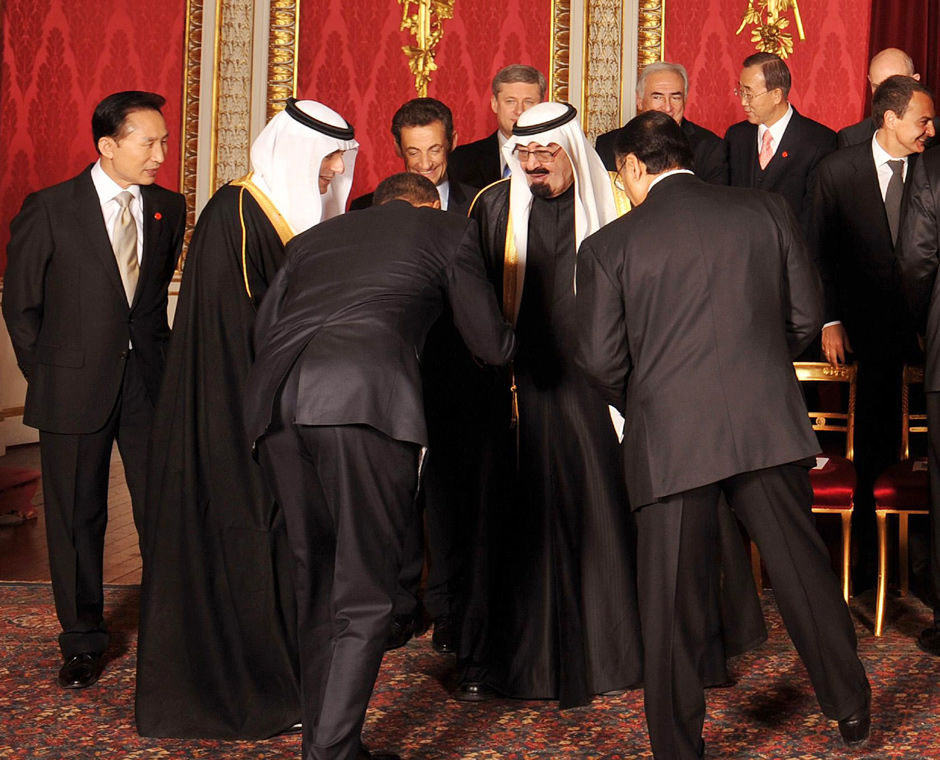
YOU KNOW FAG BOY IS USED TO BENDING OVER CENT HE TAKES IT UP HIS ASS

Bombshell Obama Vetting: 1979 Newspaper Article By Valerie Jarrett's Father-In-Law Reveals Start Of Muslim Purchase Of U.S. Presidency...

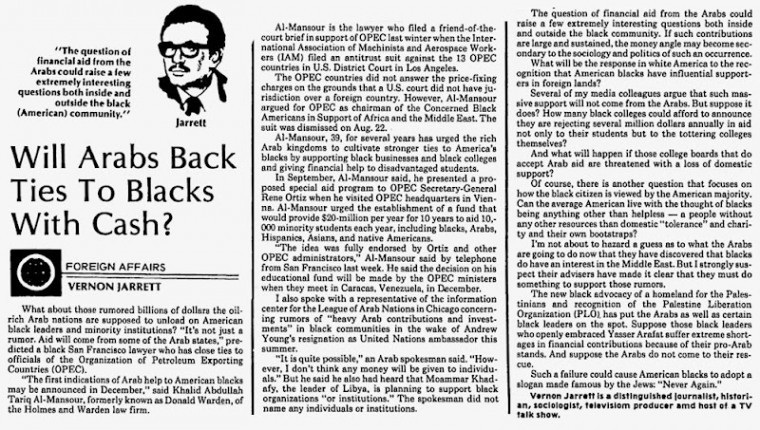
1979 article by Vernon Jarrett about Khalid al-Mansour
The Vernon Jarrett syndicated column of Nov. 6, 1979, that appeared in the St. Petersburg Evening Independent. It originally appeared in the Chicago Tribune on Nov. 2. This image was pieced together from screen shots of the St. Petersburg Independent page available for viewing in the Google Newspaper Archive. Jarrett was the father-in-law of Valerie Jarrett, President Obama's closest adviser.
Why would Muslim oil billionaires finance and develop controlling relationships with black college students? Well, like anyone else, they would do it for self-interest. And what would their self-interest be? We all know the top two answers to that question: 1. a Palestinian state and 2. the advancement of Islam in America. The idea then was to advance blacks who would facilitate these two goals to positions of power in the Federal government, preferably, of course, the  Presidency. And why would the Arabs target blacks in particular for this job? Well, for the same reason the early communists chose them as their vanguard for revolution (which literally means “change”) in America. Allow me to quote Trotsky, in 1939:  “The American Negroes, for centuries the most oppressed section of American society and the most discriminated against, are potentially the most revolutionary element of the population. They are designated by their historical past to be, under adequate leadership, the very vanguard of the proletarian revolution.”  Substitute the word “Islam” for the words “the proletarian revolution,” and you most clearly get the picture, as Islam is a revolutionary movement just like communism is. (Trivia: it is from this very quote that communist Van Jones takes his name. Van is short for vanguard. He was born “Anthony”). In addition, long before 1979, blacks had become the vanguard of the spread of Islam in America, especially in prisons. 


  Interestingly, in context with the fact that this article was written by her father-in-law, Valerie Jarrett has an unusual amount of influence over Obama (along with personal security that may be even better than his, another unusual and intriguing bit of business here). And equally interesting is that Obama, who may have been a beneficiary of this Muslim money, and may now be in this Muslim debt, has aggressively pursued both of the Muslim agendas I cited above. And, also equally interesting, is that Obama has paid a king’s ransom for court ordered seals of any such records of this potential financing of his college education, and perhaps, of other of his expenses. 


  Lastly, it’s very important to note that the main source for the article is Khalid Mansour, “the same lawyer who allegedly helped arrange for the entrance of Barack Obama into Harvard Law School in 1988.” (Valerie Jarrett, by the way,  was born in Iran . The one country protected by Obama from the sweep of the Arab Spring.) Now all of this may seem sensational, but let’s face facts. What makes it most disturbing is that not only is it all logical, but it suddenly makes a lot of previously confusing things make perfect sense.  –   Pat Dollard
Why would Muslim oil billionaires finance and develop controlling relationships with black college students? Well, like anyone else, they would do it for self-interest. And what would their self-interest be? We all know the top two answers to that question: 1. a Palestinian state and 2. the advancement of Islam in America. The idea then was to advance blacks who would facilitate these two goals to positions of power in the Federal government, preferably, of course, the  Presidency. And why would the Arabs target blacks in particular for this job? Well, for the same reason the early communists chose them as their vanguard for revolution (which literally means “change”) in America. Allow me to quote Trotsky, in 1939: “The American Negroes, for centuries the most oppressed section of American society and the most discriminated against, are potentially the most revolutionary element of the population. They are designated by their historical past to be, under adequate leadership, the very vanguard of the proletarian revolution.” Substitute the word “Islam” for the words “the proletarian revolution,” and you most clearly get the picture, as Islam is a revolutionary movement just like communism is. (Trivia: it is from this very quote that communist Van Jones takes his name. Van is short for vanguard. He was born “Anthony”). In addition, long before 1979, blacks had become the vanguard of the spread of Islam in America, especially in prisons.
​
Interestingly, in context with the fact that this article was written by her father-in-law, Valerie Jarrett has an unusual amount of influence over Obama (along with personal security that may be even better than his, another unusual and intriguing bit of business here). And equally interesting is that Obama, who may have been a beneficiary of this Muslim money, and may now be in this Muslim debt, has aggressively pursued both of the Muslim agendas I cited above. And, also equally interesting, is that Obama has paid a king’s ransom for court ordered seals of any such records of this potential financing of his college education, and perhaps, of other of his expenses.
​
Lastly, it’s very important to note that the main source for the article is Khalid Mansour, “the same lawyer who allegedly helped arrange for the entrance of Barack Obama into Harvard Law School in 1988.” (Valerie Jarrett, by the way, was born in Iran. The one country protected by Obama from the sweep of the Arab Spring.) Now all of this may seem sensational, but let’s face facts. What makes it most disturbing is that not only is it all logical, but it suddenly makes a lot of previously confusing things make perfect sense. – Pat Dollard​​

Excerpted from Daily Interlake: Searching old newspapers is one of my favorite pastimes, and I have tried to use them many times to shed light on current events — or to inform readers about how the past is prologue to our very interesting present-day quandaries.
Recently, I came across a syndicated column from November 1979 that seemed to point 30 years into the future toward an obscure campaign issue that arose briefly in the 2008 presidential campaign.
Though by no means definitive, it provides an interesting insight, at least, into how Chicago politics intersected with the black power movement and Middle Eastern money at a certain point in time. Whether it has any greater relevance to the 2012 presidential campaign, I will allow the reader to decide. In order to accomplish that, I will also take the unusual step of providing footnotes and the end of this column so that each of you can do the investigative work for yourself.
The column itself had appeared in the St. Petersburg (Fla.) Evening Independent of Nov. 6, but it was the work of a veteran newspaperman who at the time was working for the prestigious Chicago Tribune and whose work was syndicated nationally. (1)
So far as I know, this 1979 column has not previously been brought to light, but it certainly should be because it broke some very interesting news about the “rumored billions of dollars the oil-rich Arab nations are supposed to unload on American black leaders and minority institutions.” The columnist quoted a black San Francisco lawyer who said, “It’s not just a rumor. Aid will come from some of the Arab states.”
Well, if anyone would know, it would have been this lawyer — Donald Warden, who had helped defend OPEC in an antitrust suit that year and had developed significant ties with the Saudi royal family since becoming a Muslim and taking the name Khalid Abdullah Tariq al-Mansour.
Al-Mansour told Jarrett that he had presented the “proposed special aid program to OPEC Secretary-General Rene Ortiz” in September 1979, and that “the first indications of Arab help to American blacks may be announced in December.” Maybe so, but I looked high and wide in newspapers in 1979 and 1980 for any other stories about this aid package funded by OPEC and never found it verified. (Continued after the jump)
You would think that a program to spend “$20 million per year for 10 years to aid 10,000 minority students each year, including blacks, Arabs, Hispanics, Asians and native Americans” would be referred to somewhere other than one obscure 1979 column, but I haven’t found any other word of it.
Maybe the funding materialized, maybe it didn’t, but what’s particularly noteworthy is that this black Islamic lawyer who “for several years [had] urged the rich Arab kingdoms to cultivate stronger ties to America’s blacks by supporting black businesses and black colleges and giving financial help to disadvantaged students” was also the same lawyer who allegedly helped arrange for the entrance of Barack Obama into Harvard Law School in 1988.
That tale had surfaced in 2008 when Barack Obama was a candidate for president and one of the leading black politicians in the country — Percy Sutton of New York — told an interviewer on a Manhattan TV news show that he had been introduced to Obama “by a friend who was raising money for him. The friend’s name is Dr. Khalid al-Mansour, from Texas. He is the principal adviser to one of the world’s richest men. He told me about Obama.” (2)
This peculiar revelation engendered a small hubbub in 2008, but was quickly dismissed by the Obama campaign as the ditherings of a senile old man. I don’t believe President Obama himself ever denied the story personally, and no one has explained how Sutton came up with this elaborate story about Khalid al-Mansour if it had no basis in fact, and in any case al-Mansour no longer denies it. (3)
Back in 2008, while actually supporting Hillary Clinton in the New York primary, Percy Sutton was interviewed on TV and said that he thought Barack Obama was nonetheless quite impressive. He also revealed that he had first heard about Obama 20 years previously in a letter where al-Mansour wrote, “there is a young man that has applied to Harvard. I know that you have a few friends up there because you used to go up there to speak. Would you please write a letter in support of him?”
Sutton concluded in the interview, “I wrote a letter of support of him to my friends at Harvard, saying to them I thought there was a genius that was going to be available and I certainly hoped they would treat him kindly.”
Until now, there really has been no context within which to understand the Sutton story or to buttress it as a reliable account other than the reputation of Sutton himself as one of the top leaders of the black community in Manhattan — himself a noted attorney, businessman and politician. But the new discovery of the 1979 column that established Khalid al-Mansour’s interest in creating a fund to give “financial help to disadvantaged students” does provide a clue that he might indeed — along with his patron, Arab Prince Alwaleed bin Talal — have taken an interest in the “genius” Barack Obama.
It also might be considered more than coincidence that the author of that 1979 newspaper column was from Chicago, where Barack Obama settled in 1986 a few years after his stint at Columbia University. It is certainly surprising that the author of that column was none other than Vernon Jarrett, the future (and later former) father-in-law of Valerie Jarrett, who ultimately became the consigliatore of the Obama White House.
It is also noteworthy that Vernon Jarrett was one of the best friends and a colleague of Frank Marshall Davis, the former Chicago journalist and lifelong communist who moved to Hawaii in the late 1940s and years later befriended Stanley and Madelyn Dunham and their daughter Stanley Ann, the mother of Barack Obama. (4)
And to anyone who has the modicum of a spark of curiosity, it is surely intriguing that Frank Davis took an active role in the rearing of young Barack from the age of 10 until he turned 18 and left Hawaii for his first year of college at Occidental College in Los Angeles. (5)
It is also at least suggestive that Obama began that college education as a member of the highly international student body of Occidental College in 1979, the same year when Vernon Jarrett was touting the college aid program being funded by OPEC and possibly Prince Alwaleed. The fact that President Obama has studiously avoided releasing records of his college years is suggestive also, but has no evidentiary value in the present discussion. (6)
The nature of Vernon Jarrett’s relationship to Khalid al-Mansour is likewise uncertain, but it is very likely they had known each other as leaders of the black civil-rights movement for many years. Under his previous name of Donald Warden, al-Mansour had founded the African American Association in the Bay Area in the early 1960s. He had also helped inspire the Black Panther Party through his association with black-power leaders such as Huey Newton and Bobby Seale. Seale, of course, had a famous association with Chicago later, when he was part of the Chicago Eight charged with conspiracy and inciting to riot at the Democratic National Convention in 1968. (7)
In any case, it doesn’t matter if Vernon Jarrett and Khalid al-Mansour had a personal relationship or not. For some reason, al-Mansour had used Jarrett as the messenger to get out the word about his efforts to funnel Arab oil money to black students and minority colleges at about the same time that Barack Obama began his college career. That doesn’t mean either Jarrett or al-Mansour knew Obama at that time, but eight years later when Obama was a rising star in Chicago, a friend of Bill Ayers and Valerie Jarrett, it is much more likely that he did indeed have the assistance of very important people in his meteoric rise. The words of Percy Sutton about what al-Mansour told him regarding Obama certainly have the ring of truth:
“His introduction was there is a young man that has applied to Harvard. I know that you have a few friends back there… Would you please write a letter in support of him? (That’s before Obama decided to run.) … and he interjected the advice that Obama had passed the requirements, had taken and passed the requirements necessary to get into Harvard and become president of the Law Review. That’s before he ever ran for anything. And I wrote a letter in support of him to my friends at Harvard, saying to them that I thought there was a genius that was going to be available and I certainly hoped they would treat him kindly…” (2)
What possible significance could all this have? We may never know, but Vernon Jarrett, back in 1979, thought that OPEC’s intention to fund black and minority education would have huge political ramifications. As Jarrett wrote:
“The question of financial aid from the Arabs could raise a few extremely interesting questions both inside and outside the black community. If such contributions are large and sustained, the money angle may become secondary to the sociology and politics of such an occurrence.” (1)
He was, of course, right.
As Jarrett suggests, any black institutions and presumably individuals who became beholden to Arab money might be expected to continue the trend of American “new black advocacy for a homeland for the Palestinians” and presumably for other Islamic and Arabic interests in the Middle East. For that reason, if for no other, the question of how President Obama’s college education was funded is of considerably more than academic interest.

TOP DEMOCRATIC SENATOR: 'I Don't Think The Public Realizes How Stupid These Cuts Are' Read more: http://www.businessinsider.com/sequester-sequestration-senate-plan-mark-warner-2013-2#ixzz2LxAxDuGS

Sen. Mark Warner (D-Va.), a member of the Senate Budget Committee, said Congress must "get something done" to avert the looming, across-the-board cuts of the sequester set to start kicking in later this week.
"I’ve been surprised some of these Republican leaders have said they don’t want to negotiate — no eleventh hour deals," Warner told CBS' Charlie Rose on "This Morning."
"I don’t think the public realizes how stupid these cuts are. In many places we will end up cutting things that will cost the taxpayer more money than the cuts."
Warner is one whose state the White House warned would be disproportionately affected by the cuts.
Jason Furman, the deputy director of the Obama administration's National Economic Council, told reporters on a conference call Sunday that the cuts could compromise some military readiness in Virginia. About 90,000 civilian Department of Defense employees would be furloughed, and maintenance on 11 ships could be canceled, Furman said.
Warner gave three examples of how he said the cuts would affect his state — "975 separate line items" would be cut. It would also have to cut some long-term contracts with ship- and plane-builders, which Warner said would end up costing the state more. And it would have to cut back some National Institute of Health grants, meaning the price of meat could rise.
Warner urged Congress to take up the Senate's plan, which was introduced two weeks ago. It replaces 10 months of sequester cuts with an equal mix of new revenues and spending cuts, including the implementation of the so-called "Buffett Rule."
"Limping from one budget crisis to another doesn’t do anything for this economy," Warner said.
Here's a clip of Warner's appearance, courtesy of CBS: