Copyright Disclaimer Under Section 107 of the Copyright Act 1976?Fair use is a use permitted by copyright statute that might otherwise be infringing. Non-profit, educational or personal use tips the balance in favor of fair use. Unless you are in this field of investigative journalism, especially covering extremely sensitive subjects and potentially dangerous subjects as well, you simply cannot understand the complexities and difficulties involved with this work that I face every day.
The
"March 2013-Watchlisting Guidance" was leaked to journalists at The
Intercept by a source within the intelligence community.
“A source within the intelligence community” has leaked the government’s secret guidebook to how it adds names to and manages its controversial terrorist “watchlist” and was published in full by The Intercept on Wednesday. Reported by Jeremy Scahill and Ryan Devereaux, the 166-page document (pdf) issued by the National Counterterrorism Center—and titled “March 2013 Watchlisting Guidance”—details
the most up-to-date government rules for placing individuals on their
main terrorism database, as well as the no-fly list and selectee list.
It was developed by representatives from the nation's top military and
intelligence bodies including the Pentagon, CIA, NSA, and FBI.
According to the report, in 2013 the Obama administration “quietly
approved a substantial expansion” of the watchlist system, “authorizing a
secret process that requires neither ‘concrete facts’ nor ‘irrefutable
evidence’ to designate an American or foreigner as a terrorist.” It was
developed behind closed doors by representatives of the nation’s
intelligence, military, and law-enforcement establishment, including the
Pentagon, CIA, NSA, and FBI.
Scahill and Devereaux report that the guidelines permit “the elastic
concept of 'reasonable suspicion' as a standard for determining whether
someone is a possible threat.”
They continue:
The document’s definition of “terrorist” activity
includes actions that fall far short of bombing or hijacking. In
addition to expected crimes, such as assassination or hostage-taking,
the guidelines also define destruction of government property and
damaging computers used by financial institutions as activities meriting
placement on a list. They also define as terrorism any act that is
“dangerous” to property and intended to influence government policy
through intimidation.
This combination—a broad definition of what
constitutes terrorism and a low threshold for designating someone a
terrorist—opens the way to ensnaring innocent people in secret
government dragnets.
Moreover, the government tracks both “known terrorists” and
“suspected terrorists,” allowing individuals to be placed on the list
even if they are suspected of associating with potential terrorists.
“Instead of a watchlist limited to actual, known terrorists, the
government has built a vast system based on the unproven and flawed
premise that it can predict if a person will commit a terrorist act in
the future,” says Hina Shamsi, the head of the ACLU’s National Security
Project. “On that dangerous theory, the government is secretly
blacklisting people as suspected terrorists and giving them the
impossible task of proving themselves innocent of a threat they haven’t
carried out.”
The report further reveals the Catch-22 of being placed on the list based on the vague premise of “reasonable suspicion.”
"The difficulty of getting off the list is highlighted by a passage
in the guidelines stating that an individual can be kept on the
watchlist, or even placed onto the watchlist, despite being acquitted of
a terrorism-related crime," Scahill and Devereaux report. "The rulebook
justifies this by noting that conviction in U.S. courts requires
evidence beyond a reasonable doubt, whereas watchlisting requires only a
reasonable suspicion. Once suspicion is raised, even a jury’s verdict
cannot erase it."
One of the more notable details revealed in the report is the ability
to elevate an entire category of people from the watchlist to the
no-fly or selectee list, also known as a “threat-based expedited
upgrade,” when there is a “particular threat stream” that indicates that
a certain category of individual “may commit a terrorist act.”
According to the report, the Guidelines do not reveal what categories of
people have thus far been elevated in this manner.
Since 9/11, the number of individuals listed on the government’s no-fly list grew from just 16 to tens of thousands. In a recent court
filing, the government revealed that there were 468,749 nominations for
“known or suspected terrorists” in 2013 alone. Of those nominees, only
4,915—a mere one percent—were rejected.
This work is licensed under a Creative Commons Attribution-Share Alike 3.0 License
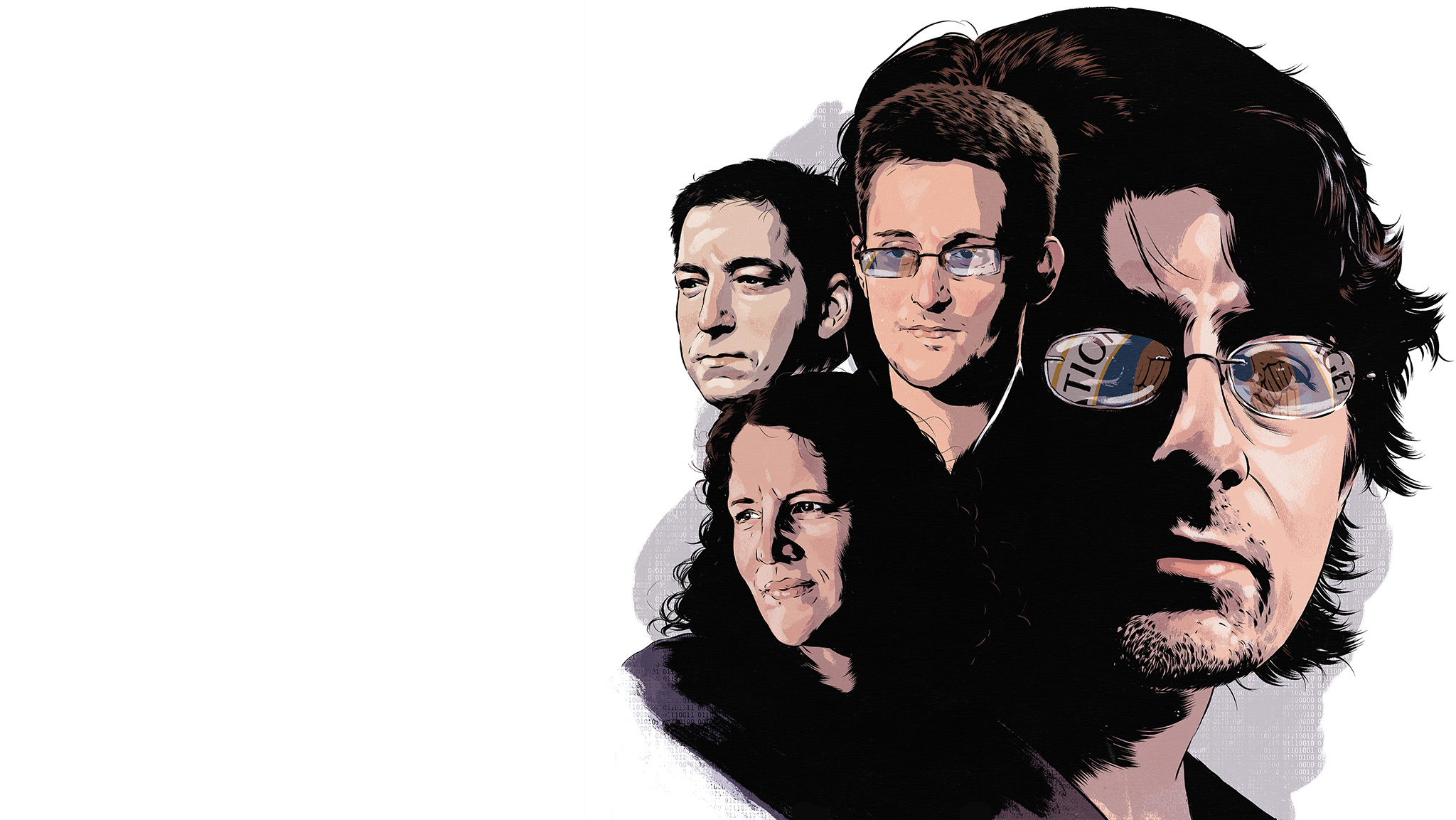
The eBay founder was a mild-mannered Obama
supporter looking for a way to spend his time and fortune. The Snowden
leaks gave him a cause — and an enemy.
Illustrations by Matthew Woodson
Every September, for a siren-snarled week, much of
midtown Manhattan surrenders to a pair of occupying powers: the United
Nations and the Clinton Global Initiative. The U.N.’s annual General
Assembly brings in the foreign excellencies and tin-pot dictators, but
it’s Bill Clinton’s event that attracts the billionaires. This year’s
edition, co-sponsored by, among others, a Greek shipping magnate’s wife
and a Ukrainian oligarch, took place inside the barricaded Times Square
Sheraton, where the Clintons made evangelical “calls to action” on
issues like water scarcity and women’s empowerment.
One evening,
in conjunction with CGI, Pierre Omidyar threw a reception across the
street. Omidyar, the programmer who created eBay, is one of America’s
richest men, a 47-year-old philanthropist intent on giving away the
fortune he made when he was 31. He is on collegial terms with the
Clintons and has been a partner in their charity work. His guests,
sipping wine inside a vaulted glass atrium, represented foundations and
banks, governments and NGOs, tech start-ups and McKinsey. Omidyar’s
foundation had just unveiled a $200 million Global Innovation Fund,
established in partnership with the U.S. Agency for International
Development. The announcement was timed to coincide with President
Obama’s speech to the conference that afternoon on nurturing civil
society.
Omidyar was late to the party, however — he’d spent much of his day
hatching plans with some of Obama’s most uncivil opponents. Down in the
Flatiron District, he has been building a digital-media organization
dedicated to a scorching brand of “fearless, adversarial journalism.”
Its prime target is the U.S. intelligence apparatus, and its marquee
voice is Glenn Greenwald, the columnist who shared a Pulitzer Prize this
year with documentarian Laura Poitras and others for obtaining and
publishing Edward Snowden’s leaks about NSA surveillance. Since that
story broke, Snowden, Greenwald, and Poitras have become heroes of a
crypto-insurgency. More quietly, Omidyar has become the movement’s prime
benefactor, financing an operation to disseminate government secrets.
Earlier this year, Greenwald, Poitras, and a third comrade in arms — former Nation writer Jeremy Scahill — launched a website called the Intercept.
It is meant to be the prototype for a fleet of publications funded by
Omidyar’s flagship company, First Look Media, to which Omidyar has
initially committed $250 million. “We have the luxury of doing something
different because we have this kind of infinite-resource backer,”
Greenwald told me on the phone from Brazil, where he is based. “We’re
thinking about how to do journalism structurally differently.” At the
time of Omidyar’s visit, a second site, Racket, was also revving up for
its launch. Headed by the polemical magazine writer Matt Taibbi, it was
going to offer scabrous satire of the financial industry and politics.
Omidyar’s organization operates a little like WikiLeaks, except it is
staffed by well-salaried journalists and backed by Silicon Valley
money. It aims to unite strident ideology with publishing technology,
cryptography, and aggressive legal defense. The Intercept has become the
custodian of Snowden’s immense archive of classified documents, which
it continues to mine for stories. Greenwald says the site also plans to
share them with outside reporters and is building a secure “reading
room” in its Fifth Avenue headquarters building, where it is currently
renovating three floors. The Intercept is encouraging others in the
intelligence world to leak via an encrypted system called SecureDrop.
Between its periodic scoops, it serves up regular doses of acidic
commentary by critics of Obama’s national-security policies.
Omidyar was an admirer of Obama’s right up to the moment the Snowden
story broke, and many people who know him well, the types you might meet
at CGI, struggle to explain his sudden turn toward confrontation. “He’s
a very serious and public-spirited person,” says General Wesley Clark,
who has been friendly with Omidyar since he raised money for his 2004
presidential campaign. Clark has publicly dismissed concerns about NSA
surveillance and told me he couldn’t really explain why Omidyar was so
agitated. Omidyar is mellow by nature; he lives in Hawaii and is a
devotee of Buddhism. “He’s not this hard-core, radical maverick,”
Greenwald says. “Back before this all happened, he just seemed like the
normal, average, amicable billionaire.” Omidyar has communicated little
about his motivations beyond a handful of abstruse public statements. He
remains a remote and somewhat mysterious figure, even to his
collaborators.
“To this day,” Greenwald says, “I’ve never met Pierre in person.”
There he was, though, inside the throng of the reception: a thin man
in a houndstooth blazer, peering intently through rimless glasses. His
thick black hair, once worn in a luxuriant ponytail, is now short and
streaked by a single gray forelock. Omidyar has an aura of reserve,
shuns personal publicity, and seems allergic to the pitching and
prostration that his $8 billion net worth inspires in others. He found
Jeff Skoll — his partner in eBay, now a philanthropist too — and
immersed himself in conversation. Then he broke away to embrace a
red-robed Buddhist monk, a fellow acolyte of the Dalai Lama’s.
Dutifully, Omidyar came forward to speak, clinking his glass next to a
microphone in an ineffective effort to quiet the conversation. He began
to read remarks off a stack of oversize notecards, but he stopped,
visibly annoyed by the squealing brakes of a passing truck. “Isn’t New
York wonderful? All this ambient sound,” he said. Then he forged onward.
“As some of you may know, we’ve been exploring my interest in
journalism. We’re really looking for new ways to bring more transparency
and accountability to our government and to society as a whole.”
Omidyar’s soft words were nearly drowned out by the cocktail-hour
din. But billionaires have many ways to voice their inner displeasure.
That morning, Greenwald had published an Intercept column
excoriating Obama’s move to bomb ISIS in Syria, suggesting he was
intentionally driving recruits to the terrorist army. “At this point,
it’s more rational to say they do all of this not despite triggering those outcomes but because of
it,” Greenwald wrote. “Continuously creating and strengthening enemies
is a feature, not a bug. It is what justifies the ongoing greasing of
the profitable and power-vesting machine of Endless War.” Omidyar later
tweeted a promotional link.
Omidyar was aware I had made interview requests, but he had remained
reticent about his fight for radical transparency. There were rumors of
turmoil behind the scenes at First Look — angry conflicts that reflected
the inherent contradictions of a leftist offensive funded by a
billionaire whose idiosyncratic belief system didn’t fit into neat
political categories. When I approached Omidyar after his speech, he
handed me his business card, flipping it over to point out one of those
square UPC-like symbols, a code that linked to his website. “This is
like a tracking chip,” he joked. “It’s like our version of the NSA
tracking thing.” Then he courteously turned away. It is possible to begin to discern Omidyar’s motivations
with a little online surveillance. Within his natural habitat, he can
be as voluble as he is personally shy. These days, his preferred medium
is his Twitter account, @pierre,
but the web is strewn with dormant blogs and avatars. His accounts
offer granules of self-disclosure in the form of complaints (about the
difficulty of ordering vegan room service), enthusiasms (the Segway),
and philosophical musings (on “Star Trek ethics”).
As an engineer, Omidyar thinks of the world in terms of structures,
and when he sees weaknesses, he becomes alarmed. Before the 2004
election, he blogged that the voting system was “headed towards a
disaster,” and he excitedly quoted an anonymous inside source who
described flaws in electronic machines that could lead to fraud. He is
fascinated by diseases like Ebola and thinks the public-health system
could be helpless in a crisis. “Since we know a pandemic is coming,” he
wrote in a blog post for a flu initiative, “it’s only a matter of time
until we’re sick and we have to take care of ourselves.”
Electronic privacy is another long-standing concern, reflected both
in Omidyar’s philanthropic donations — to the Electronic Frontier
Foundation, among other organizations — and his personal writings.
During the Bush administration, his thoughts frequently returned to
concerns about the War on Terror’s effect on civil liberties. He was
also early to recognize the way technology was creating a virtual state
of full disclosure, enticing people to consensually expose their inner
lives to the narcotic curiosity of others.
One evening in February 2004, on his personal blog, Omidyar narrated
an account of how he had been drawn into some idle snooping: “So, I’m in
a hotel room in Boston, listening to some Moby in my iTunes, and I
happen to notice a little blue icon in my list of playlists that I
haven’t seen before.”
The icon linked to someone else’s computer, shared through the
hotel’s Wi-Fi network. Omidyar clicked and browsed his neighbor’s
library, noticing a file called “conjugal visit” that looked
suspiciously like a home recording.
“There’s something creepy about this experience. Hotel rooms when
you’re by yourself are already a little creepy, since you don’t really
know what’s going on behind that wall … Now, I wonder, is he next door?
Or above? Or below?
“I check the lock on my door. But I also feel a little bit like a peeping Tom. Is there a word for this phenomenon yet?”
Two days before, not far from Omidyar’s hotel, Mark Zuckerberg had
launched Facebook; the creeping uneasiness he described is now a
defining characteristic of our times. But the rise of self-revelation
has been accompanied by disquiet about the privacy we may be ceding,
willingly or not. Omidyar thinks the public is too complacent about
intrusion and quotes Google’s Eric Schmidt, who says that government
monitoring could “end up breaking the internet.” By this, Omidyar means
that a spirit of online community and free exchange was the precondition
for the digital age, and eBay’s success, and his unfathomable wealth.
He worries that spying could turn trust to paranoia, a threat he takes
very personally. “If you think ‘I’ve got nothing to hide’ is good basis
for security policy,” Omidyar tweeted last year, “you’ve never been
racially profiled or walked into [the] wrong church.”
Omidyar’s parents are Iranian. He was born in Paris, and he is a
naturalized citizen: a member of the American community by choice. His
parents moved to Washington, D.C., when he was young and soon separated.
He was raised by his mother, Elahé Mir-Djalali, a linguist. Much of her
published work was done in collaboration with a federally contracted
think tank run by a psychologist who developed a word-association
technique to help the military understand foreign mentalities.
Academically, she was interested in the ways that “the hidden aspects of
cultural meanings” make it difficult for speakers from different
backgrounds to understand each other, and her studies identified the
discontent among students in Iran just prior to the 1979 revolution.
When Omidyar was in eighth grade, his mother moved to Honolulu to seek a
position at a government-policy institute affiliated with the
University of Hawaii. Pierre enrolled in the elite Punahou School, from
which Barack Obama had graduated the year before.
Years later, Omidyar would listen to Obama’s rhetoric of “one
America” and hear echoes of his own life. “I’ve always loved this
country and its ideals with the fervor of a convert,” Omidyar blogged
during the 2008 primaries. “He puts words to what I feel.”
Omidyar used to beg his mother to let him spend his Saturdays playing
with an Apple II at a Honolulu computer store. He went on to study
computer science at Tufts University, where he met his future wife, Pam.
They moved out to Silicon Valley in the late ’80s. As a programmer, he
“wasn’t a ninja,” says a colleague from that time, but he had the
intellectual acuity to comprehend the potential of the internet. He was
intuitive and, once convinced of his personal logic, difficult to budge.
“I think I had a bad combination of personality traits: lots of
self-confidence, and a perfectionist attitude towards my work,” Omidyar
wrote in a public online chat years later. “I probably came across as an
arrogant know-it-all, though of course that was never my intention.”
Omidyar co-founded a start-up, Ink Development, but when he disagreed
with his partners over its direction, he left to take a job with a
company called General Magic, an Apple spinoff that was developing a
rudimentary form of tablet computing. General Magic was a ’90s hotbed:
It called its young employees “magicians” and had an inspirational
rabbit that hopped freely around the office. But in Omidyar’s view, both
his start-up (which eventually sold to Microsoft, making him a
millionaire) and General Magic had a fatal flaw: Their systems were not
built to take advantage of the web. “Basically the latest, coolest shiny
toy at the time was the web, was interactivity,” Omidyar later
recalled.
Originally, the domain eBay.com had nothing to do with auctions — it
was a workshop where Omidyar would tinker. Its earliest incarnation
hosted a web page about Ebola, inspired by the national scare that
coincided with the movie Outbreak. (Later, eBay would offer a
variety of origin stories for its odd name, none having to do with Ebola
in the Bay Area.) In August 1995, as General Magic began to show signs
of financial distress, Omidyar took advantage of the Labor Day weekend
to program a simple auction service and posted a link to it on eBay.com.
He soon recruited a company president, Skoll, whose first management
decision was to remove the alarming Ebola content, over Omidyar’s
objection that it was still drawing lots of traffic.
The online-auction idea wasn’t original — a founder of a preexisting
site, OnSale, recalls talking to Omidyar about a job before he started
his competitor — but eBay was unusually frictionless. The company never
touched the inventory, and it left market regulation to buyers and
sellers. Instead of policing cheats, Omidyar wrote a manifesto declaring
“most people are honest” and set up a forum where users could assign
each other positive and negative ratings. “It turned out to be this
magic thing,” he later said. By 1997, eBay was hosting 200,000 monthly
auctions; the next year, the company went public. “We literally went
from Pierre having maybe a couple million, and me just scraping by, to
us being billionaires,” Skoll told me.
Omidyar’s insight, then contrarian, is now commonplace: Websites are
communities, and people in them care about their reputations. “When
everyone else at the time was saying, ‘Wow, what’s great about the
internet is that you can be completely anonymous,’ Pierre was saying,
‘No, no, no, I want complete transparency,’” says Steve Westly, an early
eBay executive.
While Omidyar built his online marketplace on a foundation of public
disclosure, he has closely guarded the dimensions of his own life that
he deems unfit for inspection. His crusade against government spying
grows out of a conviction that people should be able to protect the
secret parts of themselves. When eBay became a dot-com phenomenon, a
spokeswoman asked him what she should tell reporters about the company
founder. He replied: “That I like my privacy.” After eBay went public,
he retreated from the public exposure and administrative hassle that
went with running the company, ceding responsibilities to a strong CEO,
Meg Whitman. He drifted for a while: first to Paris, then Las Vegas. He
built himself a 48,000-square-foot mansion overlooking the desert, which
he told Esquirehe liked because it gave him “the sense of what the planet was like before humans showed up.”
Eventually, he and Pam decided to relocate back to Hawaii — about as
far as you can get from mainland America without being an exile. Omidyar
was still fretful about his security and cognizant of the state’s
isolation. He had heard that Hawaii had food supplies for only about a
week in case of a catastrophe. In 2009, the Honolulu Advertiser
reported he kept emergency stockpiles near his home and had purchased a
solar-powered ranch in Montana to serve as a “safe house.” But the
Omidyars took to the island lifestyle. Pam surfed, and their three kids
were brought up relatively free of ostentation. Pierre and Pam donated
generously to Hawaiian causes, including sustainable agriculture. He
drove a Prius with a LIVE ALOHA bumper sticker.
Though he continued to be eBay’s board chairman and largest
shareholder, Omidyar receded from view in Silicon Valley. “Pierre has
been such a reclusive guy for the past few years,” says Philip Rosedale,
who founded the technology firm Linden Lab, developer of the animated
interactive world Second Life. During the mid-2000s, Omidyar immersed
himself in the Second Life community, adopting a secret identity: a
tattooed black man named Kitto Mandala. Even after Omidyar became a
Linden Lab investor, Rosedale primarily interacted with his animated
avatar. Mandala rode a Segway and wore a T-shirt that said KISS ME I’M
LAWFUL EVIL. He could fly, and hardly anyone knew he was really a
billionaire.
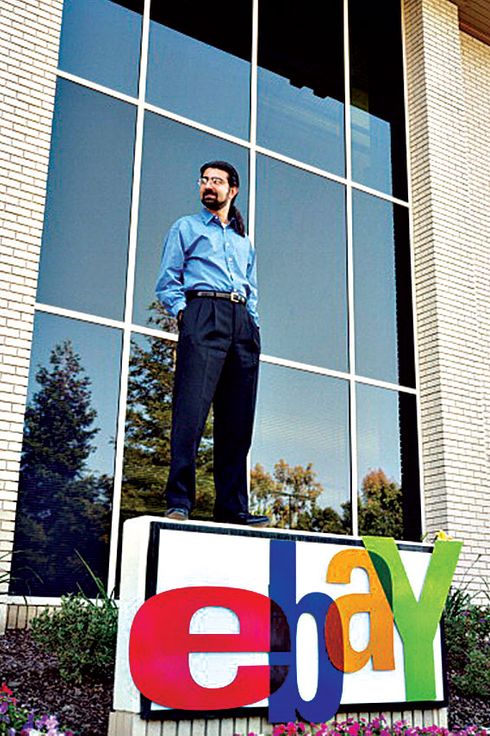
Pierre Omidyar in 1999.
Photo: Yann Gamblin/Getty Images
In 2003, Omidyar took a trip with some of his real-life peers
to NASA’s Space Camp in Alabama. Larry Page and Sergey Brin were there,
as was Elon Musk, who had just sold PayPal to eBay. They played
astronaut for a week, simulating a space-shuttle launch and
weightlessness. They had dinner with Buzz Aldrin and a NASA official,
during which the campers pressed to know why America hadn’t sent a man
to Mars.
Musk is now building a private company, SpaceX, with the aim of
personally landing on Mars. Brin wants to defeat Parkinson’s disease,
while Page has invested in promoting longevity, even immortality. Jeff
Bezos, Amazon’s founder, has his own rocket company and plans to restore
the Washington Post to financial health — no small challenge
given the struggles of the news business, in part owing to the
disruption of classified advertising by companies like eBay.
Omidyar, by contrast, had trouble settling on a moon-shot project. He
didn’t aspire to live forever or touch the stars. He wanted to do
unglamorous work at the grass roots, applying the optimistic lesson he
drew from eBay: that “people are basically good” and capable of
overcoming forces like disease, ignorance, poverty, and repression. But
how could this humanistic philosophy bring actual humans together?
Through a foundation, Omidyar tried sprinkling angel investments on
“social entrepreneurs” and created a patented technology platform meant
to allow them to trade ideas the way people bought and sold goods on
eBay. (Some users grew frustrated when they learned the conversation
wasn’t meant to be a route to Omidyar’s own money, and it ultimately
shut down.) Meanwhile, Pam, who previously worked in biotechnology,
funded projects like a video game called Re-Mission, designed to help
kids fight cancer, and founded an organization called Humanity United,
which campaigns against human trafficking and genocide. Pierre realized
that information gave rise to action, and that led him to think about
newspapers, too.
“He was genuinely interested and concerned about a dissipating news industry,” says Brian Greenspun, publisher of the Las Vegas Sun, who had lengthy discussions with Omidyar almost a decade ago. “And what impact it will have on our democracy.”
Omidyar believed that powerful institutions needed to be kept in check, so he funded organizations like the Sunlight Foundation, a watchdog for money in politics, and the Center for Public Integrity, an investigative-journalism nonprofit. At the same time, his own philanthropic organization, Omidyar Network,
conducted itself with unusual secrecy. Founded in 2004, it was at the
vanguard of a movement called “venture philanthropy.” It is modeled on a
VC firm, making both grants to nonprofits and equity investments in
for-profit companies. The organization is partly a private entity,
partly a foundation that functions as “just a checkbook,” as Omidyar
wrote in the Harvard Business Review. At the cost of millions in
tax breaks, this hybrid structure allows the Network to get around many
nonprofit regulations. Though Omidyar has been one of the most generous
donors to Guidestar, which tracks federal financial disclosures by
nonprofits, you won’t find much useful information about Omidyar Network
there.
Many in the philanthropy world were aghast when Omidyar began
mingling altruism and capitalism, but he dismissed the objections as
“old thinking.” He found an area that promised to unite both instincts:
microfinance. Omidyar loved the idea that giving out tiny loans in
developing countries could unleash entrepreneurialism. He endowed a $100
million fund, administered by Tufts, that invests in microfinance
institutions, and donated to numerous nonprofits in the sector. In 2008,
Omidyar took a trip to India, where he visited a village near Hyderabad
with the founder of a lender called SKS, in which Omidyar Network was
an indirect shareholder, via a 22 percent investment in a Cayman
Islands–based private-equity fund. He watched as cross-legged women in
saris borrowed cash. But when SKS mounted an IPO, the microfinance
venture turned into a philanthropic debacle. Unitus, Inc., the
Omidyar-supported nonprofit that ran the private-equity vehicle, had a
convoluted structure rife with potential boardroom conflicts of
interest. (“We have managed to stay out of jail, so we must not be
violating any ethics,” one Unitus board member assured a consultant paid
by Omidyar.) As it prepared to reap millions from the stock sale,
Unitus disbanded its charitable microfinance operations, declaring the
concept “validated.” But SKS’s stock later crashed in the midst of
political uproar in India over harsh collection tactics, which were tied
by opponents to a number of suicides.
Omidyar seems to take such setbacks in stride; he sees traditional
philanthropy as overly risk-averse. “In Silicon Valley,” he said at a
2011 nonprofit conference, “we say if you haven’t tried something and
failed, and actually learned something from that failure, then why would
I want to work with you?” But Omidyar’s habit of investing heavily in
big ideas, and sometimes dropping them abruptly, made him appear fickle
and inscrutable to many in the philanthropy world. “He got this
reputation of being an arrogant know-it-all,” says one nonprofit-sector
consultant, echoing Omidyar’s earlier self-assessment. “But they all
kissed the ring because they wanted his money.”
When Omidyar moved away from microfinance, he returned his attention
to another desperate population: journalists. Fixing the problem of news
appealed both to his apocalyptic side — in 2007, he proposed creating a
peer-to-peer text-messaging service that would help people to “survive a
flu pandemic or other widespread disaster” — and to his belief in the
responsibilities of citizenship. In 2008, he started a company called
Peer News, working with a small team of programmers in an office in
Honolulu. At first it developed a system called Ginx, which was supposed
to track the information coursing through Twitter. But it wasn’t able
to break into the crowded market, so Peer News pivoted: It would create
an ad-free subscription website covering Hawaiian government.
Omidyar conceived of the Honolulu Civil Beat,
launched in 2010, as what he called “a new civic square,” and he hoped
to reproduce the model around the country. He recruited a staff of six
“reporter-hosts” led by a newspaper refugee, John Temple, whose last
editing job had terminated with the closure of the Rocky Mountain News.
After a difficult start — half the initial reporting staff left within
months — the Civil Beat found its niche in weighty investigations.
Omidyar was a constant presence in the newsroom. When Pam learned of a
remote beach that was despoiled by washed-up plastic, they flew there on
his private jet with a reporter. Omidyar took the website’s photos
himself.
As a business, however, the Civil Beat never thrived. Omidyar was
tight-lipped about audience numbers, even requiring his reporters to
sign confidentiality agreements, but the subscription model clearly
didn’t work. On Twitter, he pleaded to know how much a reader was
willing to pay for his journalism: “No amount, no matter how small? Or a
fair price?” Ultimately, he formed a partnership with Arianna
Huffington to collaborate on an advertising-supported sister site. While
the Civil Beat still covers politics and pension funds, HuffPost Hawaii
promotes clickable content like yoga articles and photo galleries of
cute seals.
The compromise solution assured the Civil Beat’s survival, but it was
far from Omidyar’s original vision. For all his good intentions, he was
still searching for that galvanizing cause. Little did he know it had
been hidden there all along, in an underground bunker 25 miles outside
Honolulu that served as an NSA signals operation center. On June 1, 2013
— three days after the HuffPost Hawaii partnership was announced — a
technician who worked at the facility, Edward Snowden, made his
rendezvous with reporters at a hotel in Hong Kong. The radicalization of Pierre Omidyar happened with jarring
swiftness. In 2012, he advertised his proximity to Obama — he served on a
presidential commission — by tweeting out a photo of Marine One
hovering above the White House lawn. That same year, he responded to
campaign-season viciousness by tweeting out a list hashtagged
#RepublicansIRespect, citing figures like Robert Gates (a former CIA
director) and Condoleezza Rice. He started the Democracy Fund, a
foundation intended to promote moderation. “I’ve heard him use the term anti-partisan
to describe himself,” says Joe Goldman, the fund’s president. “He
believes it’s dangerous to get caught up on one side or the other.”
But on June 5, 2013, Omidyar’s Twitter account posted a link to a Greenwald story in the Guardian:
“Revealed: NSA collecting phone records of millions of Americans
daily.” The issue touched a nerve in him — if ever there were a power
that needed watching, it was the NSA. As further stories described the
extent of the surveillance and Snowden identified himself, Omidyar
vented his outrage. “Mr. President, look in the mirror,” he tweeted on
June 23, “when did America become a country to seek asylum from?
Whistleblowers are not spies.” On July 4, Omidyar tweeted the text of
the Fourth Amendment. At this juncture, there were many ways Omidyar
could have gone about influencing policy. He could have sought a meeting
at the White House — Pam’s human-rights organization collaborates
closely with the national-security staff — or he could have funded a
super-PAC. He could have rallied his fellow Silicon Valley billionaires
to flex their lobbying might. Instead he decided to build a machine for
confrontation and, as he puts it, “to convert mainstream readers into
engaged citizens.”
Omidyar kicked the tires on the Washington Post and raised the possibility of working with — or even somehow acquiring — the nonprofit outfit ProPublica. But the Post
sold to his old competitor Bezos. ProPublica, like other nonprofits
Omidyar talked to, wasn’t for sale. Amid a flurry of furious interaction
with privacy activists, Omidyar encountered Trevor Timm of the Freedom
of the Press Foundation. While discussing the Snowden leaks via an
encrypted video chat, Omidyar mentioned that he was thinking of starting
his own media organization. Timm suggested that he contact Greenwald.
“I think within a week, I talked to Glenn on the phone,” Timm says.
“And he said, ‘Yeah, we’ve already hired ten people.’ ”
Greenwald had a tempestuous relationship with his Guardian
editors and had already been planning to launch a website with Poitras
and Scahill. “It was really kind of amazing, because we were actually in
the process of doing almost exactly the same things,” Greenwald told
me. “The obvious difference between what we were doing and what he was
doing is that he has $8 billion.”
During last year’s Clinton Global Initiative, Omidyar summoned NYU
journalism professor Jay Rosen to his suite at the Hilton to discuss
surveillance, whistleblower prosecutions, and the future of journalism.
Rosen later became a formal adviser to what would be called First Look
Media, espousing what he calls the “personal franchise model” of
building a new-media brand: buying up stars with portable readerships.
But while acquiring the Greenwald franchise made business sense, it came
with complications. Practically, it was dispersed — Omidyar in
Honolulu, Greenwald in Rio, Poitras in Berlin — and the journalists were
afraid of what might happen if they returned to the U.S. Director of
National Intelligence James Clapper labeled them “accomplices” to
Snowden’s alleged espionage, and Mike Rogers, the Republican chairman of
the House Intelligence Committee, likened them to a “thief selling
stolen material.” Now that material was First Look’s chief journalistic
asset.
Before any firm plans were in place, much to Omidyar’s chagrin, word leaked to BuzzFeed that Greenwald was leaving the Guardian
to pursue what he called a “once-in-a-career dream journalistic
opportunity.” The founders’ initial statements were full of
revolutionary swagger. “To quote that old CIA torturer,” Scahill told a
German interviewer, “we gotta put on the big-boy pants.” He described “a
journalist’s paradise,” where reporters would write what they pleased
without interference from editors, the government, or Omidyar himself.
To the world, First Look looked like Greenwald’s personal project,
but Omidyar never expected to be a passive investor. He engaged in
extensive discussions with Arianna Huffington, including a brainstorming
session aboard a private jet when they went to India last October for a
conference organized by the Dalai Lama. “He wants to do it in a way
that can reach a mass audience, not just a niche audience,” Huffington
told me. Omidyar thought he would create an omnibus site covering news,
sports, and entertainment, generating readers and revenue for a galaxy
of star-centered publications. He hired Taibbi, the Rolling Stone writer most famous for likening Goldman Sachs to a “vampire squid,” to start Racket, lampooning the financial industry in the tradition of Spy.
First Look released an animated video in which Omidyar pledged to
“bring back to journalism what’s been lost,” as a cartoon reporter
sweated over a computer. “How does a company support itself given such
ambition?” he narrated. “We’re figuring that out.” In fact, there were
still lots of things to figure out, such as who was in charge, whether
First Look’s journalism would be expected to make money, and if so, how.
As First Look raced to launch the Intercept, its vehicle for
advancing the Snowden disclosures, an Omidyar Network headhunter was
dispatched to harvest talent, promising journalists the creative freedom
that comes with a $250 million budget. Omidyar probably expected that
the potential beneficiaries would be grateful. Instead, there was much
gossip and trepidation. Within the ecosystem of journalism and
transparency nonprofits, there is hardly an organization that doesn’t
take Omidyar’s money, or hope for it, but many are wary of his
influence. “If you’re answering to Omidyar,” says the director of one,
“then you’re really not independent.” And Greenwald himself, who had
declared war on U.S. intelligence and rejects journalistic pieties about
objectivity, is a polarizing force. “I think the concept of adversarial
journalism is a limited and flawed one,” says Steven Aftergood, the
author of Secrecy News, a respected blog that has received past Omidyar
Network funding. “It is not an impartial search for truth as much as it
is a combative attempt to defeat a perceived adversary.”
To take on the intelligence agencies, First Look has adopted some
elements of spycraft. It is seeking out moles, and one of its first
hires was a cryptography expert, who fortified its systems against
penetration. To protect journalists from government retaliation, Omidyar
established the Press Freedom Litigation Fund. But despite his
aggressive approach, Omidyar ran into immediate criticism from the
conspiratorial extremes of the left. Julian Assange attacked the “big power” of First Look,
calling Omidyar an “extreme liberal centrist” and questioning his
suspicious visits to the White House. The tech-news site PandoDaily
published a series of scathing articles. “Never before has such a vast
trove of public secrets,” journalist Mark Ames wrote last November, “been sold wholesale to a single billionaire as the foundation of a for-profit company.”
Earlier this year, Omidyar convened a staff retreat at his Las Vegas
mansion, which produced a declaration of editorial independence,
promising that First Look would be incorporated as a nonprofit and that
he would have “no involvement in the newsroom’s day-to-day operations.”
In reality, though, he was deeply involved, demanding personal approval
of even trivial expenses, and intent on finding a way to make the
venture financially self-sustaining. But his staff was determined to
hold him to his promise of “independence.” Many are vociferous
personalities, not known for playing well with others. When one
prominent editor was approached about a management role, he told
Omidyar’s headhunter, “You don’t need an HR department, you need a
psychotherapist.”
The confusion inherent to any start-up has been exacerbated by
Omidyar’s ruminative style. This spring, he went through a period of
deep thinking, highlighted by a summit with news-industry veterans at a
hotel he part-owns in Laguna Beach, California. Under “Chatham House
Rules,” no one was to talk directly about what was said. “He’s a true
believer, I believe,” says Ken Doctor, a media analyst who attended.
Many of those who have heard Omidyar and his aides, at that summit and
other meetings, have come away thinking his plans sounded naïve and not
fully baked. Sandy Rowe, a former editor of the Oregonian who was
brought on as a consultant, says the fuzzy vision gives Omidyar
flexibility. “This is a man who, since he said he would put down this
$250 million, has never said, ‘Here is my plan.’ ”
The absence of a plan, however, contributed to dissension within
First Look, and chatter began to emanate from behind its wall of
operational secrecy. There was an East Coast–West Coast feud, a divide
between the journalists and the technologists. Omidyar’s loyalists out
in California and Hawaii grumbled as Greenwald traveled the world,
promoting a book, picking up awards, and speaking out of turn. Poitras,
meanwhile, was immersed in finishing a documentary on Snowden. There was
an internal battle over budgets, which stalled hiring and hindered
journalistic output. The Intercept initially published at a piddling
rate. In June, the three co-founders of the Intercept and Taibbi wrote a
joint letter to Omidyar demanding freedom to proceed with their
expansion.
Omidyar then published a blog post
saying he had “definitely rethought some of our original ideas and
plans.” Instead of quick expansion, he announced that First Look would
be in “planning, start-up, and experimental mode for at least the next
few years,” focusing its immediate efforts on the Intercept and Racket
while working to develop new journalistic technology and design with a
team in San Francisco. He also appointed a confidant as First Look’s
editorial boss: the former Civil Beat editor John Temple. “I think that
the message,” Temple told me in August, “is that we’re not trying hard
enough if we’re not failing a little bit, if we’re not saying things
that don’t bear fruit.”
The shift proved beneficial to the Intercept, which is no longer under the day-to-day management of its founders. Omidyar lured editor John Cook
away from Gawker to run the site, and after a publication pause and a
redesign, it has been gaining momentum, breaking big stories about the NSA’s surveillance of American Muslim leaders and the seemingly arbitrary standards of the government’s terrorist-screening system.
The latter disclosure reportedly came from a leaker other than Snowden;
the FBI recently searched the home of a government contractor suspected
of being the source.
The factional conflicts within Omidyar’s enterprise, however, seem
far from settled. In August, Temple spoke enthusiastically about Racket,
which he said had broadened its focus to include political topics. But
as its launch date neared, Taibbi disappeared from the company
amid disputes with First Look higher-ups. Omidyar announced Taibbi was
leaving and that First Look would now “turn our focus to exploring next
steps” for Racket, a project that a spokeswoman said had cost him $2
million over its eight months of development. In the wake of the
tumultuous departure, the Intercept published a remarkable inside account
describing “months of contentious disputes” between Taibbi and his
superiors over his management, including a complaint from an employee
that he was “verbally abusive.” But the journalists did not spare
Omidyar from blame, describing what they called “a collision between the
First Look executives, who by and large come from a highly structured
Silicon Valley corporate environment, and the fiercely independent
journalists who view corporate cultures and management-speak with
disdain.” The iconoclasts even questioned Omidyar’s “avowed strategy” of
hiring “anti-authoritarian iconoclasts.”
Even before the turmoil, Temple hinted that a strategic
reconsideration was under way. “It will be more complex,” he told me,
“than an organization of iconoclasts.” He says that Omidyar sees
journalism as “the third phase of his professional life,” bringing
together his technology experience and philanthropy, and is prepared to
be patient, even if it perplexes outsiders. Temple says there is no
incongruity between Omidyar’s communitarian ideals and his financing of
an insurgency. “It’s not all about civility,” Temple says. “It’s about
having a healthy and open society.” There’s a tangible insight buried in
that amorphous sentiment: Omidyar’s interest in journalism is
mechanistic. He wants to aggregate to himself the power to declassify
and to bring about the “greater good,” as he defines it.
In October, the founding Intercept gang — minus Omidyar — got
together for a party at Mayday Space, a loft in a graffitied section of
Bushwick. The Snowden saga had entered its Redford-and-Hoffman phase
with the premiere of Poitras’s documentary Citizenfour,
which was partly financed by Skoll’s Participant Media and looks
destined for Oscar consideration. A DJ spun songs next to a huge
propaganda-style poster reading WHISTLE-BLOWER! KNOW YOUR PLACE … SHUT
YOUR FACE. Smokers congregated on the balcony, which had a distant view
of the Empire State Building, lit red. Greenwald hinted of further
scoops. “Stay tuned, is all I can say,” he told me.
Greenwald says that he and Omidyar plan to finally meet later this
month, when they will appear at a very different sort of gathering: an
invite-only event called Newsgeist, co-sponsored by Google and the
Knight Foundation. Billed as an “unconference,” it has no agenda other
than “reimagining the future of the news.” Greenwald told me “top
editors, executives, moguls, and founders” are expected to attend,
including Dean Baquet of the New York Times. I asked the
organizer from Google about other attendees and speakers, but he said he
could disclose no further details, to “protect the privacy and security
of our invited guests.” It seems that the Newsgeist is very hush-hush.
Dutch newspaper NRC Handelsblad reported it, headlining “NSA infected 50,000 computer networks with malicious software.”
It cited leaked Edward Snowden information. His revelations are the
gift that keeps on giving. Activists representing him keep important
information coming.
It’s vital. Everyone needs to know. Unchecked NSA spying threatens fundamental freedoms. They’re fast disappearing.
Their on the chopping block for elimination. Police state lawlessness runs America. It’s too great a threat to ignore.
According to NRC, NSA hacked over 50,000 computer networks. It installed malware. It facilitates surveillance.
It’s “designed to steal sensitive information.” Snowden provided
documents prove it. A 2012 management presentation showed NSA uses
“Computer Network Exploitation (CNE) in more than 50,000 locations.”
It secretly infiltrates computer systems through malware. Belgian telecom provider Belgacom was hacked.
Britain’s Government Communications Headquarters (GCHQ) installed
malware in its network. It did so to gain access to its customers’
telephone and data traffic.
It did it through a false Linkedin page. It was done through unwitting company employees.
NSA has a “special department.” It has over 1,000 military and
civilian hackers, intelligence analysts, targeting specialists, computer
hardware and software designers, and electrical engineers.
It’s top secret. It’s called the Office of Tailored Access Operations
(TAO). It identifies computer systems and supporting telecommunications
networks to attack.
It successfully penetrated Chinese computer and telecom systems for around 15 years. It does the same thing globally.
Most NSA employees and officials know little or nothing about TAO.
Its operations are extraordinarily sensitive. Only those needing to know
are kept informed.
Special security clearances are required to gain access to its top secret work spaces. Armed guards keep others out.
Entering requires a correct six digit code. Retinal scanner checks are used. TAO targets foreign computer systems.
It collects intelligence by hacking, cracking passwords, compromising
computer security systems, stealing hard drive data, and copying all
subsequent emails and text messages.
NSA calls doing so Computer Network Exploitation (CNE). In October 2012, Obama issued a secret presidential directive. It selected overseas targets for cyber attacks.
His Offensive Cyber Effects Operations (OCEO) claimed to “offer
unique and unconventional capabilities to advance US national objectives
around the world with little or no warning to the adversary or target
and with potential effects ranging from subtle to severely damaging.”
Washington “identif(ies) potential targets of national importance
where OCEO can offer a favorable balance of effectiveness and risk as
compared with other instruments of national power.”
It operates domestically the same way. NSA director Keith Alexander
heads US Cyber Command (Cybercom). He’s waging global cyberwar.
US Cyber Command (USCYBERCOM) has full operational control. It’s a cyber hit squad. It’s part of the US Strategic Command.
Rules of engagement are classified. Anything goes is policy.
Cyber-warriors are freewheeling. They operate globally. Cyber-preemption
reflects greater police state power.
TAO personnel penetrate, steal, damage, destroy or otherwise
compromise targeted sites. It’s perhaps the most important component of
NSA’s Signal Intelligence (SIGINT) Directorate.
NRC said TAO operations installed about 20,000 “implants” by early 2008. By mid-2012, they “more than doubled to 50,000.”
NSA prioritizes cyber operations. “Computer hacks are relatively
inexpensive.” They give NSA information otherwise not available.
Malware “can remain active for years without” detection. ” ‘Sleeper
cells’ can be controlled remotely and be turned on and off at will.”
Implants are digital sleeper cells. A “push of a button” activates
them. NSA has been conducting these type operations since the late
1990s.
Dutch intelligence services AIVD and MIVD “displayed interest in hacking.” In early 2013, a Joint Cyber Unit (JSCU) was created.
It’s an inter-agency operation. It uses experts with a range of IT
skills. It doesn’t go as far as NSA. Dutch law prohibits it. For how
long remains to be seen.
Last August, the Washington Post headlined “The NSA has its own team of elite hackers.” It discussed TAO operations.
It may “have had something to do with (developing) Stuxnet and Flame malware program.” Washington and Israel were involved.
In spring 2010, Iranian intelligence discovered Stuxnet malware
contamination. It infected its Bushehr nuclear facility. At the time,
operations were halted indefinitely.
Israel was blamed. So was Washington. Had the facility gone online
infected, Iran’s entire electrical power grid could have been shut down.
Flame is a more destructive virus. Internet security experts say it’s
20 times more harmful than Stuxnet. Iran’s military-industrial complex
is targeted.
So is its nuclear program. Maximum disruption is intended. Whether
plans to do so continue remains to be seen. Iran is alerted to the
possibility. Leaksource calls
itself the “#1 source for leaks around the world.” Last August, it
headlined “Codename GENIE: NSA to Control 85,000 ‘Implants’ in
Strategically Chosen Machines Around the World by Year End,” saying:
According to “top secret documents” the Washington Post obtained, “US
intelligence services carried out 231 offensive cyber-operations in
2011.”
Doing so represents “the leading edge of a clandestine campaign that
embraces the Internet as a theater of spying, sabotage and war.”
Snowden leaked information revealed it. GENIE involves using computer
specialists. They break into foreign networks. They do so to “put
(them) under surreptitious US control.”
“Budget documents say the $652 million project has placed ‘covert
implants,’ sophisticated malware transmitted from far away, in
computers, routers and firewalls on tens of thousands of machines every
year, with plans to expand those numbers into the millions,” said
Leaksource.
GENIE’s next phase involves an automated online system code-named
“TURBINE.” It’s able to potentially manage “millions of implants.”
It elevates intelligence gathering to a higher level. It lets it engage in widespread “active attack(s).”
Teams of FBI, CIA, and Cyber Command operatives work at NSA’s Remote Operations Center (ROC).
Their missions overlap. So does NSA’s National Threat Operations Center. It focuses on cyberdefense.
Snowden was involved as a Booz Allen Hamilton contractor. He learned NSA’s best hacking techniques.
The agency designs most of its implants. It spends millions of
dollars annually on “additional covert” “software vulnerabilities”
purchases.
It gets them from “private malware vendors.” They represent a growing source. They’re largely European based.
China, Russia, Iran and North Korea are called the “most challenging targets” to penetrate.
Other prioritized countries include so-called terrorist safe havens.
They include Afghanistan, Pakistan, Yemen, Iraq and Somalia.
NSA’s goal is sweeping. It wants to revolutionize data gathering. It wants to access “anyone, anywhere, anytime.”
It intends to “identify new access, collection and exploitation
methods by leveraging global business trends in data and communication
services.”
It wants total information control worldwide. It wants to go where no
previous spy agency went before. It wants no operational restraints. It
intends to keep doing whatever it wants.
Congress is a willing facilitator. Fake fix legislation facilitates
NSA lawlessness. It codifies collecting phone records of hundreds of
millions of Americans.
It permits the same thing online. It’s already out of committee. It’s heading for Senate passage.
Obama will sign into law whatever Congress sends him. He supports mass surveillance.
He’s waging war on fundamental freedoms. Police state lawlessness is official US policy. Obama is its leading exponent. Stephen Lendman lives in Chicago. He can be reached at lendmanstephen@sbcglobal.net. His new book is titled “Banker Occupation: Waging Financial War on Humanity.” http://www.claritypress.com/LendmanII.html Visit his blog site at sjlendman.blogspot.com. Listen to cutting-edge discussions with distinguished guests on
the Progressive Radio News Hour on the Progressive Radio Network. It airs Fridays at 10AM US Central time and Saturdays and Sundays at noon. All programs are archived for easy listening. http://www.progressiveradionetwork.com/the-progressive-news-hour http://www.dailycensored.com/nsa-infects-50000-computer-systems-worldwide/